

One Blocked Drain Can Become a Whole House Plumbing Problem: How It Happens
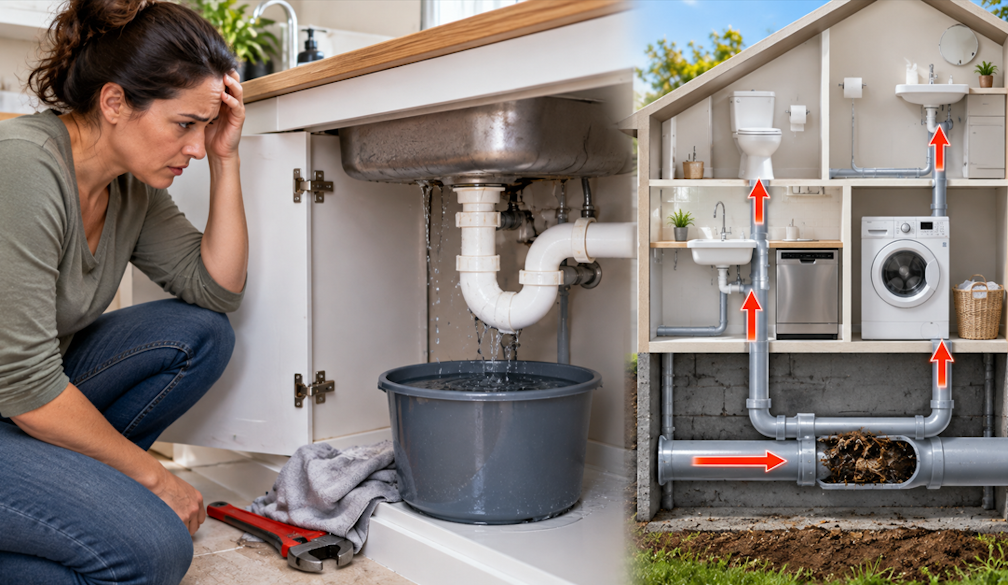
A blocked hand basin feels local. So does a slow shower. Homeowners naturally focus on the fixture they can see because that is where the water is pooling.
Under the floor, however, household drainage is a connected network. Smaller fixture pipes join branch lines, branches join larger drains, and those drains eventually carry wastewater away from the property. A restriction at one point can therefore affect several rooms once it becomes large enough or sits far enough downstream.
Understanding that layout explains why a problem that begins as "the ensuite sink is slow" can end with a toilet gurgling, a shower filling from below and wastewater appearing at an outdoor gully.
For anyone calling a blocked drain plumber Adelaide-wide, symptoms are especially important to describe. The number and location of affected fixtures help identify how deep in the system the restriction may be.
Stage one: a single fixture starts behaving differently
The earliest stage is often harmless enough to ignore. One basin takes longer to empty. A shower leaves a shallow pool around the waste. The kitchen sink needs a minute before the last water disappears.
At this point, the blockage may genuinely be local. Hair in a shower waste, food residue in a kitchen trap or a small object near the fixture can affect only one outlet.
The clue is independence. If every other fixture nearby behaves normally, a local cause is more likely. Clearing accessible debris may solve the problem completely.
Concern increases when the same fixture repeatedly slows despite cleaning or when another fixture begins to react.
Stage two: the branch line loses capacity
Several fixtures in one area often connect to a shared branch. A bathroom basin, shower and bath may join before the line reaches the main drain.
If the restriction sits after those connection points, each fixture may still drain when used alone. Problems appear when two are used close together. The shower gurgles as the basin empties. The floor waste bubbles when the bath drains. Water takes longer to disappear during the morning rush.
This is not necessarily a total blockage. The pipe still has an opening, but the opening is too small for normal peak flow.
Grease, soap, hair, foreign objects and internal pipe defects can all create this reduced capacity.
Stage three: fixtures start influencing one another
This is the point where a "single blocked drain" becomes a system problem.
A washing machine may discharge and cause water to rise in a nearby shower. A toilet flush may produce bubbles in a floor waste. The level in one toilet may change when another fixture empties.
These interactions happen because water and air cannot move normally through the shared downstream line. The wastewater looks for available space, often pushing air or water toward the lowest connected opening.
The fixture that reacts is not necessarily the source of the blockage. It may simply be the easiest place for pressure and water level changes to become visible.
Stage four: the main property drain becomes restricted
If the blockage sits in the main drain after several branches join, symptoms can spread through much of the house.
Kitchens, bathrooms and laundries may all slow. Toilets can become reluctant to flush. Outdoor inspection points or gullies may hold water. The whole property begins to feel "plumbed together" because, downstream, it is.
Older Adelaide homes with clay or earthenware drains can develop root entry, cracked joints and displaced sections. Newer PVC systems can still suffer from construction debris, poor installation, damage or foreign objects.
The age of the home suggests possibilities, but inspection is what confirms the cause.
Stage five: wastewater finds the lowest escape point
A drainage system under normal gravity flow does not have much pressure. When a downstream line is full, however, incoming wastewater has nowhere to go.
It then rises toward the lowest available opening. Inside, that can be a shower or floor waste. Outside, an overflow relief gully may discharge first by design.
An overflowing gully should never be capped to stop the mess. Its lower level is part of the property's protection against sewage backing up through internal fixtures. If it is overflowing, reduce water use and arrange assessment.
If sewage is entering the home, stop using affected fixtures and keep people and pets away from contaminated areas.
Why continuing to use water makes the problem look sudden
Homeowners sometimes say a drain "failed all at once" after weeks of mild symptoms. Often the restriction was developing gradually and one high-flow event finally exceeded the remaining capacity.
A long shower, dishwasher discharge, washing machine cycle and toilet flush within the same period can send more wastewater downstream than a partially blocked line can carry.
The pipe does not necessarily become dramatically worse in that exact minute. The household simply asks more of the restricted system than it can provide.
This is why early signs matter. A drain that is only slightly slow during light use may be much closer to failure than it appears.
A plumber maps the symptoms before choosing the tool
For a blocked drain plumber Adelaide diagnosis begins with location. Which fixture changed first? Which others are affected? Does the problem stay within one bathroom or cross the house? Does the outdoor gully overflow? Did the issue begin after renovation or heavy rain?
Access points can then be used to test and clear the line. Mechanical equipment or high-pressure water jetting may restore flow depending on the obstruction and pipe condition.
If the blockage is recurrent, affects several branches or involves older pipework, CCTV inspection can reveal the underlying reason. Roots, cracks, displaced joints, a sagging section or foreign material can all explain why the problem spread.
The best time to act is while the problem is still giving warnings
One slow drain does not mean the whole house is about to back up. It does deserve attention when it persists, returns after clearing or begins interacting with other fixtures.
Watch for progression. Local slowness becomes shared slowness. Shared slowness becomes gurgling. Gurgling becomes water moving between fixtures. Eventually, wastewater reaches the lowest outlet because the main path is full.
That sequence is what turns a small inconvenience into an urgent plumbing problem.
If you catch the issue earlier, there is usually more room to investigate calmly, reduce water use and choose the right repair. Once multiple fixtures are backing up, the priority becomes containment as well as diagnosis. Recognising the connection between drains is what helps homeowners act before the entire system becomes involved.


 Daily Bulletin


