

Scientific modelling is steering our response to coronavirus. But what is scientific modelling?
- Written by: Rachael L. Brown, Director of the Centre for Philosophy of the Sciences and Lecturer at the School of Philosophy, Australian National University
As they released the modelling of the COVID-19 pandemic behind Australia’s social isolation policies this week, Prime Minister Scott Morrison and Chief Medical Officer Brendan Murphy were guarded.
They emphasised the limits of scientific models, and how they could easily be misinterpreted.
This is not surprising. Many people don’t have a clear understanding of what scientific models are, and what we can and can’t expect from them.
Scientific models can be powerful tools for understanding complex phenomena such as pandemics, but they can’t tell us everything.
What is a scientific model?
Scientific models are representations of parts of the real world. They range from small-scale physical models of real systems, such as the famous San Francisco Bay Model – a miniature version of the bay used to investigate water flow – to the type of mathematical models used to understand the spread of COVID-19.
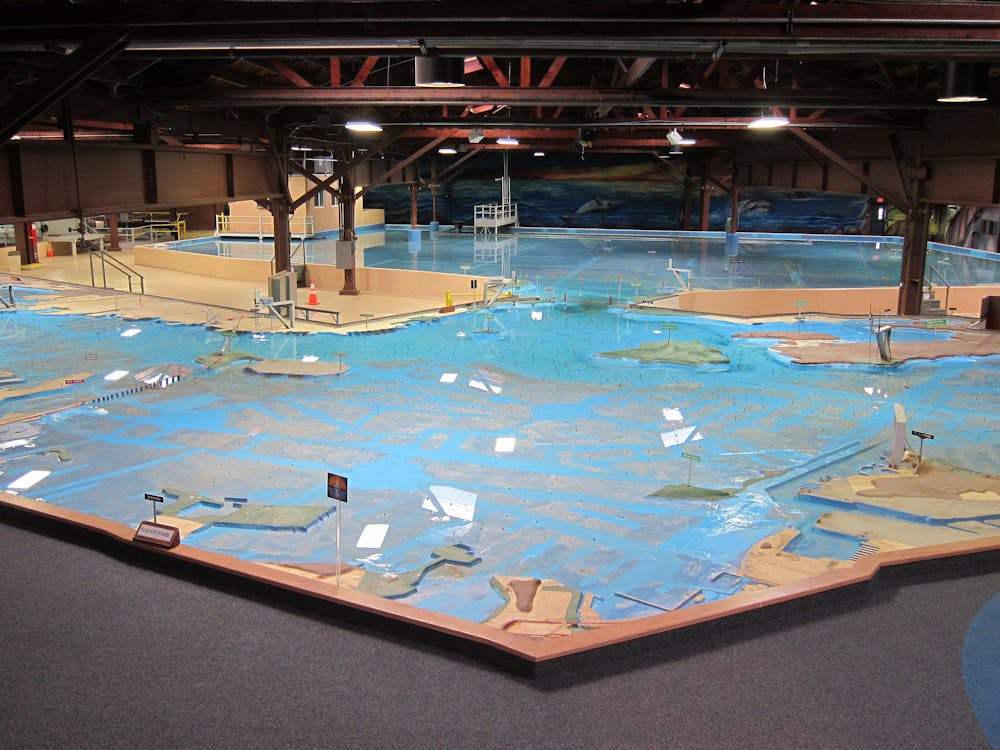 The San Francisco Bay Model was built in the 1950s to study the effects of a proposal to build dams in the bay.
Something Original / Wikimedia Commons
The San Francisco Bay Model was built in the 1950s to study the effects of a proposal to build dams in the bay.
Something Original / Wikimedia Commons
Models can be used to indirectly explore the nature of the real world. They can help us understand which features of real-world systems are important, how those features interact, how they are likely to change in the future, and how we can alter those systems to achieve some goal.
Why are models so valuable?
Scientific models let us explore features of the real world that we can’t investigate directly. In the case of COVID-19, we can’t do direct experiments on what proportion of Australia’s population needs to engage in social distancing to “flatten the curve”. Even if we could devise good experiments, it takes days or weeks for people to become sick and transmit COVID-19, so any experimental results would arrive too late to be useful.
Models are invaluable in situations like the COVID-19 pandemic, where time is of the essence and we are interested in effects on a large scale.
What are the limits of scientific models?
A model’s usefulness depends on how accurately it represents the real world. To make an accurate model, you need good data.
That’s one reason why models of the spread of COVID-19 that use data from densely populated parts of Europe are unlikely to offer valuable insights into the situation in suburban Sydney. Data from one situation may not apply to the other.
This is a major challenge for the COVID-19 pandemic, especially in Australia. The lack of extensive local data has left our policymakers relying on models based on a combination of overseas data, general theory and pre-existing modelling of influenza pandemics.
Because of this, the models are not designed to be used for making predictions about what will happen.
Read more: Modelling suggests going early and going hard will save lives and help the economy
For example, Imperial College London is producing relatively detailed modelling that can be used to make accurate predictions about specific cases in the United States and the United Kingdom. But such models require detailed data.
The Australian modelling generated by the Doherty Institute to look at the impacts of interventions on the spread of COVID-19 is simpler and more general. These models offer valuable large-scale insights, but far less local precision.
Such general models have been particularly useful early in the pandemic, when localised information is scarce. As we build a more detailed picture of Australian circumstances, modelling will become more specific and more accurate, and these general models will be less important.
One challenge for modelling in a real-world context like COVID-19 is that our models may not get it right every time. This is partly because we lack enough fine-grained information about the real-world situation.
It is also because individual actions and sheer bad luck in the short term can make big differences in the longer term. A single individual who fails to isolate or quarantine themselves can produce a very large ripple of downstream effects. We have seen this in the case of South Korea’s Patient 31, who triggered an enormous cluster of infections in her church.
What does this all mean?
Despite the uncertainty inherent in the COVID-19 pandemic, we should be optimistic about the science. The general principles behind the models we are basing our public policy on are the product of decades of testing and research, and we are learning more and more specific information about COVID-19 every day.
Thanks in large part to the power of model-based science, we are in a far better place than any generation before us to deal successfully and efficiently with a pandemic of this scale.
Authors: Rachael L. Brown, Director of the Centre for Philosophy of the Sciences and Lecturer at the School of Philosophy, Australian National University


 Daily Bulletin


