

Psychology can explain why coronavirus drives us to panic buy. It also provides tips on how to stop
- Written by: Melissa Norberg, Associate Professor in Psychology, Macquarie University
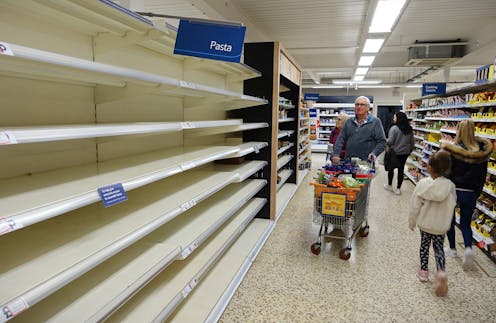
In an address on Wednesday, Prime Minister Scott Morrison expressed his dismay at the hordes of “panic buyers” sweeping supermarket shelves clean across the country:
Stop hoarding. I can’t be more blunt about it. Stop it. It is not sensible, it is not helpful and it has been one of the most disappointing things I have seen in Australian behaviour in response to this crisis.
It started with toilet paper, and now many non-perishable foods are difficult to source, as shoppers stockpile in preparation for the worst.
But is there a rationale for such behaviour? And how can we move beyond our psychological impulses to shop smarter, and consider the needs of others?
COVID-19 - an unwitting stress test
The coronavirus outbreak is not only a time of uncertainty, but also a period in which many of us are experiencing social isolation. Both of these factors can psychologically motivate people to buy things they don’t need.
Feeling unable to tolerate uncertainty is associated with more extreme hoarding behaviour. Hoarding entails the collection of more items than can be feasibly used, to the point of impeding the functionality of a home. Even though the behaviours we’re seeing may not be “hoarding” in this sense, they’re likely driven by the same psychological mechanisms.
One of the strongest predictors of hoarding behaviour is an individual’s perceived inability to tolerate distress. If it’s in a person’s general nature to avoid distress, they may be at risk of buying more products than they can feasibly use during the pandemic.
For such people, it may be difficult to believe authorities when they announce supermarkets will not close. Or, if they do believe them, they may decide it’s best to “prep”, just in case things change.
Read more: When possessions are poor substitutes for people: hoarding disorder and loneliness
The coronavirus also reminds many people of their own mortality, and this can lead to an increase in spending to offset fear.
Even if a person typically feels able to handle distress, they may still end up buying more than they need. Seeing empty shelves can trigger an urge to snatch what is left. Research on the “scarcity heuristic” suggests we assume items are more valuable if they are in low supply.
Also, consumer goods are more than functional. Products and brands also serve psychological purposes and can change how we feel. For example, some people turn to alcoholto alleviate anxiety or distress.
How to overcome psychological forces
So how can we make rational decisions, when multiple psychological forces make this difficult?
While no perfect remedy exists, cognitive behavioural therapy (CBT) techniques can help people avoid making decisions based on unhelpful urges and emotions. CBT has been shown to improve intolerance of uncertainty, and reduce anxiety and fear.
CBT involves problem-solving and engaging in avoided behaviour to test the validity of one’s beliefs. The idea is to challenge unhelpful thoughts, and make decisions based on evidence.
To apply this approach when shopping during the coronavirus pandemic, you should start by taking stock of the items you already have at home, and how long they will last.
When stocking up, it’s important to limit waste and be considerate. It’s not helpful to buy food that spoils, or buy so many products that others, including the elderly, experience hardship. Buying 100 rolls of toilet paper is useless if it takes a year to use them.
Food waste can be limited by developing meal plans for the next two to three weeks, keeping in mind when certain products expire. By focusing your attention on what you will realistically use during this time, you can make more informed decisions about what to buy.
It’s OK to feel anxious
When shopping, take a list with you to guide your purchases, and try your best to stick to it. This way, you’ll be less likely to succumb to anxiety-driven purchases triggered by the sight of empty shelves, or thoughts of supermarkets closing. That said, be willing to buy substitutes if certain items are sold out. You can plan for this in advance.
You may start to feel anxious when only buying items for use in the immediate future. That’s OK. Numerous research trials have shown people can tolerate anxiety, and that changing unhelpful behaviour reduces anxiety in the long run.
Research has also shown people who chronically hoard can tolerate distress better than they think. So, while anxiety may be inevitable for some on their next shopping trip, they will likely be able to tolerate it. And it may be reduced if the above strategies are adopted.
Even before the COVID-19 pandemic, Australians had a problem of buying things they didn’t need. We’re the ninth-largest contributor of household waste per person in the world, spending more than A$10.5 billion each year on goods and services we rarely use. Over half of that expenditure is for food that gets wasted.
Perhaps understanding the psychological mechanisms underpinning our shopping behaviour can help us make more rational purchases during this time of uncertainty.
Authors: Melissa Norberg, Associate Professor in Psychology, Macquarie University


 Daily Bulletin


