

The 'herd immunity' route to fighting coronavirus is unethical and potentially dangerous
- Written by: Arindam Basu, Associate Professor, Epidemiology and Environmental Health, University of Canterbury
As most of the world tries to suppress the coronavirus spread, some countries are going it alone - trying to manage the pandemic through so-called “herd immunity”.
Herd immunity means letting a large number of people catch a disease, and hence develop immunity to it, to stop the virus spreading.
The Netherlands reportedly plans to use herd immunity to combat the coronavirus epidemic, just as Britain retreats from such plans after warnings it could lead to 250,000 deaths.
A “herd immunity” strategy has been criticised by the World Health Organisation, which said far greater action is required. Other health experts say the approach is experimental at best, and dangerous at worst.
So can herd immunity protect us from the coronavirus, and are countries wise to adopt it?
 British Prime Minister Boris Johnson was criticised for seemingly adopting a herd immunity strategy.
EPA
British Prime Minister Boris Johnson was criticised for seemingly adopting a herd immunity strategy.
EPA
First, let’s understand immunity
Our bodies fight infectious diseases such as coronavirus through our immune systems. The body produces “antibodies” in response to intruder organisms to fight and remove them.
Once the body has fought off a disease, it retains a “memory” of the germ, and how to fight it better and faster next time.
In theory, once a person has developed immunity to a virus they won’t catch it again. The theory of herd immunity is that when a large number of people develop immunity to a virus, it will eventually stop spreading to people who haven’t yet caught it.
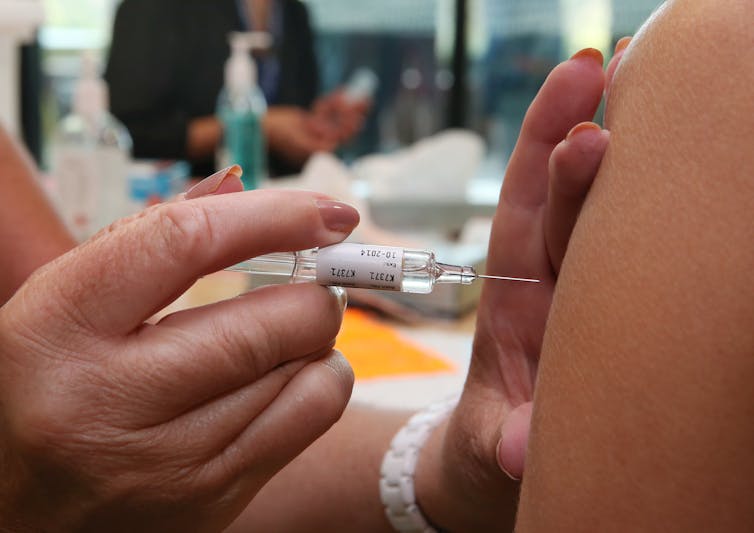 Herd immunity is more effective if a vaccine is available.
AAP/David Crosling
Herd immunity is more effective if a vaccine is available.
AAP/David Crosling
Number-crunching on herd immunity
Herd immunity is essentially a numbers game.
It all rests on the basic reproduction rate - in other words, how many new infections each case will generate.
A rate with a value of 1 would mean that one person can pass it on to at least one other person. The higher this number, the more infections from that one case. So to end the spread, this number will need to drop below 1.
The reproduction rate for coronavirus is between 2 and 3.
Read more: How does coronavirus kill?
As infection spreads, the pool of susceptible people shrinks as more develop immunity. Herd immunity aims to lower the number of susceptible people to the point where the reproduction rate drops below 1 and the spread of infection stops.
In the case of measles, 95% of people need to be immune for infection to cease. For coronavirus, I calculate this figure is around 40%, based on a reproduction rate of 2.6. So, if about 60% people are immune to the infection, this is sufficient herd immunity to stop coronavirus spreading.
(There have been a few reports of people becoming infected with coronavirus twice, but they haven’t been substantiated in peer-reviewed research, so can be discounted for now.)
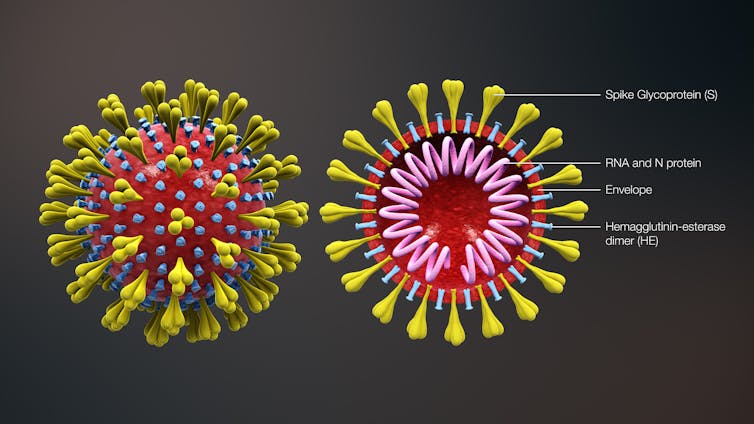 An image showing the main elements of coronavirus.
Wikimedia
An image showing the main elements of coronavirus.
Wikimedia
So is herd immunity a good plan?
On the face of it, a herd immunity strategy might seem wise. But the absence of a coronavirus vaccine means it is very high-risk.
The best way to rapidly develop herd immunity is through vaccination. A vaccine delivers a small amount of a virus into the body, and the immune system learns how to fight it off without having to get sick. But we do not yet have a vaccine for coronavirus.
If vaccines are not available and the infection spreads, some people will develop a mild version of the disease and recover. But it is dangerous and unethical to rely on this method to combat the disease.
First, the intermediate and longer term consequences of coronavirus are not yet known. And second, while some people are not badly affected by the disease, under a herd immunity strategy they could still pass the virus to elderly people who are at high risk of dying from it.
One expert analysis found that creating herd immunity in the UK would require more than 47 million people to be infected. With a 2.3% fatality rate and a 19% rate of severe disease, this could result in more than a million people dying and a further eight million needing critical care.
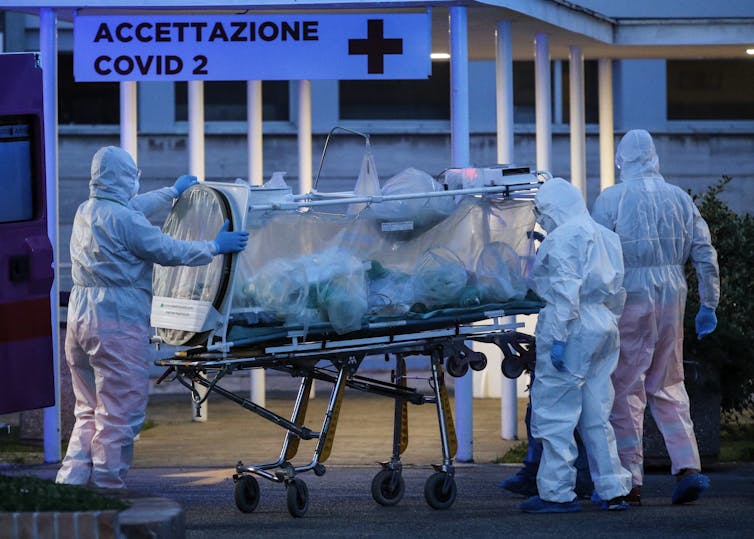 A coronavirus patient being transported to hospital in Italy.
EPA
A coronavirus patient being transported to hospital in Italy.
EPA
What should we be doing?
Let’s say Australia and New Zealand relied on herd immunity. Now let’s assume, conservatively, that 10% of the population were infected – that’s 500,000 New Zealanders and 2.5 million Australians. Over a short period, those numbers would disastrously overwhelm the nations’ health systems.
The safest public health strategy is to prevent the onset of coronavirus at all costs. This would buy the health system time, “flattening the curve” so hospitals were not inundated with cases all at once.
This is why it’s so important to control movement across our borders, impose self-isolation, restrict public gatherings, trace the contacts of existing cases and isolate those with the virus. Australia and New Zealand are both now essentially following these measures. It might also be wise to screen passengers in departure terminals for signs of the virus, and test where necessary.
Also critical is educating the public on safe hygiene and ensuring supply of disinfectants, hand sanitisers, safe food, soap, and water, as well as access to services when needed. Now is also the time to take extra care of our elderly.
With these measures in place, we give ourselves the best chance of putting the coronavirus genie back in the bottle sooner rather than later, and minimising the number of deaths.
Authors: Arindam Basu, Associate Professor, Epidemiology and Environmental Health, University of Canterbury


 Daily Bulletin


