

Why police and prosecutors don't always disclose evidence in criminal trials
- Written by: Jarryd Bartle, Sessional Lecturer in Criminal Law, RMIT University
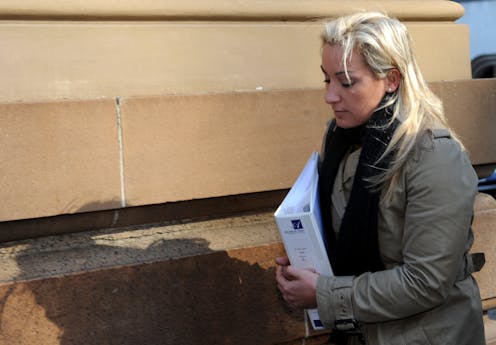
In the final episode of Exposed, the ABC documentary series on the conviction of Keli Lane, the fairness of her trial was called into question due to admitted flaws in the police investigation.
The Bridge of Hope Innocence Initiative, a group dedicated to investigating claims of wrongful conviction in Australia, is examining whether those deficiencies also include a failure by police to disclose hours of recordings to Lane’s defence lawyers.
The failure of prosecutors and police to disclose material that was not used at criminal trials has emerged as a potential cause of wrongful convictions and other miscarriages of justice in cases across Australia.
Prosecutors are obliged under the common law to disclose any relevant evidence they possess to defence lawyers, even if that material hurts the prosecutor’s case.
These obligations are also laid out in the rules that govern the conduct of members of the bar, such as the Victorian Legal Profession Uniform Conduct (Barristers) Rules 2015, which provides that prosecutors must disclose to their opponents “as soon as practicable” all available material that could be relevant to the guilt or innocence of an accused person.
Despite these obligations, cases of non-disclosure continue to be brought to light, both in Australia and other countries.
Repeated cases of disclosure failures
In the Lane case, the apparent failure of police to disclose an estimated 2,000 potentially crucial recordings was only discovered following meticulous reviews of the case materials by our researchers.
Lane was convicted of the 1996 murder of her infant daughter, Tegan. The police had placed intercepts on her phone and a listening device in her house over several weeks in 2004 and 2008, but only a selection of those recordings was disclosed as part of the prosecution’s case.
We have made a freedom of information request to access to any undisclosed recordings and determine their exculpatory value. This application is currently under review by the Information and Privacy Commission NSW.
Read more: A criminal record: women and Australian true crime stories
The 1995 wrongful conviction of Andrew Mallard demonstrates the role of disclosure errors in miscarriages of justice. Mallard had been convicted of murdering a jeweller in her shop with a weapon that was never found. The prosecution case was based on a series of admissions alleged to have been made by Mallard in police interviews, including a drawing of a wrench that he said he had used in the murder.
However, only one interview was recorded by the police. After the trial, it was revealed the prosecution had not disclosed crucial evidence to the defence, including police enquiries that challenged the use of a wrench in the killing.
Mallard spent 12 years in prison before being exonerated when another man’s palm print was found during a cold-case review. He was later given an A$3.25 million compensation payment by the WA government.
In the UK, a recent report by a House of Commons Select Committee found that so-called “disclosure errors” were widespread in that country, too, and the Crown Prosecution Service had yet to recognise “the extent and seriousness of [these] failures”.
The report was sparked by the case of Liam Allan, who was accused of a number of sexual offences. Allan’s lawyers requested various pieces of evidence from the prosecution, including text messages they believed were potentially exculpatory. However, the prosecution failed to disclose this material, noting that the request was not “proportionate or necessary”. The evidence was only handed over following repeated requests and a change of barristers.
It was later revealed at trial that 40,000 text messages had not been disclosed. Once the text messages came to light, the prosecution concluded there was no longer sufficient evidence to support a conviction, and the case was dropped.
The police and Crown Prosecution Service later apologised to Allan.
Why the failure to disclose?
The UK Commons report found that failures to disclose evidence were at least partly due to perceptions by police and prosecutors that this is a common courtesy rather than a core obligation of their jobs.
Policing culture is often associated with a lack of transparency and resistance to external examination.
Read more: Truth or lies: overturning wrongful convictions
This was illustrated in a 2013 review of Queensland police led by former Australian Federal Police Commissioner Mick Keelty. Keelty found that police in the state did not see themselves as public servants and actively resisted attempts at interaction from other government departments. He referred to it as the “blue iron curtain”, and raised issues about a lack of transparency and the service being too risk-averse.
Though there are no mechanisms currently in place to monitor and ensure disclosure of evidence in Australia, prosecutors are generally obliged to do this in the interest of justice. However, their role is often influenced by institutional and public pressure to act as partisan agents of the state. This in turn means they are wary of disclosing evidence that could hurt the prosecutor’s case.
What can be done to change things?
In Australia, one of the chief barriers to remedying the situation is a lack of understanding of the prevalence of the problem. The limitations of freedom of information laws also make it difficult for lawyers, journalists and advocates to establish the existence or extent of non-disclosure after trial.
The UK Commons report had three key recommendations that are worthy of consideration in Australia:
a shift in culture towards viewing disclosure as a core justice duty, and not an administrative add-on
the right skills and technology to review large volumes of material that are now routinely collected by the police
clear guidelines on handling sensitive material for police and prosecutors
Ultimately, the criminal justice system needs to be oriented to a culture of full disclosure to ensure exculpatory material is not ignored, potentially leading to wrongful convictions. A fair defence requires an open investigation and prosecution.
Authors: Jarryd Bartle, Sessional Lecturer in Criminal Law, RMIT University


 Daily Bulletin


