

Economic growth and 'Trump-proofing' – why the latest inter-Korea summit matters
- Written by: Benjamin Habib, Lecturer in International Relations, Department of Politics and Philosophy, La Trobe University
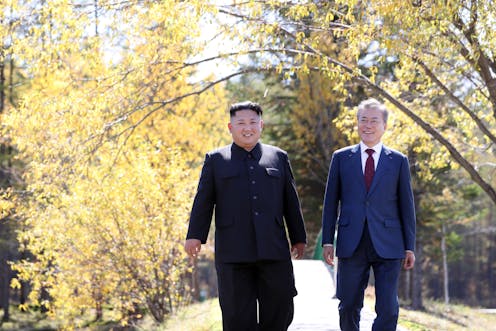
Last week’s fifth inter-Korean summit provided another round of iconic moments in a year of extraordinary drama in Korean Peninsula politics.
From Moon Jae-in’s address at the Arirang Mass Games to the leaders’ photo-op on the shores of the crater lake at Paekdusan, the three-day summit produced plenty of symbolism. More importantly, it increased the detail and scope of confidence-building measures agreed in the earlier Panmunjom Declaration.
Read more: US-North Korea summit agreement is most revealing for what it leaves out
Much of the commentary in the wake of the summit has focused on what the Pyongyang Declaration means for the potential denuclearisation of North Korea. To view the summit through the narrow lens of nuclear politics would be to overlook the significance of deeper patterns that are emerging from inter-Korean détente.
Filling in the details
The first notable feature of the Pyongyang Declaration is the increased depth of military-to-military confidence-building measures, as articulated in its attached annex. One of the questions emerging from the Panmunjom Declaration related to how that document’s vague commitments to cooperation would be fleshed out in detail.
In the Pyongyang Declaration are measures for increased conflict management procedures and greater operational level consultation. This includes a series of measures along the demilitarised zone (DMZ) and Northern Limit Line maritime boundary to reduce the risk of confrontation.
A holistic approach to security
There is a clear human security focus in the breadth and depth of the Pyongyang Declaration that has moved inter-Korean engagement well beyond denuclearisation. Human security is about protecting individuals and communities from threats to their well-being and survival. This might be from traditional security threats of war or persecution, or from non-traditional threats such as food insecurity, inadequate housing and sanitation, environmental degradation, or pandemic disease.
Growing the web of inter-Korean economic links can improve economic opportunities for North Korean citizens and create mutual interests that decrease the appetite of both governments for conflict. Breaking ground on the construction of east and west transportation corridors was an example of this, along with reopening the Kaesong industrial zone and Geumgangsan tourist precinct.
What’s new here is the establishment of special economic zones and tourist precincts. A large number of South Korean firms are ready to seize on new business opportunities in the North that may result from these openings. For the North, these projects fit within Kim Jong-un’s objective of economic modernisation.
Also of interest is the addition of cooperation on environmental capacity-building and public health. As Myeong Soojeong from the Korea Environment Institute has argued, South and North Korea share connected ecosystems (ecology transcends borders). Environmental degradation in North Korea is likely to increase the cost to South Korea in the event of reunification.
Cooperation on public health and pandemic disease prevention would also benefit the well-being of North Korean people, especially given the North’s well-documented outbreaks of tuberculosis.
From a South Korean perspective, the thinking behind broad-based engagement is that a comprehensive security strategy that improves the human well-being of North Korean citizens can reduce the threat posed by North Korea. By building on these mutual interests, the two Koreas give themselves space to pull back from the dangerous insecurity spirals that have made Korean Peninsula politics so volatile.
Appealing to multiple audiences
The expansion of the scope of engagement plays well politically for domestic constituencies on both sides of the DMZ. Moon has staked enormous political capital on rapprochement with the North, while Kim needs to bring the people with him to legitimise his economic modernisation program and see off internal factions.
From this perspective, the expansion of the family reunion program will be popular on both sides of the DMZ and provide valuable opportunities for separated families to reconnect.
The cultural and sports exchanges are largely symbolic trust-building activities. But these are also an important piece of diplomatic signalling to the international community that the process is serious and now is not a time for confrontation.
The announcement of a joint bid to host the 2032 Summer Olympic Games is particularly poignant, given the importance of this year’s Pyeongchang Winter Olympics in helping to defuse red-hot tensions that had bubbled up through 2017.
We should also not forget the influence of the 1988 Seoul Olympics in opening a greater window of political opportunity for democratisation in South Korea.
Power transitions
It is intriguing that confidence-building measures related to the North’s nuclear program are not mentioned until well into the Pyongyang Declaration. North Korea’s agreement to independently verified dismantlement of its missile launch platform at Dongchang-ri/Sohae is noteworthy. But promises to dismantle infrastructure at the Yongbyon nuclear site are conditional on reciprocal action from the United States, which is far from certain.
Indeed, apart from these two concessions, the Pyongyang Declaration is not really about denuclearisation at all. What’s increasingly clear is that inter-Korean détente is now driving Korean Peninsula politics, and increasingly shaping the agenda of US interactions with the DPRK. The US-ROK alliance remains in place, but the goalposts of this relationship are moving.
All the hype surrounding inter-Korean economic integration notwithstanding, North Korea is not a virgin territory that South Korea can lay claim to. The DPRK is already strongly integrated into China’s economic orbit through trade corridors, Chinese direct investment and the reality of the Chinese yuan as the North’s de facto currency.
By connecting to North Korea through greater infrastructure links, the South will also be opening a connection with China’s vast land-based transportation network and beyond. The geopolitical implications of inter-Korean economic cooperation bringing South Korea closer to the Sinosphere have not received as much attention as they might.
Read more: Summit on, then off, now on again? The seemingly endless game-playing of US-North Korea relations
That the inter-Korean process might need to be Trump-proofed illustrates a growing distance between South Korea and the United States in the Trump era. One could indeed make the case that both the South and North Korean governments may not see the US as a credible negotiating partner at this time, given US President Donald Trump’s elastic foreign policy positions, his record of alienating allies, and the likely lack of domestic support for engagement in US foreign policy circles. This was well illustrated by the recent address by Harry Harris, US ambassador to the ROK, stressing “complete, verifiable, irreversible denuclearisation” (CVID).
Extraordinarily, Washington’s insistence on CVID now seems out of date given the growing momentum of inter-Korean détente. Moon appears determined to push on with engagement regardless of the US position.
This would have been unthinkable under previous American administrations. Such are the shifting goalposts of power in world affairs in the Trump era.
Authors: Benjamin Habib, Lecturer in International Relations, Department of Politics and Philosophy, La Trobe University


 Daily Bulletin


