

Outrage over schoolgirl refusing to stand for anthem shows rise of aggressive nationalism
- Written by: Gwenda Tavan, Associate Professor, Politics and International Relations, La Trobe University
This week, nine-year-old Queensland school girl, Harper Nielsen, was threatened with suspension by her school for refusing to sing the Australian national anthem. The heated and at time preposterous reaction to the story adds fuel to a question that has been lingering in public debate for a while now: is Australian nationalism on the rise?
According to Nielsen and her parents, her refusal was intended as a gesture of solidarity with Indigenous Australians, whom she felt were marginalised and disrespected by a song that glorifies white Australia in its declaration that we “are young and free”.
Read more: The far-right's creeping influence on Australian politics
While many people praised the young girl’s brave and principled stand, conservative Liberal politician Tony Abbott indirectly criticised her actions as impolite. Other self-described “patriotic” politicians went further, strongly attacking the character and motives of Nielsen and her parents.
Jarrod Bleijie, the Queensland shadow minister for Education, tweeted:
Senator Pauline Hanson advocated physical abuse as a suitable penalty for the young girl’s transgression: “It’s about who we are as a nation, it’s part of us … Here we have a kid who’s been brainwashed and I’ll tell you what, I’d give her a kick up the backside.”
The incident appears to confirm that in Australia, like many liberal democracies around the world, much-vaunted values of openness, tolerance and respect for diversity and freedom of opinion are in decline, while aggressive nationalism is increasing.
There are numerous other examples to support this view: the rise of far-right, populist, anti-immigration political parties and movements, the increasingly exclusionary and racist tones and language of “mainstream” political leaders both here and overseas, violent street clashes between right-wing nationalist and anti-racist forces.
This is capped off by shrill demands by politicians and sections of the media for unquestioning displays of loyalty to “nationalist” symbols and institutions including the flag, the national anthem and contentious national days like Australia Day and ANZAC Day.
Whether such incidents reflect an increase in the actual numbers of Australians embracing aggressive nationalism, or simply an intensification of feeling and behaviour amongst a select minority, is not clear at this point.
But ultimately, the issue of numbers is less important than the general mood such controversies convey. Right-wing xenophobes and nationalists are clearly feeling emboldened. Collectively, we must ask ourselves why this is the case and what should be done about it.
There is good reason for concern. History shows us how dangerous nationalist and racist sentiment is for the quality and character of liberal democracies. Assertions of the primacy, unity and superiority of the national group can easily slip into the denigration, marginalisation, oppression, expulsion and even decimation of individual and minority groups considered to be “other”.
Demands for unquestioning loyalty and conformity in the name of national unity and pride can undermine much vaunted liberal traditions of freedom of speech, thought and association.
White Australia is a country seemingly so inured to its own racist traditions that the systematic mistreatment of Indigenous people, refugees and asylum-seekers, though hotly debated in public forums, is tolerated by a large section of the population. Now that right-wing politicians feel empowered enough to publicly denigrate and threaten a nine-year-old child for her political views, perhaps more people will feel compelled to pay attention.
There is, of course, a discernible double standard at work in the claims that Nielsen should be “punished” for her views and should just “follow the rules.” These, after all, are the very same people who have demanded the right to express their views on all manner of issues, including “the right” to be bigots or deny equal treatment to others on the basis of religious belief. Free speech is fine, it seems, as long as it expresses a view social conservatives agree with.
History is also often the victim of nationalist mobilisations. By this I mean the tendency of “patriots” to select those aspects of the national story that “fit” the narrative of a timeless, unified, undifferentiated, organic community to which they are “loyal”. In the process, they edit out the bits that show how contested and contingent our national story really is.
Read more: Explainer: what is free speech?
The national anthem, Advance Australia Fair, is a case in point. Claims that not singing the anthem “disrespects our country and our veterans” assume the song holds deep historical, moral and sacred meaning. The truth is more prosaic.
Advance Australia Fair became our national anthem in 1974, following a competition launched by the Whitlam Labor Government and a public opinion poll by the Australian Bureau of Statistics to identify the relative popularity of three “unofficial” Australian songs: Advance Australia Fair, Waltzing Matilda and Song of Australia. Advance Australia Fair was the clear front-runner, but it is worth remembering that only just over half of respondents (51.4%) nominated it. In other words, nearly 50% of the population did not. So much for collective unity.
Indeed, it was not so long ago that those who showed loyalty to symbols of independent Australian identity such as the current national anthem were derided for their lack of patriotism. In 1943, when Minister for Information, Arthur Calwell, directed Advance Australia Fair be played in Australian cinemas as part of a broader effort to deepen nationalist sentiment and mobilise popular support for the war effort, conservatives criticised the move as disloyal to the British Empire.
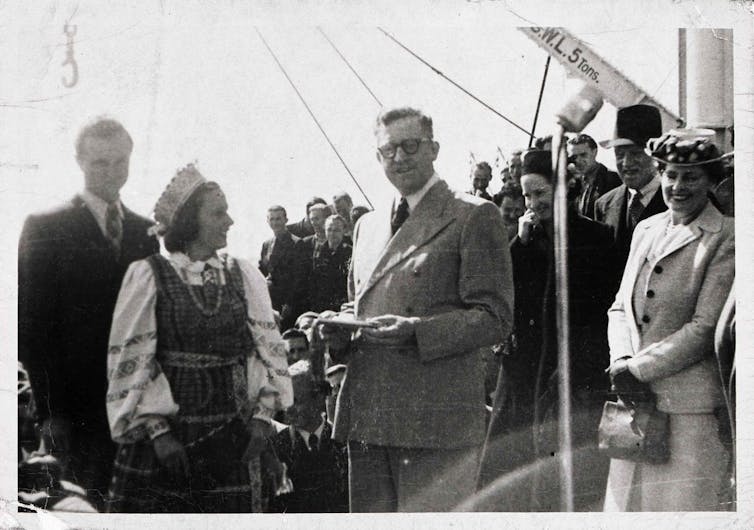 Arthur Calwell tried to stir nationalist sentiment by ordering Advance Australia Fair to be played in cinemas.
National Maritime Museum
Arthur Calwell tried to stir nationalist sentiment by ordering Advance Australia Fair to be played in cinemas.
National Maritime Museum
Calwell was similarly derided when he introduced an independent Australian citizenship in the form of the Australian Nationality and Citizenship Act 1948. One Liberal MP in the House of Representatives argued the legislation would “be supported by every enemy of Great Britain and Australia”.
The public bullying of Harper Nielsen should concern us as yet another example of the dangers of unbridled nationalism, and the potential it has to undermine our cherished freedoms.
Nonetheless, the incident provides some cause for hope. It is heartening to see someone so young working thoughtfully through the issues, resisting the pressure of demands for unthinking, unblinking conformity to someone else’s ideal of what national belonging is all about, and reach her own conclusions.
Those who like the story Australians tell themselves of their inherent anti-authoritarianism, might even be tempted to say: “how very Australian” of her.
Authors: Gwenda Tavan, Associate Professor, Politics and International Relations, La Trobe University


 Daily Bulletin


