

How to stop nagging your child to practise their musical instrument
- Written by: Timothy McKenry, Professor of Music, Australian Catholic University
It’s 4pm on a Thursday, and your child is on the couch with the iPad. You need to leave for the weekly music lesson in half an hour. You can see dust has gathered on the piano (or the flute or the saxophone), and another week has passed with only infrequent and erratic attempts at practice.
Your child claims to want lessons, but doesn’t seem to put in the effort. The prospect of paying another term’s tuition is the last straw. You order your child off the couch and direct them to their instrument. What ought to be a rewarding activity for your child has become a bone of contention between you. And you dislike the nagging parent you’ve become.
What parents say and do matters
Research confirms the benefits of learning a musical instrument. It develops a life-long skill and offers children a means of enjoyment and self-expression.
Not surprisingly, many parents who can afford the cost willingly spend money to give their children this experience.
Read more: How to use music to fine tune your child for school
But there are real challenges that sit alongside the benefits of learning an instrument. Difficulty in finding time and motivation to practise, frustration over a perceived lack of progress, anxiety about performing in public and unhelpful beliefs about innate talent being more important than practising can make the whole process a misery.
Parent encouragement, though well-intended, can quickly descend into nagging. And the reality of a child learning an instrument at home – the unpolished sounds, the seemingly incessant technical work (scales and arpeggios) – can challenge the family dynamic.
Research into motivation and music education shows what parents say and do is enormously influential in determining the quality of the learning experience for their child. Nagging or bribing a child to practise only makes the activity feel like a chore. Children who are nagged to practise are likely to stop playing as soon as they can make that choice.
So, what can parents do to encourage their children to practise? The following practical tips are drawn from multiple studies conducted by musicians, teachers and educational psychologists.
1. Start young and keep it fun
Most young children enjoy singing and movement. They are also not overly self-conscious or concerned with self-image. While a teenager might baulk at singing or playing an instrument for fear of how their peers might react, younger children freely engage in musical activity.
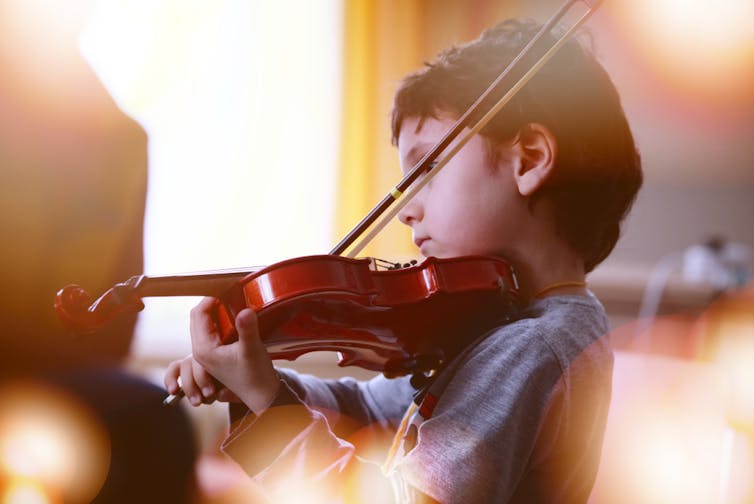 Younger children are less self-conscious about making music.
www.shutterstock.com
Younger children are less self-conscious about making music.
www.shutterstock.com
Regular musical play normalises the act of making music and helps children develop habits that will, in time, underpin regular practice. A good early childhood musical program can help children shift gradually from play-based learning to a more structured learning when they are ready.
It’s vital these experiences are fun. The advice for parents? Join in! Show your child that music is fun by having fun with your child making music.
2. Praise their effort not their ‘talent’
The media generally lauds professional musicians as “talented”. What’s lost in the mythology our culture weaves around these people is that their seemingly effortless mastery of an instrument is in fact the result of much effort and learning.
Praising a child for being talented reinforces a fixed mindset around musical ability. If a child believes people are either talented or not talented, they are likely to view their own struggles with learning music as evidence they aren’t talented.
Parents should praise the effort their child puts into learning their instrument. This recognises that practice makes perfect.
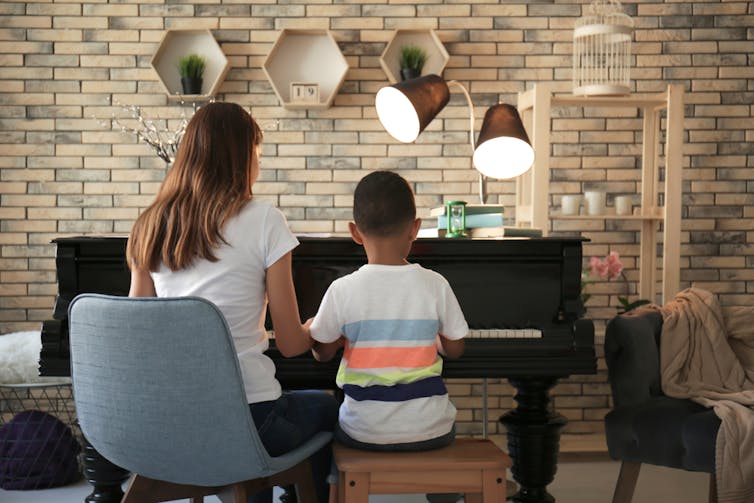 Learning music should be a shared activity.
www.shutterstock.com
Learning music should be a shared activity.
www.shutterstock.com
3. Emphasise the long-term benefits of playing
Parent praise has less impact over time on a child’s motivation to practise. Teenagers either develop an internal motivation to continue learning their instrument, or stop.
But a ten-year study of children learning instruments shows children who display medium and long-term commitment to an instrument practice more and demonstrate higher levels of musical achievement.
Children who imagined themselves playing their instrument into adulthood were more likely to be highly motivated.
Read more: Study habits for success: tips for students
Parents should encourage your children to see learning an instrument as a useful skill that can bring satisfaction and joy into adult life. It isn’t simply this year’s after-school activity.
4. Encourage appropriate music
Children are often motivated to learn an instrument in response to a growing interest in popular music. But leveraging a child’s desire to replicate the latest Ed Sheeran song as a mechanism for motivation can be a problem.
Read more: Brits 2018: why everyone loves Ed Sheeran’s Shape of You
While popular music can and should be part of any music education, the latest popular music isn’t necessarily fit-for-purpose as a teaching tool. This can result in great harm – ranging from disappointment when the music is beyond the ability of a learner, to very real damage to the voice or fingers.
My own research shows using popular music as a way to get children into music education might meet a market demand, but is not always in children’s best interest. The adult environment that surrounds popular music sits awkwardly with a safe educational environment. Having a seven-year-old sing “Fever When You Kiss Me” strikes the wrong note.
Read more: Force-feeding kids classical music isn't the answer
Parents should choose a qualified teacher with a well-articulated teaching philosophy that emphasises gradual learning. Avoid teachers who spruik instant success on Australian Idol and, particularly for younger children, parents should prohibit sexualised repertoire.
Take an interest in the music your child learns. Get to know the names of the pieces they’re learning and ask to hear them.
5. Value your child’s music
Lessons, exams and practice schedules are all very well, but ultimately music should be a shared activity. Don’t always banish your child to their room to practise.
Create an environment where music is a vital part of the household. Encourage your child to perform at family occasions. As they learn, empathise with their struggles and celebrate their triumphs. Never begrudge the money you spend on lessons and never, ever nag.
Authors: Timothy McKenry, Professor of Music, Australian Catholic University


 Daily Bulletin


