

Why do kids lie, and is it normal?
- Written by: Penny Van Bergen, Senior Lecturer in Educational Psychology, Macquarie University
Children typically begin lying in the preschool years, between two and four years of age. These intentional attempts at deception may worry parents, who fear their child will become a pint-sized social deviant.
But from a developmental perspective, lying in young children is rarely cause for concern. In fact, lying is often one of the first signs a young child has developed a “theory of mind”, which is the awareness others may have different desires, feelings, and beliefs to oneself. When a child misleadingly claims “Daddy said I could have an ice cream”, they’re using this awareness of others’ minds to plant false knowledge.
While lying itself may not be socially desirable, the ability to know what others are thinking and feeling is an important social skill. It’s related to empathy, cooperation, and care for others when they’re feeling upset.
How lying changes with age
Young children’s first lies are often more humorous than effective. Imagine the child who claims not to have eaten any cake while her mouth is still full, or who blames the family dog for drawing on the wall. Young children may know they can deceive others, but they don’t yet have the sophistication to do so well.
Before age eight, children frequently give themselves away when lying. In one study, children aged three to seven were asked not to peek at a mystery toy (Barney) that had been placed behind them. Nearly all did, and nearly all lied about it later (increasing with age).
But across the group, children also had trouble maintaining the lie. Liars aged three to five were surprisingly good at keeping a straight face but typically gave themselves away by describing the Barney toy by name. Liars aged six and seven had mixed success, with half feigning ignorance and half accidentally saying Barney’s name.
As children get older and their perspective-taking ability develops, they’re increasingly able to understand the kinds of lies that will be believable to others. They also become better at maintaining the lie over time.
Moral development also kicks in. Younger children are more likely to lie for personal gain, while older children increasingly anticipate feeling bad about themselves if they lie.
Read more: The evolution of lying
Older children and teens are also more likely to draw distinctions between different kinds of lies. White lies, to them, are considered more appropriate than harmful or antisocial lies.
While studies that estimate the frequency of lying among children and teens are rare, teenagers are especially likely to lie to parents and teachers about things they consider their own personal business.
One study found 82% of US teenagers reported lying to their parents about money, alcohol, drugs, friends, dating, parties, or sex in the past year. They were most likely to lie about their friends (67%) and alcohol/drug use (65%). Perhaps surprisingly, they were least likely to lie about sex (32%).
When reading short scenarios in which the protagonist lied to his or her parents, the teens were also likely to consider the lying acceptable if it was to help somebody or keep a personal secret, but not if it was to harm or hurt someone.
Is lying a cause for concern?
Despite its prevalence, lying among children is rarely cause for concern. It’s important to remember many adults also lie – sometimes for good, as in the case of white lies that protect someone’s feelings, and sometimes for ill. While estimates vary, a study found approximately 40% of US adults reported telling a lie in the past 24 hours.
In some instances, chronic lying can become a concern if they occur alongside a cluster of other behaviours that are maladaptive. For example, deceitfulness through lying is often present in conduct and oppositional defiant disorders (ODD).
Young people with conduct disorders or ODD cause considerable disruptions in the home or at school through persistent aggression and harm to others or property. But to meet diagnoses, lying would have to occur with a cluster of other symptoms such as refusal to comply with authority figures, persistent violations of rules, and failure to take responsibility for their actions.
Read more: Truth is, everyone lies all the time
Another cause for parental concern is if lying serves to mask other mental health problems due to fear or shame. For example, a child or adolescent suffering from severe anxiety may lie chronically to avoid confronting situations that make them afraid (for example, school, parties, germs).
They may also lie to avoid the stigma of mental health disorders. In these instances, consulting your doctor or a mental health professional (such as a psychologist or psychiatrist) will help clarify whether lying is indicative of a mental health concern.
Parents and teachers make a difference
While lying is developmentally normal, parents and teachers can support children’s truth-telling in three ways.
First, avoid excessive or over-the-top punishments. In a study comparing a West African school that used punitive punishments (such as hitting with a stick, slapping, and pinching) and a school that used non-punitive reprimands (such as time outs or scolding), students at the school with punitive punishments were more likely to be effective liars.
Children from families that place a strong emphasis on following the rules and not open dialogue also report lying more frequently.
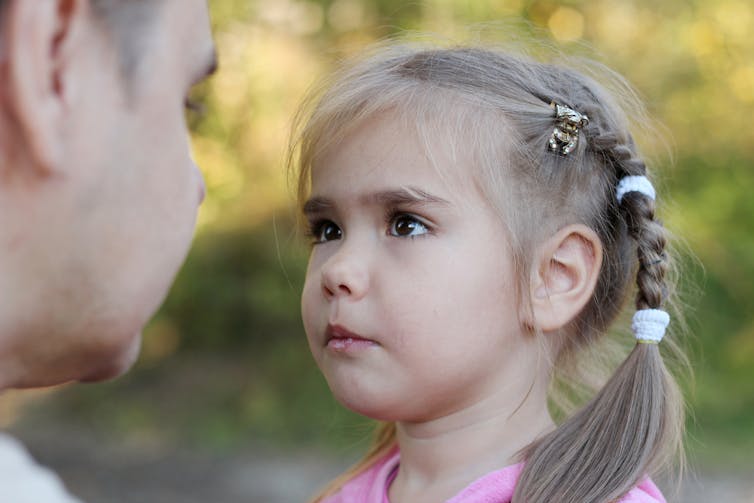 By figuring out whether your child is trying to deceive you on purpose, you can target your response more effectively.
from www.shutterstock.com
By figuring out whether your child is trying to deceive you on purpose, you can target your response more effectively.
from www.shutterstock.com
Second, discuss emotional and moral scenarios with children. This “emotion coaching” supports children’s understanding of when lies are most harmful, how they affect others, and how they themselves might feel when they lie. Children increasingly anticipate pride for telling the truth, and parents can emphasise these positive aspects of truth-telling.
Third, ensure the lie really is a lie. Very young children are prone to blend real life and imagination, while older children and adults frequently remember arguments differently to one another. If a child reports physical or sexual abuse, these allegations must always be investigated. By distinguishing whether or not there is a deliberate attempt at deception, parents and teachers can target their response effectively.
Read more: How's your poker face? Why it's so hard to sniff out a liar
Lying in children is developmentally normal
Lying is developmentally normal and an important sign other cognitive skills are also developing.
If lying is persistent and is impairing the child’s ability to function effectively in everyday life, it’s worth consulting a mental health expert or your doctor.
But in other situations, remember that lying is just one way children learn to navigate the social world. Open and warm discussions about telling the truth should eventually help to reduce children’s lies as they develop.
Authors: Penny Van Bergen, Senior Lecturer in Educational Psychology, Macquarie University
Read more http://theconversation.com/why-do-kids-lie-and-is-it-normal-98948


 Daily Bulletin


