

Love them or loathe them, private label products are taking over supermarket shelves
- Written by: Gary Mortimer, Associate Professor in Marketing and International Business, Queensland University of Technology
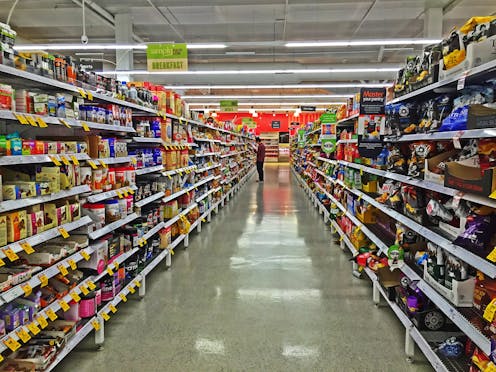
Coles is aiming to have private label products make up 40% of its product range over the next five years. This increase will apply across multiple tiers of products, with a focus on quality, innovation and new strategic global relationships.
More supermarket-owned brands will mean lower prices for consumers and greater margins for the retailer. But the move could significantly impact Australian suppliers as their branded products are delisted and supermarkets seek out cheaper manufacturers overseas.
Read more: Phantom brands haunting our supermarket shelves as home brand in disguise
In Australia, private label products currently account for 18.1% of all retail dollar sales. The proportion is similar in North America (17.7%).
This is significantly less than supermarkets in other countries. Private label products account for 41% of supermarket sales in the UK, 42% in Spain, 36% in Germany and between 27 and 32% in most other European countries.
Why private labels?
In one academic study, 85% of the retailers surveyed said “improved margins” was their main reason for investing in private label products.
A private label product with features and quality parity with national brands may cost retailers 40% to 50% less to manufacture and distribute to customers.
Some American convenience stores claim gross margins of up to 72% on private label bottled water, for instance, compared to 45% on branded alternatives.
Read more: Woolies private label strategy will play directly into the hands of Aldi
Overall, supermarkets see an 8-10% premium on margins for private label products over branded ones.
Private label products also help retailers differentiate themselves from competitors by giving them unique products.
Private labels have increased their footprint across many retailers, including discount department stores, liquor and convenience stores and traditional full-line department stores like Myer.
The flipside of private label expansion
The main fears about the continued growth of private label brands are that it could discourage suppliers from innovating with their products, jeopardise the livelihoods of smaller, independent suppliers, and ultimately result in less choice for consumers.
Consumers are currently benefiting from increased competition. Progressively higher-quality private label products are available at much lower prices than branded products.
Just a few years ago then Woolworths CEO Grant O'Brien said the company would put customers “before” suppliers.
Some researchers suggest that increasing private label ranges could impede innovation in the food industry. This is largely because branded manufacturers will have less incentive to invest in new products only to have them copied by the contract manufacturers who produce private label goods.
But a recent report from the European Commission actually found innovation in the food supply chain is not under pressure. And a quick wander through any major supermarket will illustrate the effort supermarkets are making to improve quality and introduce new product lines.
Read more: Woolworths and Coles should heed simplicity lesson from Aldi
Smaller, local independent brand manufacturers and wholesalers could be exposed to “delisting” – where a supermarket does not renew a supply contract in order to free up shelf space for its own private label alternatives.
Naturally, if Coles is aiming to increase the proportion of its own branded products, minor brands will be the ones to disappear from shelves, not major brands like Coke, Cadbury or Nescafe.
As for less choice, most shoppers will not notice the difference, or may enjoy the shopping experience more.
Supermarket shopping is notoriously a low-involvement, mundane and habitual task. Shoppers often visit the same supermarkets, buy the same products and browse the same aisle. In fact, studies continue to demonstrate that the “abundance of choice” is problematic for many shoppers, who simply seek an “optimal choice”.
Research shows that when faced with a “good, better and best” option, people choose the one in the middle. This is why we see supermarkets offering very basic generic private label products all the way through to “select” and “finest” options.
Accordingly, a successful private label strategy hinges on leveraging perceptions of both price and value. Private label products are a key weapon for Coles and Woolworths to compete with Aldi and Kaufland for price-sensitive customers.
Read more: House-brand push boils down to capitalism's crisis
Australian supermarkets previously looked to local manufacturers to produce their private label ranges. However, Aldi, Kaufland, Costco and Lidl have found success by leveraging their global sourcing strategies, providing both quality and economies of scale, and so lower prices.
This appears to be on the cards for Coles. It has also announced a wish to develop new strategic global relationships to realise its 40% private label target.
This suggests that Coles may overlook local manufacturers, instead seeking out international manufacturers to produce some ranges.
Read more: 'Honey, I shrunk the store': Why your local supermarket is getting smaller
Coles’s announcement comes as supermarkets are getting smaller in the face of rising costs. Together, these trends could have long-term implications for the Australian grocery industry.
The presence of more private label goods will likely require domestic manufacturers to themselves produce more private label goods to minimise offshoring. But, in doing so, manufactuers will commoditise themselves, thereby giving retailers even more power.
Authors: Gary Mortimer, Associate Professor in Marketing and International Business, Queensland University of Technology


 Daily Bulletin


