

Designing the compassionate city to overcome built-in biases and help us live better
- Written by: Jenny Donovan, Urban Designer and Sessional Lecturer, La Trobe University
When we design, build, manage, occupy or even just pass through a place, we change it. Whether we are conscious of it or not, these changes can embellish, adorn, colour, tint or taint that place in the eyes of the people who share it. These perceptions influence how appealing those people will find particular behaviours.
These influences might be seen as biases that are figuratively and sometimes literally set in stone. They are the result of design decisions that effectively dedicate spaces to a particular activity (or activities) and deter other activities. The illustrations below show examples of this.
 Biases that push us to choose one behaviour over another are built into our surroundings.
Designing the Compassionate City, Author provided
Biases that push us to choose one behaviour over another are built into our surroundings.
Designing the Compassionate City, Author provided
These designed characteristics play an important role in framing the range of experiences that people enjoy, endure or miss out on. Over time this affects the trajectory of their lives, which has significant implications for human well-being.
Read more: This is what our cities need to do to be truly liveable for all
If we consider the biases as messages we receive from our surroundings, we need to ask: are these messages biased towards helping or hindering us? Do they invite us to meet our needs? That is the fundamental precondition to thriving and fulfilling our potential.
The truth of it is that we are usually not good at prioritising our needs. Despite the wealth of evidence and awareness of the benefits of being active and engaging in social interaction, many people choose sedentary lifestyles and do not cultivate their social connections.
Unfortunately we are easily distracted by our wants and prone to prioritising some needs to the detriment of others. For example, we choose the security of staying indoors over the need to stay active.
Good design can improve the choices we make
That’s where good urban design comes in. By being aware of human needs and weaving in the right qualities, urban design can tilt the balance of influences so the people who experience our handiwork are more likely to perceive that healthy, needs-fulfilling experiences are not just possible but preferable.
Read more: Most people just park themselves, so how do we promote more healthy activity in public parks?
My book, Designing the Compassionate City, suggests a model of human needs and gathers together the stories of projects overseas and in Australia that explicitly sought to achieve this goal. These revealed that, in addition to the well-known spatial qualities readers will be familiar with, a number of key recurring themes are important in biasing places so that they favour people doing the things they need to do to meet their needs. These include:
Changes in hearts and minds are as important as those on the ground. Sometimes all that needs to happen is for people to interpret the existing messages they are getting from their surroundings differently; to give greater weight and value to the characteristics that help them to meet their needs and “tune out” the things that distract or deter them from meeting these needs.
Good design can be used to privilege needs-fulfilling behaviours and stop a particular use dominating a space to the exclusion of others.
Read more: Contested spaces: living off the edge in a city mall where design fuels conflict
Welcome to the woonerf
A good example of this are the woonerfs, literally “living yards”, which are new or reworked streets that have been developed in the Netherlands since the 1970s. These allow play, socialisation and nature to safely escape the private domain and spread into the shared domain.
Woonerfs do this by using design props that invite walking, playing, socialising and cycling. At the same time, they tightly control car movements so the “vehicle domain” does not overwhelm these other activities.
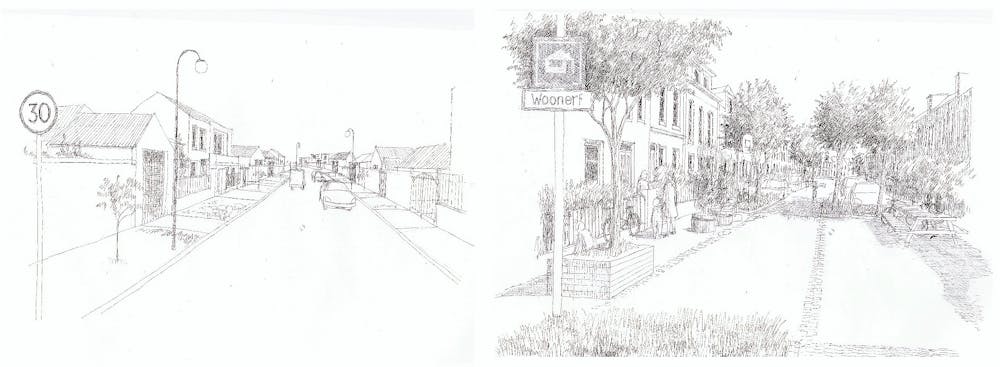 Two streets with the same width and alignment convey different messages, one promoting car use, the other a variety of activities.
Designing the Compassionate City, Author provided
Two streets with the same width and alignment convey different messages, one promoting car use, the other a variety of activities.
Designing the Compassionate City, Author provided
Polyvalence is a term borrowed from chemistry where one thing can act in two or more ways at once. It is used here to describe the quality of designing places to give off multiple messages that different people will receive as relevant to whatever their needs are at the time.
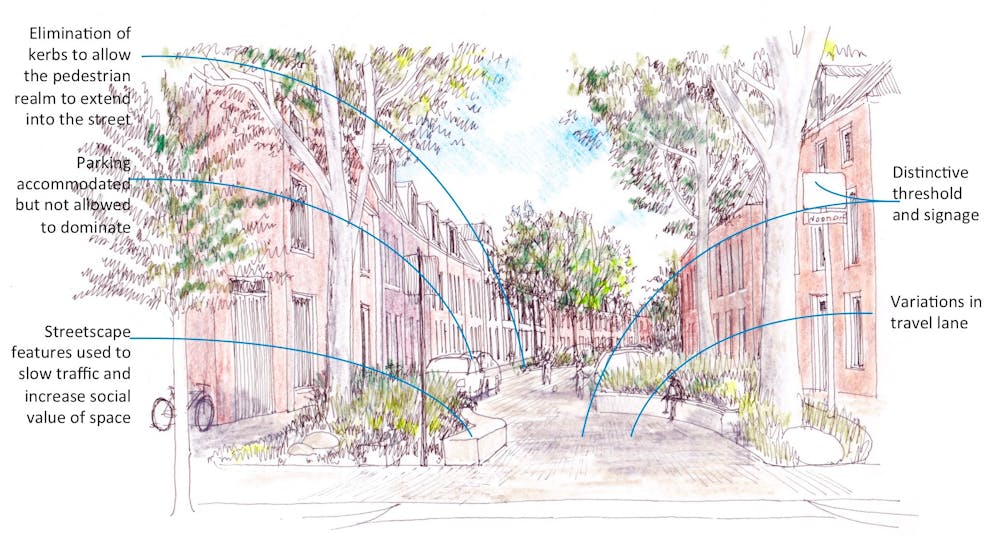 Key elements in a woonerf that conveys multiple messages relevant to different people’s needs at the time.
Designing the Compassionate City (Routledge 2018), Author provided
Key elements in a woonerf that conveys multiple messages relevant to different people’s needs at the time.
Designing the Compassionate City (Routledge 2018), Author provided
Next we need to create adornable public spaces. Man is man’s greatest joy, as the Icelandic saying goes. Whatever we make can be made better by adding people.
Adornable spaces are spaces such as footpaths, parks, squares, street furniture and so on that are good as they are, but can be enhanced when people interact with or adorn them. Examples include features that invite children to play, that invite adults to stay long enough to bump into someone they know, that are enlivened by smiles, laughs, artworks, and just by the presence of others.
 An example of an adornable place.
Designing the Compassionate City, Author provided
An example of an adornable place.
Designing the Compassionate City, Author provided
Finally, compassionate design emphasises little design over big design where possible. Creating places that are a canvas for self-expression and that allow people to contribute to the public realm help develop skills and a sense of achievement.
 Little design interventions in a London mews contribute significantly to the ‘genus animii’, the sense of place.
Designing the Compassionate City, Author provided
Little design interventions in a London mews contribute significantly to the ‘genus animii’, the sense of place.
Designing the Compassionate City, Author provided
These ideas don’t quite fit easily into the silos of policy or practice. Nurturing these qualities will be challenging.
Doing nothing, however, means towns and cities stay places that stifle many of their inhabitants’ human potential, with all that entails. The question we need to ask ourselves shouldn’t be “can we afford this?”, but “how can we afford not to?”
Read more: Eight simple changes to our neighbourhoods can help us age well
Authors: Jenny Donovan, Urban Designer and Sessional Lecturer, La Trobe University


 Daily Bulletin


