

It's funny to name species after celebrities, but there's a serious side too
- Written by: Kevin Thiele, Adjunct Senior Lecturer, University of Western Australia
Microleo attenboroughi. Scaptia beyonceae. Crikey steveirwini. These are the scientific names of just a few of the nearly 25,000 species of plants, animals, fungi and micro-organisms discovered and named in Australia in the past decade.
In each case, the honoured celebrity’s name is Latinised and added to the name of an existing or new genus – a set of closely related species that share common characteristics. In the above examples, Microleo (meaning “tiny lion”) is a genus of extinct carnivorous possums, while Scaptia is a genus of colourful horseflies. And in the case of Crikey steveirwini, a rare snail from northern Queensland, even the genus name honours Irwin, in the form of his favoured colloquialism.
Read more: It's not the science of tax, and five other things you should know about taxonomy
Scientists have been naming species in honour of celebrities since the 18th century. The father of taxonomy, Carl Linnaeus, coined names to curry the favour (and open the purses) of rich patrons.
These days, we usually do it to curry short-lived attention from the public by injecting a degree of attention-grabbing frivolity. Scaptia beyonceae is one example – so named because the fly in question has a shiny, golden bum.
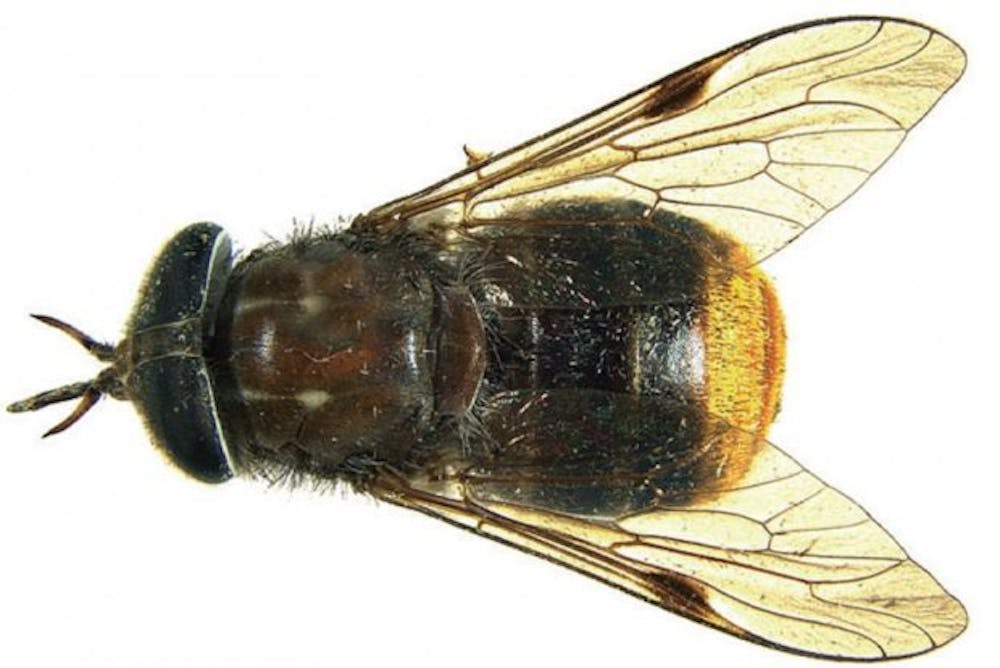 I don’t think you’re ready for this genus: Scaptia beyonceae.
Erick/Wikimedia Commons, CC BY-SA
I don’t think you’re ready for this genus: Scaptia beyonceae.
Erick/Wikimedia Commons, CC BY-SA
But to taxonomists and biosystematists – the scientists who discover, name, classify and document the world’s living and fossil species – the naming of organisms is a serious business.
Not just celeb jokes
Consider this. The current best estimate is that Australia, including its shores and surrounding oceans, is home to more than 600,000 species of plants, animals, fungi, microbes and other organisms.
This tally ranks Australia as one of the most biologically rich and diverse nations on Earth. We are “megadiverse” – one of a select handful of nations that together comprise less than 10% of Earth’s surface but are home to more than 70% of its living species.
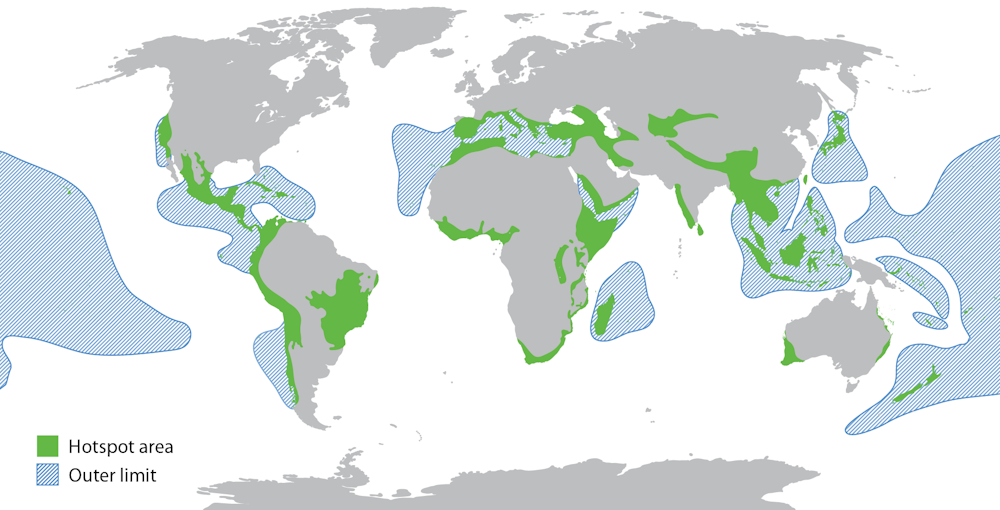 The world’s biodiversity hotspots.
AAS/Royal Society Te Apārangi
The world’s biodiversity hotspots.
AAS/Royal Society Te Apārangi
Now consider this: only 30% of Australia’s living species have been discovered, named and documented so far. That leaves more than 400,000 Australian species that we know absolutely nothing about.
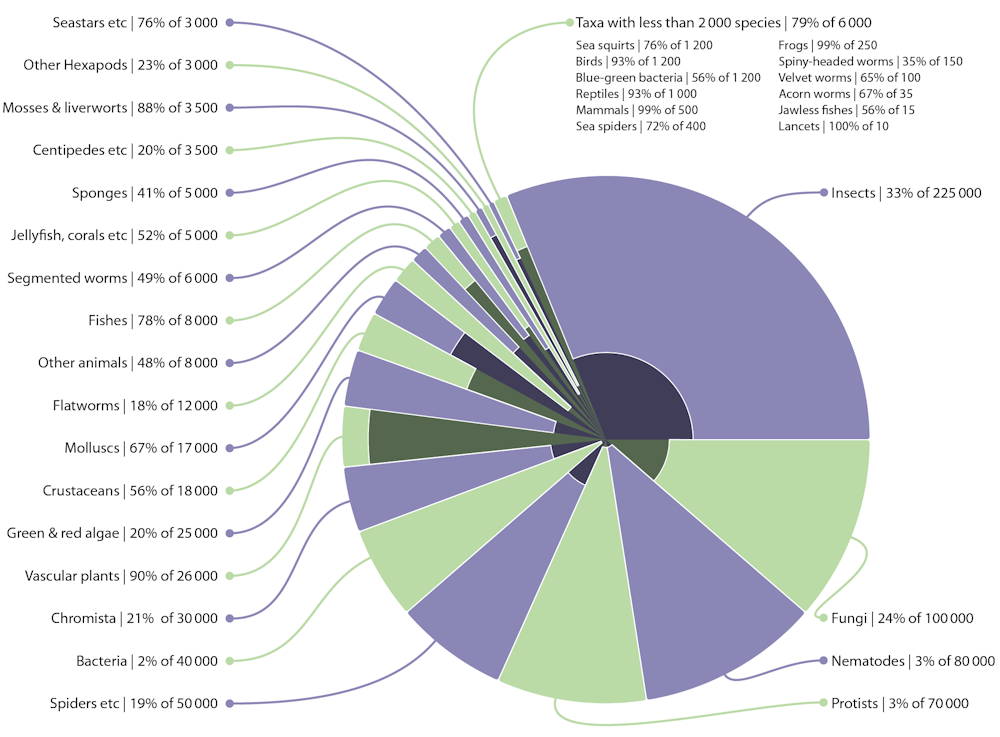 Estimated number of described (centre shaded areas) and undescribed (outer unshaded areas) species in Australia and New Zealand.
AAS/Royal Society Te Apārangi
Estimated number of described (centre shaded areas) and undescribed (outer unshaded areas) species in Australia and New Zealand.
AAS/Royal Society Te Apārangi
Does this matter? Do organisms need names? The answer is yes, if we want to conserve our biodiversity, keep our native species, agriculture and aquaculture safe from invasive pests and diseases, discover new life-saving drugs, answer some of the greatest scientific questions ever asked, or make full use of the opportunities that nature provides to improve our health, agriculture, industries and economy.
Taxonomists construct the framework that allows us to understand and document species and manage our knowledge of them. Such a framework is essential if we are to sustainably manage life on Earth. At a time when Earth is facing an extinction crisis, brought about by land clearing, pollution and global warming, it is more vital than ever.
Without the understanding provided by taxonomists, we’re like the largest, most complex global corporation imaginable, trying to do business with no stock inventory and no real idea of what most of its products look like or do.
Time for an overhaul
The magnitude of the task seems daunting. At our current rate of progress, it will take more than 400 years even to approach a complete biodiversity inventory of Australia.
Fortunately, we don’t have to continue at our current rate. Taxonomy is in the midst of a technological and scientific revolution.
New methods allow us to cheaply sequence the entire DNA code of any organism. We can extract and identify the minute DNA fragments left in a river when a fish swims past. We are globally connected like never before. And we have supercomputers and smart algorithms that can catalogue and make sense of all the world’s species.
In this context, the release today by the Australian Academy of Science and New Zealand’s Royal Society Te Apārangi of a strategic plan to guide Australian and New Zealand taxonomy and biosystematics for the next decade is a significant step. The new plan outlines how we will rise to the grand challenge of documenting, understanding and conserving all of Australia’s biodiversity.
Grand challenge
The plan lays out a blueprint for the strategic investments needed to meet this grand challenge. It envisages a decade of reinvestment, leading to a program of “hyper-taxonomy” – the discovery within a generation of all of Australia’s remaining undiscovered species.
It sets out the ways in which we can use our knowledge of species to benefit society and protect nature, and also the risks involved if we don’t. A small example: there are an estimated 200 unnamed and largely unknown species of native Australian mosquitoes. Mosquitoes cause more human deaths than any other animal on Earth. New mosquito-borne viruses and other parasites are being discovered all the time. It doesn’t take much to put these facts together to see the risks.
Read more: We can name all of Earth's species, but we may have to hurry
With such a weighty challenge and such important goals, it’s hardly surprising that taxonomists sometimes indulge in a little quirky name-calling. Names like Draculoides bramstokeri, a cave-dwelling relative of spiders; or the tiny, harmless pseudo-scorpion Tyrannochthonius rex; or Hebejeebie, the name that botanists simply couldn’t resist when a new genus was separated from Hebe.
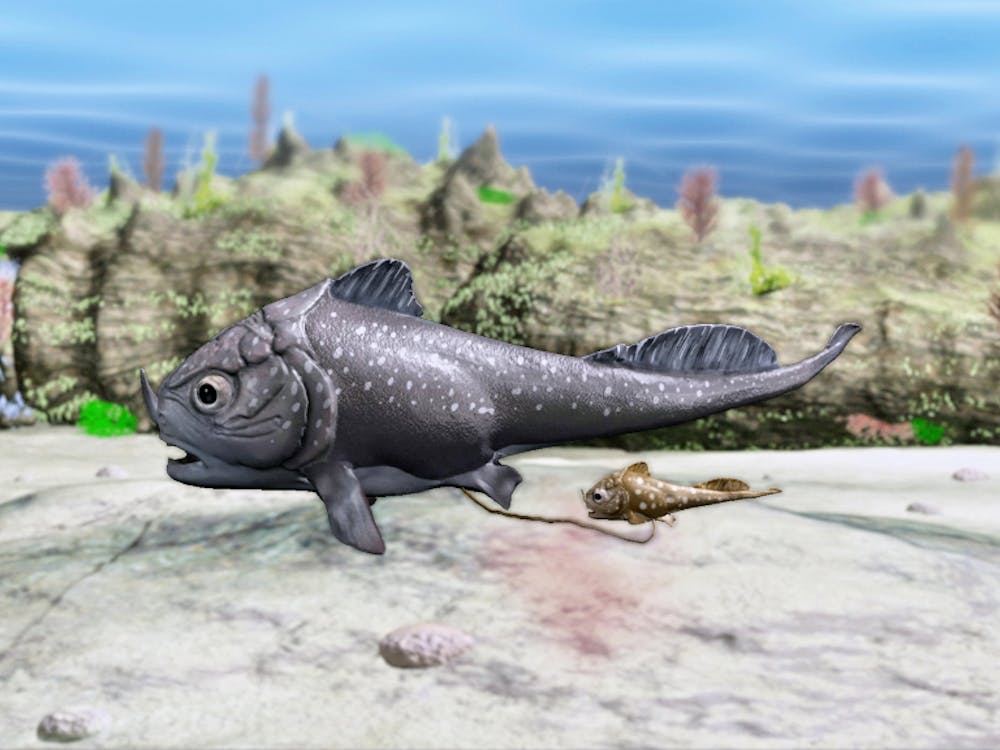 Materpiscis attenboroughi lived hundreds of millions of years before its celebrity namesake.
MagentaGreen/Sularko/Museum Victoria/Wikimedia Commons, CC BY
Materpiscis attenboroughi lived hundreds of millions of years before its celebrity namesake.
MagentaGreen/Sularko/Museum Victoria/Wikimedia Commons, CC BY
One of the greatest celebrities of all, the naturalist Sir David Attenborough, has more than a dozen species named in his honour. No fewer than five of them are Australian. These include the brightly coloured slug-snail Attenborougharion rubicundus, and the fossil of the first known organism to give birth to live young, Materpiscis attenboroughi.
As Sir David puts the case in endorsing the plan, discovering and naming species is vitally important, not only for the future of taxonomy and biosystematics, but for the future of our living planet.
Authors: Kevin Thiele, Adjunct Senior Lecturer, University of Western Australia


 Daily Bulletin


