

Germany’s (not so) grand coalition may cause ripple effects on European refugee policy
- Written by: Kelly Soderstrom, PhD Candidate in International Relations, University of Melbourne
After a tumultuous 2017 election and six months of political uncertainty, Germany finally has a government. The so-called “grand coalition” made up of the centre-right Christian Democrats (CDU), its right-wing sister party, the Christian Social Union (CSU), and the centre-left Social Democrats (SPD), will govern Germany for the next four years.
At the centre of it all is the coalition agreement. The 179-page document sets out the goals for the government, including a new approach to Germany’s refugee policy.
The agreement explains “a new direction for Europe, a new dynamic for Germany, a new cohesion for our country”. It notes two changes in German leadership: a change in the power dynamics among the ruling parties, and a strong emphasis on using the European Union (EU) to achieve German political objectives.
With a weakened CDU under Chancellor Angela Merkel ceding considerable control to the anti-immigration CSU and the socialist SPD, the centre of German political power has shifted. This shift will have a profound impact on German and EU refugee policies.
Read more: Angela Merkel wins a fourth term in office – but it won't be an easy one
The issue of refugees is discussed deeply in German society. Since the height of the refugee crisis in 2016, when 722,370 people applied for asylum in Germany, the number of asylum applicants has decreased significantly.
However, 1.6 million refugees remain in Germany and Europe’s refugee crisis appears to be far from over. Not unexpectedly, this is a huge source of tension in the government.
At first, Merkel gained praise for her humanitarian, liberal refugee policy focused on refugee reception and integration. However, growing anti-immigrant sentiment, evident in the rise of groups like Patriotic Europeans Against the Islamisation of the West (PEGIDA), the electoral success of the far-right Alternative for Germany (AfD) and the difficulties in integrating a large number of refugees all resulted in increasingly protectionist sentiment.
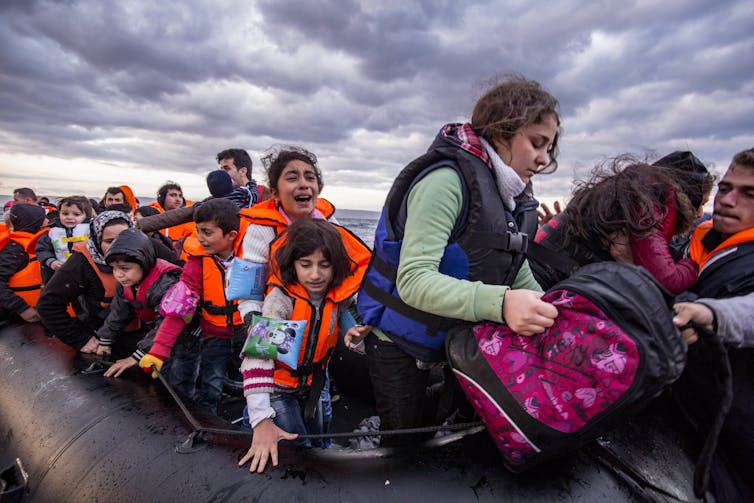 Germany needs to provide a feasible refugee policy that is manageable and does not split the coalition.
Shutterstock
Germany needs to provide a feasible refugee policy that is manageable and does not split the coalition.
Shutterstock
Merkel had pushed for refugee responsibility-sharing across the EU. However, no pan-EU approach drawing on the German example eventuated. Many EU member states refused to honour the major instrument for delegating responsibility for refugees, the Dublin Regulation, or participate in the EU-wide refugee redistribution scheme.
Given Merkel’s weakened position in the coalition, it is not clear that Germany will continue her humanitarian approach.
The government faces two leadership challenges in refugee policy. Firstly, it needs to provide Germany with a feasible refugee policy that is manageable and does not split the coalition. Secondly, it is attempting to lead a different type of coalition – namely, the EU’s 28 member states.
Read more: Why Europe shouldn't follow Australia's lead on asylum seekers
Leadership in Germany: Can Merkel still say ‘wir schaffen das’?
In domestic refugee policy, Germany is fractured. Of the three coalition partners, the anti-immigration CSU is the primary winner in migration and refugee policy. CSU leader and Interior Minister Horst Seehofer is leading dramatic restrictions in refugee policy. Although the SPD negotiated a modest victory with 1,000 family reunification visas per month for refugees, government parties are refusing to do more than this.
Creating a cap on refugee visas was a major point of controversy between the CDU and CSU. The CSU prevailed, with the coalition agreement calling for an annual cap of 180,000-220,000 refugees. However, that cap may not take effect as only 198,317 first-time asylum applications were filed in Germany in 2017. Yet this threshold creates distraction from Merkel’s humanitarian approach as it prioritises immigration control over humanitarian obligation.
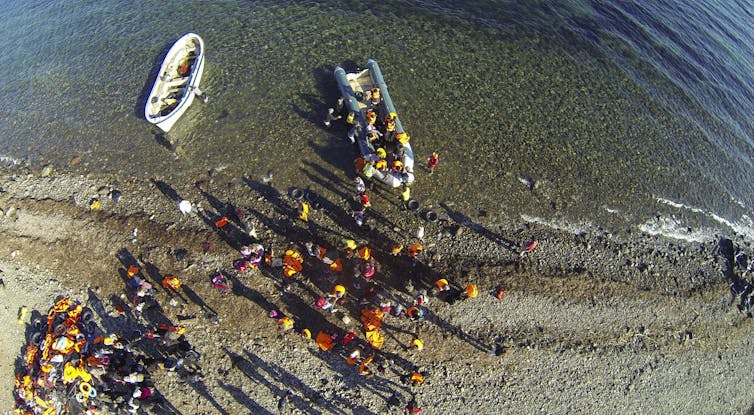 There is some good news for refugee integration in Germany.
Shutterstock
There is some good news for refugee integration in Germany.
Shutterstock
This, coupled with the limitations on movement of refugees imposed by centralised processing centres and repatriation centres for failed asylum seekers, demonstrates new constraints in refugee policy. This in turn demonstrates the CDU’s diminishing power and the fracturing of the centre of policy leadership.
Yet there is some good news for refugee integration. The grand coalition still maintains a focus on refugee integration, especially through language acquisition and participation in the labour market.
As Germany struggles with its fractured leadership and seeks consolidation and centralisation of refugee processing procedures, the German approach is becoming increasingly binary: if you are not a refugee, you must leave; if you are a refugee, you must integrate.
Read more: Donald Trump's ban will have lasting and damaging impacts on the world's refugees
Leadership in Europe?
When it comes to the EU, the grand coalition government has four objectives: halt secondary movement of refugees; toughen the EU’s external borders; tackle external push factors; and create a robust mechanism for responsibility-sharing.
The Common European Asylum System aims for common application procedures for refugees and accommodation standards to prevent asylum-shopping across countries. The German government is also renewing calls for a quota-based refugee redistribution and resettlement scheme among EU states.
In calling for increased policing of the EU’s external borders and a common approach to push factors, these mechanisms paint refugee protection as a security issue rather than a humanitarian one.
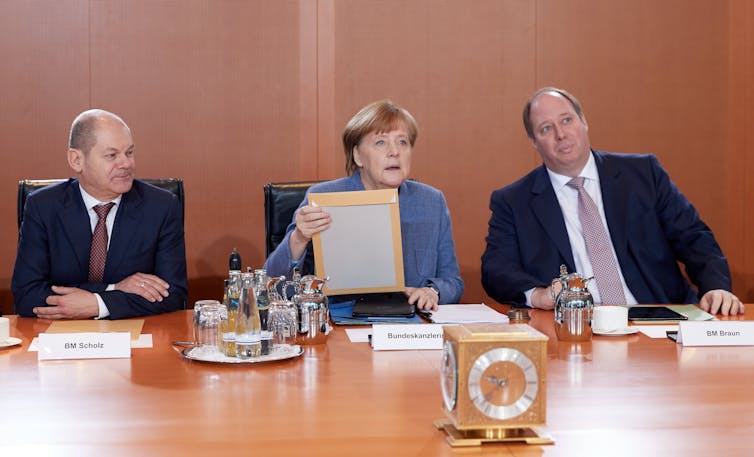 Germany regards leadership of the EU as the key to achieving its interests.
Hayoung Jeon/AAP
Germany regards leadership of the EU as the key to achieving its interests.
Hayoung Jeon/AAP
During the Eurozone crisis, Germany showed strong leadership in EU policy. However, it has failed to persuade other member states to follow its leadership on refugees. Its leadership may further weaken as other states refuse to follow.
Will Germany step up to lead in Europe?
The EU is deeply divided on refugee policy and distracted by other concerns. The United Kingdom is consumed by Brexit negotiations, while many eastern and central European states refuse to participate in EU-level refugee resettlement schemes.
The anti-refugee populist parties have increased influence across Europe. Merkel has few natural allies, if any, in the grand coalition or within the EU on this issue.
Read more: What Europe can teach Canada about protecting democracy
Yet Germany regards leadership of the EU as the key to achieving its interests. Merkel is emphatic that “Germany will only do well if Europe is doing well”.
However, Germany is falling in line with more restrictive policies, rather than leading the EU towards a more comprehensive and humanitarian solution to the refugee crisis.
If Germany leads EU policy change, we may well see increased blocking of access to the EU for refugees and policies that emphasise control and expediency over humanitarian values.
Authors: Kelly Soderstrom, PhD Candidate in International Relations, University of Melbourne
-grand-coalition-may-cause-ripple-effects-on-european-refugee-policy&media=https://dailybulletin.com.au/https://images.theconversation.com/files/214030/original/file-20180410-75767-1ir25wk.jpg?ixlib=rb-1.1.0&q=45&auto=format&w=754&fit=clip&description=Germany’s%20(not%20so)%20grand%20coalition%20may%20cause%20ripple%20effects%20on%20European%20refugee%20policy "Pin It")

 Daily Bulletin


