

Live from Pyeongchang: how an Olympic broadcast works
- Written by: Merryn Sherwood, Lecturer in Sports Journalism, La Trobe University
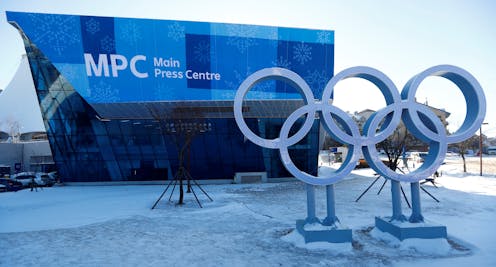
Most major sports events that appear on our screens follow a similar broadcast model. TV stations pay for the broadcast rights and then employ the production crew – including expert camera operators, producers and talent – to take the event from the confines of a stadium to a spectacle viewed by millions.
It’s costly but worth it. Sport is one of TV’s most valuable products.
Read more: Are sport broadcast rights worth the money?
But at a major event like the 2018 Pyeongchang Olympics (which many are now tuning into), where the International Olympic Committee (IOC) sells broadcast rights to multiple regions, this would become a logistical nightmare.
So, instead of the Australian rights holder, Channel 7, setting up its cameras on a downhill skiing course next to other overseas broadcasters, the video is delivered globally through a central service.
What is the Olympic Broadcasting Service?
While earlier broadcasts were a combination of the organising committee working with local broadcasters to make a feed to be delivered around the world, the IOC in 2001 created a dedicated ongoing department, the Olympic Broadcasting Service.
The service has run the full broadcast since the 2010 Vancouver Olympics, when it hired 2,500 temporary staff – including camera operators, technical staff, commentators and reporters – to deliver 800 hours of live coverage. In Sochi in 2014 that rose to 1,300 hours of coverage delivered by more than 3,400 staff.
However, the Winter Olympics are small fry compared to Summer Olympics. At the 2016 Rio Olympics, more than 7,200 Olympic Broadcasting Service staff created the broadcast, with 1,000 cameras delivering 7,100 hours of footage. That turned into more than 350,000 hours of coverage broadcast globally.
And, for the first time, more hours were broadcast on digital platforms from Rio than on traditional TV.
The role of rights holders
The Olympic Broadcasting Service model is that a neutral feed with independent commentary is sent out to rights-holding broadcasters in real time. They can either take that feed or push in their own commentary over the top.
This is why, if you are in Australia, you are likely to see specialist commentators drop in to events where Australians might do well. For example, multiple world champion Jacqui Cooper will offer expert comments on aerial skiing alongside Australian hosts. But you might hear a Canadian accent if Channel 7 simply takes the Olympic Broadcasting Service feed for, say, curling.
For others, the service becomes the base for a much-expanded production. NBC’s Olympic production for Pyeongchang includes additional cameras in venue to supplement the Olympic Broadcasting Service, 89 of their own expert commentators and 13 studio sets.
The largest set is a 325-square-metre dome that includes a giant video wall, 18 monitors, 15 different locations for reporters to deliver pieces-to-camera, plus an anchor desk, interview areas and a news update desk.
But in an era of shrinking media budgets, there will also be more broadcasts from off-location. NBC will have a further five studios based in the US. Channel 7 anchored Rio Olympics shows back in Australia as well as in Brazil.
This approach isn’t necessarily exclusive to Olympics. Commentary on ATP tennis tour events is often recorded in London studios, rather than on site: technology increasingly allows this to be an option.
A new reality
Olympics have often provided the impetus for large-scale broadcasting innovations. For instance, TV was introduced in Australia for the 1956 Games in Melbourne.
The Olympic Broadcasting Service production at Rio was the first to use drones, captured footage in 8K Super Hi-Vision footage (which is so far available only on a limited number of screens in Japan), and also made content available in virtual reality.
In Pyeongchang, networks such as Eurosport and NBC will broadcast virtual reality content live for the first time.
At each Olympics fans can simply expect more coverage as networks move to capitalise on content across multiple screens. But it won’t necessarily come cheap.
Other markets may be used to paying a premium for major events through pay TV channels, so Eurosport and NBC charging for their virtual reality access may not raise too many eyebrows. But Australia is an interesting case: sporting events of major significance are on an anti-siphoning list that ensures these are broadcast on free-to-air TV.
The only way Australians could watch the entire feed produced from the Rio Games was to purchase a premium A$19.99 app, which was much criticised. This time Channel 7’s communications suggest that all content will be available for free on the app, but a premium A$14.99 upgrade will offer less commercial content, and HD coverage.
It will be interesting to see if this option is popular and, if so, whether it works more effectively than before.
Authors: Merryn Sherwood, Lecturer in Sports Journalism, La Trobe University
Read more http://theconversation.com/live-from-pyeongchang-how-an-olympic-broadcast-works-91238


 Daily Bulletin


