

How the Australian Constitution, and its custodians, ended up so wrong on dual citizenship
- Written by: Hal Colebatch, Visiting Professorial Fellow, UNSW
For those who take only an ordinary interest in politics, the drama over citizenship and eligibility to be a member of parliament has been puzzling. Surely these people looked at the rule book, the Australian Constitution, before deciding to stand for election? Why were their nominations accepted if they weren’t qualified?
Well, it’s not quite that simple. The constitution is not the rule book, but the record of a deal between the leaders of six self-governing colonies to form a federation; it covers what they wanted to cover, and it means what relevant people make it mean.
It doesn’t say that there has to be a prime minister, but it does say that “there shall be an Inter-State Commission”. That we do have a prime minister and don’t have an inter-state commission reflects the way relevant people have used the words in the constitution.
What did the constitution writers think they were doing?
The constitution was put together by many hands over ten years. The qualifications for candidature were drafted by the Tasmanian attorney-general, Andrew Inglis Clark, in a straightforward and inclusive way: at least 21 years old, resident of the electorate, and a subject of the Queen (which would have included New Zealanders, Canadians and Britons).
But Samuel Griffith, the Queensland prime minister (as they were then called), wanted a section on disqualification. This would cover felony, bankruptcy and:
any person who has taken an oath or made a declaration or affirmation of allegiance to a Foreign Power or done any act whereby he becomes a subject or citizen … of a Foreign Power.
So there were separate sections on qualifications and disqualifications, from different sources and reflecting different values, and they took this form in the successive drafts of the constitution.
In the smoke-filled room: the drafting committee
The final session of the constitutional convention was held in Melbourne early in 1898. There was no further discussion of what became the now-infamous section 44, and a drafting committee took over to prepare a final draft.
Edmund Barton – soon to become Australia’s first prime minister – was the chair and dominant figure. He insisted on working till 4 or 5am, even though the other two members of the committee had gone to bed and only Robert Garran, the secretary, was left to maintain the illusion of a committee.
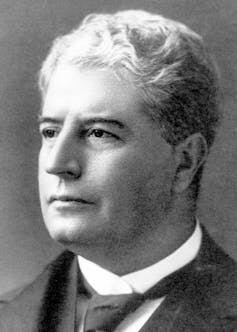 Sir Edmund Barton, who snuck in 400 amendments to the constitution at the last minute.
Parliamentary Education Office
Sir Edmund Barton, who snuck in 400 amendments to the constitution at the last minute.
Parliamentary Education Office
After four days of drafting, Barton presented the convention, on its second-last day, with 400 amendments. He proposed a three-hour break for the delegates to study them, after which they could be put to the vote en bloc.
Barton assured the convention that there was only one amendment of substance – to section 44(ii). What he did not say was that section 44(i) had been completely rewritten, changing it from an active voice (“done any act whereby”) to a passive voice (“is a subject or citizen … or is entitled to”).
No attention was drawn to this change, there was no explanation of it, and there was no time for debate on any clause unless someone objected to it. The constitutional text that proved so significant more than a century later was a last-minute change, drafted in private and accepted out of weariness.
In his history of the convention, J.A. La Nauze points out that, by this stage, the delegates “had had enough”, but muses:
it may one day interest a curious lawyer to inquire whether judicial review has lingered with significant consequences on new words approved on trust and intended … merely ‘to put the wishes of the convention in more complete and concise form’.
As it turned out, it interested more than the curious lawyer, and created a problem which has yet to be adequately managed.
Appealing to the umpire?
The constitution was rather unclear about how these provisions would be enforced. It said both that questions about qualification could be settled by each house, but also that “any person” who believed that an elected representative was disqualified by section 44 could sue them in “any court of competent jurisdiction”.
In any case, there was little call for either until the High Court decided in 1999 that the UK was a foreign power.
Even then it refused to hear a case calling for Tony Abbott and Julia Gillard to produce evidence they had renounced their UK citizenship, on the basis that they had declared that they were qualified, and so the court should presume that they were. To do otherwise would be a vexation and an abuse of the court’s time.
But when the court did deign to interest itself in the matter, it took the traditional High Court view that it was not interested in the problem, or what the writers of the constitution were trying to do, but only with the possible meaning that a black-letter lawyer could squeeze from these words, irrespective of its impact on the governing of Australia.
Where does this leave us?
The situation now is that the qualifications for candidature for the Australian parliament are set by the parliament, but the disqualifications are largely set by foreign governments via the High Court. This diminishes the ability of electorates to choose the representative they want (though, when given the chance, electorates show what they think of the High Court’s action by returning the ousted members in the ensuing byelection).
Read more: Grattan on Friday: Voters just want citizenship crisis fixed – but it isn't that easy
And the High Court’s escapade in the china shop is not yet over, for it has yet to rule on the disqualification of those who are “entitled to” foreign citizenship, even if they have not applied for it. If the court applied the same logic that it has used in the cases already decided, this would disqualify not only any Jew, but also anyone with a Jewish parent, grandparent or spouse, all of whom are entitled to Israeli citizenship under the Israeli Law of Return.
The best course would be to start with recognising the problem, rather than searching for a preferred solution. In contemporary Australia, identities are often complex, and citizenship entitlements may be multiple and overlapping. How these are to be recognised in the qualifications for candidature demands a period of public discussion culminating in political action.
The only way we could get this is to take the matter out of the hands of the High Court and foreign governments and return the task of defining qualifications and disqualifications for candidature to parliament. This could be done by adding to section 44 the phrase “until the parliament otherwise provides”, which is used in section 30 on qualifications, and at a number of other points in the constitution.
This would be a logical and constitutional response to the political problem that has landed on us. If the five main parties in the parliament (all of which have had their parliamentary representation threatened by the High Court’s actions) supported a referendum to achieve this change, it would probably be carried.
The voters, too, as they showed in New England and Bennelong, have had enough. They want the political leaders to lead.
Authors: Hal Colebatch, Visiting Professorial Fellow, UNSW


 Daily Bulletin


