

Why Trump's decertification of the Iran nuclear deal may prove a costly mistake
- Written by: Ben Rich, Lecturer in International Relations and Security Studies, Curtin University
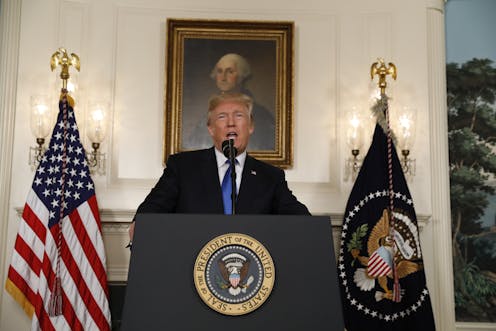
US President Donald Trump’s decision on Friday to decertify the Iran nuclear deal threatens the future of the landmark agreement, creates greater instability in the Middle East, and weakens America’s position in the wider global order.
Why is the agreement important?
Adopted in October 2015, the agreement was the culmination of 20 months of intense negotiations between Iran and a US-led coalition made up of the UN Security Council P5 nations (the US, the UK, Russia, France and China) as well as Germany. It significantly limited Iran’s capacity to enrich uranium and achieve a domestic nuclear weapons capability.
In exchange, a range of longstanding US and EU economic sanctions were removed against Iran. This allowed access to wider export markets for its beleaguered oil industry and permitted greater amounts of external investment – particularly from interested parties in Europe and China.
Iran was permitted to retain a civilian nuclear program for power and medical purposes. However, this was subjected to regular checks by international inspectors to ensure no nefarious activities were taking place.
Further reading: Why now? Understanding the Iranian nuclear breakthrough
The US president is required to certify that Iran is complying with the agreement every 90 days. If non-compliance is detected, the president’s decertification begins a congressional process that can end with the reimposition of sanctions.
Many saw the agreement as a significant and positive foreign policy legacy for former president Barack Obama. It was a rare achievement for an administration that largely fumbled in its approach to the Middle East.
Trump’s bellicosity
Consternation over Trump’s inability to effectively handle the Iran deal began long before he was sworn in as president. On the campaign trail, Trump described it as a “disaster” and “the worst deal ever negotiated” without clearly stating why.
As president, Trump has sullenly recertified the agreement twice. But he always indicated he wanted to assume a more hostile stance toward Iran.
While taking a harder line toward Iran is hardly a desire Trump holds alone among Republicans, he has offered little coherent vision on an alternative. Aside from vague threats of violence and suggestions he could “renegotiate” the agreement, Trump has provided little in the way of viable policy options.
In the case of the former, short of regime change, this would only lead to a more hostile Iran and a greater probability of nuclearisation – just as it did in similar circumstances during the Bush years.
For the latter, Trump is unlikely to be able to mobilise the necessary partners to return to the negotiating table. Nor could he entice an antagonised Iran to trust future US commitments after it feels the US has once again duped it.
The ‘spirit’ of the deal
Trump’s justification for decertification stems from his view that Iran is violating the deal’s “spirit”. This is despite other partners in the negotiations, and his own advisers, indicating that Iran remains compliant with the agreement.
Trump cites Iran’s support for militia groups like Hezbollah in Lebanon and the Houthis in Yemen, as well as its ongoing ballistic missile program and backing of Syria’s Assad regime, as a dereliction of its commitment to the deal.
The problem with this logic is two-fold and interrelated.
First, none of these activities are included in the nuclear agreement. While they are certainly challenges to be responded to with a combination of carrots and sticks, the deal was never designed or intended to resolve them.
Second, Trump seems to expect that the agreement should act as a panacea to the wider challenge of Iran for the US. This attitude ignores the complex, slow and ongoing nature of adversarial diplomacy.
Normalising Iran within the international system – the ultimate goal of US engagement – is a process that will likely take decades. In this endeavour, an all-or-nothing attitude only serves to weaken Washington’s position in any ongoing delicate negotiations, where both parties need to walk away with some sense of accomplishment, dignity and confidence in their partners.
Obama was starkly aware of such realities. He knew that while he might not be able to curtail all of Iran’s regionally destabilising activities, discussions on the nuclear issue in isolation could offer a path forward.
Undermining multilateralism
The decertification also reinforces Trump’s disdain for multilateralism as a key tool for promoting US interests and resolving international problems.
Not only does Trump’s decision incense America’s partners in the deal, it also joins a long list of multilateral frameworks, alliances and agreements he has either abdicated, threatened or weakened. These include the Trans-Pacific Partnership, the North America Free Trade Agreement, the Paris climate accord, and NATO.
US participation and leadership in these institutions directly serves its own international interests: it helps it shape the norms and standards by which other countries engage in the global arena.
But, by undermining these same structures through such non-consultative and unilateral actions, the US disincentivises other countries from adhering to the rules-based international architecture it has sought to sculpt since 1945.
This has direct relevance for normalising Iran’s behaviour. It has viewed the international system as arrayed against it since at least the Iran-Iraq War in the 1980s.
Under such conditions, getting Iran to embrace a less revisionist and disruptive approach to foreign policy through socialisation and co-operation will hardly be helped by undermining a key structure of rapprochement.
At a wider level, such unilateralism harms US relations with its more traditional allies, which view it as a less reliable and predictable partner.
Trump’s transactional worldview may put little stock in national prestige. But such qualities can be just are crucial to the long-term diplomatic relationships of international affairs as short-term material concerns.
Should the US wish to maintain its global primacy, it cannot simply devolve into a bully power and expect others to remain in lock-step with its goals. While most US presidents have seemed to grasp this concept to varying degrees, it seems wholly beyond Trump’s neophytic views on grand strategy in foreign affairs.
Authors: Ben Rich, Lecturer in International Relations and Security Studies, Curtin University


 Daily Bulletin


