

The eyes have it: how vision may have driven fishes onto land
- Written by: John Long, Strategic Professor in Palaeontology, Flinders University
About 375 million years ago, certain fishes had developed powerfully strong paired fins that were capable of transporting them out of the water and onto land.
These fishes would eventually evolve into the first truly terrestrial animals, called tetrapods. They had four limbs bearing digits – fingers and toes – to help them when they walked around around on land.
But one of the biggest mysteries for scientists is figuring out what could have driven such fishes out of the water and onto land in the first place.
Was it availability of new food sources, or perhaps their need to escape from predators in the water?
A new theory says it was improved vision, as shown by dramatic increases in eye size and visual acuity, that enabled fishes peeping upwards at the waterline to spot prey on land.
This would have motivated them to venture out of the water to hunt for food. The new research is published today by Malcolm MacIver from Northwestern University in the US and colleagues. They have named this the “Buena Vista” hypothesis, from the Spanish for “good view”.
All the better to see you with
The team measured the eye sizes of many kinds of fossil fishes and early tetrapods that lived between 390 million and 250 million years ago to show a dramatic increase in eye size just before the most advanced fishes, called elpistostegalians, left the water to evolve into the first tetrapods.
While fossil eyeball capsules are sometimes preserved perfectly in 3D, most fossil eyes are reconstructed from the shape of the curved sclerotic ring bones that surround the eye, combined with size and shape of the orbit, which is the hole in the skull that envelops the eyeball.
 How the eye size (white circle) increased dramatically in the evolution of lobe-finned fish that lived entirely in water to the first land living tetrapods.
John Long, Flinders University
How the eye size (white circle) increased dramatically in the evolution of lobe-finned fish that lived entirely in water to the first land living tetrapods.
John Long, Flinders University
The increase in eye-socket size as measured from fossil skulls of fishes and early amphibians corresponds to a three-fold increase in eye size.
Experimental models of visual ability against different environment scenarios, from deep in water to being in air during daylight, give an estimation of the efficiency of vision in each case. The researchers computed the range, volume and viewing factors across a range of conditions and pupil sizes.
The results showed that fishes underwent a series of visionary improvements in stages moving from water to land. The first step was when they began to look upwards towards light. Ambush predators, which surprise their prey by a rapid attack coming up from underneath, do this.
A Devonian fish called Panderichthys had a head shaped perfectly for this type of attack. Its vision was best adapted for scanning across the plane of view when looking up for prey.
The second stage was when fishes took to surfacing and poking their eyes above water to peer through the air at the environment around them.
Fishes such as Tiktaalik, the fish most closely related to tetrapods, exemplify this stage very well. It has a long crocodile like head with similarly placed eyes in the centre, raised up so they can look around.
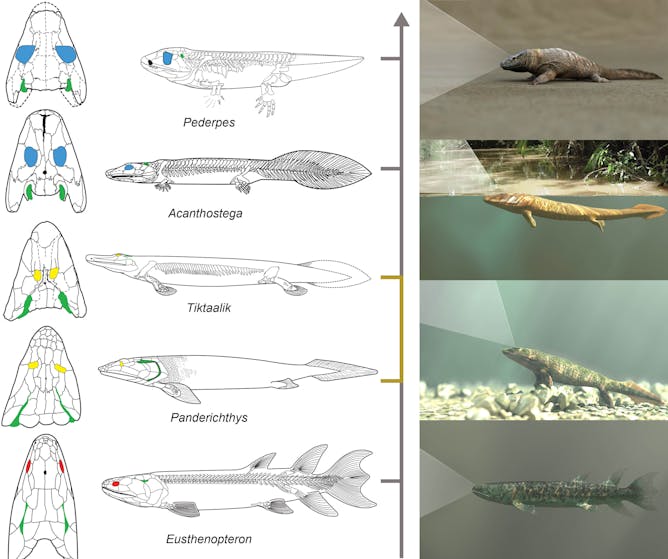 How vertebrate vision improved dramatically in the stages from life in water as a fish to life on land as a limbed tetrapod.
Malcom MacIver, Northwestern University
How vertebrate vision improved dramatically in the stages from life in water as a fish to life on land as a limbed tetrapod.
Malcom MacIver, Northwestern University
It was found that after the emergence of vision, from the fully aquatic vision to totally aerial vision, there was a five million fold increase in the total amount of space monitored by vision.
Even looking from the water’s edge, by poking their eyes above the water, fishes such as Tiktaalik had a massive increase in visual ability to spot prey, such as large worms or bugs on the nearby river bank.
The latest work is not without some doubts, as lead author MacIver told me:
The simulations showed that the bulk of the eye size increase occurred before tetrapods were on land, while my own earlier prediction was that the increase would occur after they were on land.
That’s because I’d only envisaged seeing through air happening at the same time as terrestriality. So it was a big relief when I subsequently came across Long and Gordon’s 2004 paper that synthesized several anatomical changes and gave the idea that early tetrapods, still largely fully aquatic, may have hunted like crocodiles – living in water but hunting by seeing through air.
The new research suggests that this Buena Vista view was perhaps the zip-line effect for fishes to take more active forays onto land. This would have accelerated the development of more robust limbs and the emergence of well-developed digits to replace fin rays.
Some of these advanced fishes, such as Panderichthys, already had digits present inside their fins.
Fully formed rows of fingers and toes would be clearly more advantageous for moving on land, though some of the first tetrapods had evolved digits whilst living in water.
Vision and the beginning of complex planning
The big implication of this research is the effect it all had on our brains with the shift in behaviour and cognition that accompanied this transition onto land.
With larger eyes, vertebrates began long range sensing for the first time. To sneak up on prey successfully implies they must have been planning an ambush attack, such as creeping up from behind. Otherwise the prey would see them coming and escape if they approached directly.
In living fishes and amphibians the time between prey detection and escape is reduced by about 6 microseconds through using a single large cell called a Mauthner neuron cell to initiate the escape plan. This neural circuity enables ultra-fast reactions to stimuli.
These Mauthner command cells are today only found in fishes and amphibians. Later, more efficient nerves in the spine displaced the need for Mauthner cells.
It seems that the origin of long range vision started with a common ancestor of fishes and tetrapods, most likely one of the highly advanced lobe-finned fishes such as Tiktaalik.
So be thankful for our fishy ancestors that boldly ventured to go where no fish had gone before, out of the water up on to land. Without the long range vision that accompanied this event our ability to plan and perform complex actions might never have evolved.
Authors: John Long, Strategic Professor in Palaeontology, Flinders University
Read more http://theconversation.com/the-eyes-have-it-how-vision-may-have-driven-fishes-onto-land-73060


 Daily Bulletin


