

Baird's back in NSW: experts react to the Coalition win
- Written by: Liz Minchin NSW Election Editor at The Conversation
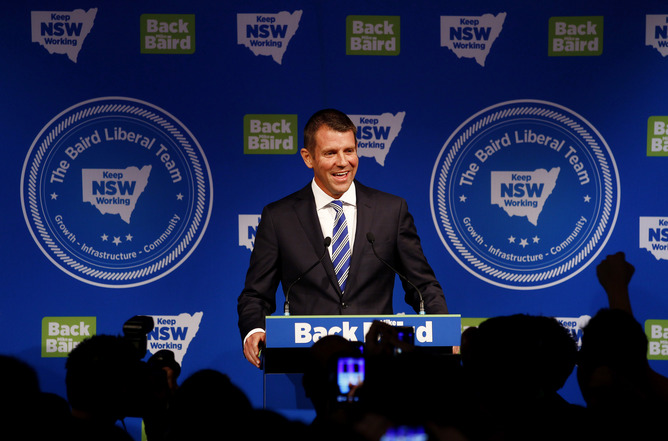
Mike Baird’s Liberal National coalition has been comfortably returned to government in New South Wales, despite more than a 9% statewide swing against it on the two-party preferred vote.
Arriving to chants of “four more years”, Baird told his cheering supporters that “the people of New South Wales have chosen hope over fear”.
After calling Labor leader Luke Foley “a tough opponent” and thanking him for his “gracious” concession speech, Baird declared his government had won a mandate on electricity privatisation in the face of “the biggest scare campaign” in the state’s history.
Baird also acknowledged the support of Prime Minister Tony Abbott (who was not at the victory party) and others from the federal government, including Foreign Minister Julie Bishop (who was there).

Earlier, Foley called Baird a “formidable and an honourable opponent”, while vowing that Labor would “be a credible alternative government” and that he would re-contest the Labor leadership.
“With this result tonight we’ve gone from a rump in the state parliament to a real opposition,” Foley said.
ABC election analyst Antony Green called it a “good comfortable victory” for the Coalition, which will have a “perfectly workable majority” in the lower house. By 10:30pm, the Coalition was on track to win 53 seats, Labor 34, the Greens four, with two independents.
In the upper house, the government may still need to negotiate with minor parties to pass its electricity “poles and wires” privatisation plan.
While privatisation was the dominant election issue across the state, rural and regional NSW swung harder against the government, with anti-coal seam gas campaigns among the key factors. The previously safe Nationals-held far north coast seats of Ballina and Lismore look set to fall to the Greens, with swings of around 25-30% in both seats.
How the campaign was won
University of Sydney senior lecturer Anika Gauja said the government had won with a “presidential-style campaign, designed to capitalise on the popularity of leader Mike Baird”.

“From the campaign slogan ‘Back Baird’ to the personal pledge card issued to voters, the strategy was designed to channel any policy debate and ambiguity through a personal commitment from the premier. This strategy has proved successful – the government has been returned despite running with an unpopular keystone policy,” Dr Gauja said.
“Returning from the brink of annihilation in 2011, the ALP has worked hard on running strong grassroots campaigns in key marginal seats for the last 12 months. However, that hasn’t been enough in some seats it had been aiming for, including the inner-Sydney seats of Newtown and Balmain, which the Greens look set to win.
“On a broader scale, with a relatively unknown leader, Labor has had to emphasise policy difference rather than personality. This began in the first few weeks of the official campaign with a positive commitment to funding health and education without selling assets, but as election day neared the strategy turned to the attack – culminating in a scare campaign over the sale of electricity assets to the Chinese government.”
“Baird will no doubt take his election victory back to parliament claiming a mandate to proceed with privatisation plans. But his ‘personal pledge’ will not help his case in the Legislative Council, where the government looks very likely to have to rely on an alliance with the Christian Democrats to get the plans through. Labor, the Greens and the Shooters are strongly opposed to leasing poles and wires, and each party will certainly claim the support of their voters in opposing the policy.”
Macquarie University political history lecturer Lloyd Cox said that “at the end of the day, Labor was just starting from too far behind after the debacle of the 2011 election”.
“The privatisation issue did not play out as it did in Queensland,” Dr Cox said. “This can be explained principally by the differences in leadership in the two states: the unpopularity of Campbell Newman and popularity of Baird.”
A landmark win for the Liberals
The University of Wollongong’s Gregory Melleuish said NSW had now stolen Victoria’s mantle as “the jewel in the crown” for the Liberal party.

“If we look at New South Wales politics since the 1930s, one major feature has been the dominance of the Labor Party. Coalition governments have not been common and between 1976 and 2011 there were only eight years of the Liberals and Nationals in power,” Associate Professor Melleuish said.
“[In the past], Victoria almost seemed to be ‘naturally’ Liberal just as New South Wales was ‘naturally’ Labor. At a federal level the leadership of the party from Sir Robert Menzies to Malcolm Fraser was dominated by Victorians with the only interloper being Sir William McMahon. How times have changed!”
“The federal Liberal government is currently dominated by politicians from New South Wales, from Tony Abbott to Malcolm Turnbull. The return of the Coalition government in New South Wales, following on from the victory of Labor in Victoria last year, would seem to confirm this reversal of roles of the two major Australian states. It is now New South Wales that is the jewel in the Liberal crown. The explanation for this reversal of roles remains to be explored.”
Electricity privatisation and coal seam gas
The Grattan Institute’s energy program director Tony Wood predicted that pundits would be kept busy in the days ahead debating much privatisation and coal seam gas had affected the final results.
“The Labor Party made privatisation the issue in this election,” Mr Wood said. “In the light of the clear victory for Mike Baird, the attention will turn to the upper house and whether the returned government will be able to successfully claim a mandate for privatisation.
“The evidence confirms that privatisation would be good for NSW electricity consumers, despite the dubious claims made to the contrary during the campaign. This was supported by previous Labor ministers at both state and federal levels, so it would be a great pity if these benefits were to be denied.
“It would appear that the anti-coal seam gas campaign was a strong factor in some rural and regional seats (such as Ballina) and it will be important for the government to develop and implement a clear plan on this issue. The report of the NSW Chief Scientist would be a good place to start, supported by a strong communication and consultation process with all stakeholders.”
University of Sydney senior lecturer Peter Chen said that while Baird government was making strong claims about a mandate on privatisation, he expected it would try to downplay the electoral impact of coal seam gas.
“However, the future of the Nationals as a party and Coalition member will depend on how cross-cutting issues like resource exploitation in agricultural electorates are resolved,” Dr Chen said.
Big swings in regional NSW and Western Sydney
There was a stronger swing against the government in rural and regional parts of the state, and particularly across the Hunter and Illawarra regions (where the swings were about 15%).
University of Wollongong honorary principal fellow Philip Laird, said key issues in the Hunter region that helped Labor included a number of former Liberal MPs being embroiled in corruption investigations, as well as people’s concerns about losing their rail access to the heart of Newcastle. Labor also picked up seats in the NSW Central Coast vacated by former Liberal MPs affected by ICAC investigations.
In the Illawarra region, Associate Professor Laird said the fact that there was a close race for Wollongong between Labor and an independent “reflected in part a view that both major political parties for 20 years have taken the city too much for granted”.
But in some seats, the Liberals not only defied the statewide swing, but managed to hold onto seats that had been expected to fall to Labor.
Before the election, University of Technology, Sydney, professor of sociology Andrew Jakubowicz predicted that key community groups were set to affect the outcomes in a number of Western Sydney seats, both for and against Labor.
“The ALP should have won East Hills (which was held by the Liberals by just 0.2%), but conservative social groups pushed back against the progressive ALP candidate Cameron Murphy and delivered a pro-Liberal swing,” Professor Jakubowicz said.
“In Lakemba, Lebanese Muslim groups backed ALP candidate Jihad Dib, who gained a 15% swing.”
But in nearby Auburn, a campaign involving the same Lebanese Muslim community and a Turkish group was run against Labor leader Luke Foley, resulting in the ALP suffering a 1-2% swing to the Liberal candidate Ronny Oueik.
“Overall in Western Sydney, ‘local’ Labor candidates drawn from the communities gained swings of up to 16%, while Labor candidates that alienated local populations for some reason saw swings to the Liberals of up to 7% (Seven Hills).
“In very real and immediate ways then, race and ethnic political issues have affected voting patterns, both amongst non-Anglo groups, and the Anglo community. Even so well-known local candidates with good records in local government performed well, such as Anthalouk Chantivong in Macquarie Fields (11%).
“Foley in particular will need to watch his back in Auburn, where local antipathy to his affiliations (Israel and Armenia) could provide a continuing bumpy ride. The normalisation of racially-inflected attacks at the local level has been a feature of the campaigns.”
Economic and social challenges ahead
Ahead of the election, Premier Baird said that he had “no Plan B” to fund his A$20 billion infrastructure plan without getting his electricity privatisation plan through.
But University of Sydney senior lecturer Lynne Chester predicts that there are a number of factors that could undercut the price the government can achieve for the “poles and wires”.
“Mike Baird made an election ‘guarantee’ of lower network charges after 2019 … which will push down the sale price. That’s where the falling dominoes come into play,” Dr Chester said.
“A lower sale price means less interest earnings (the estimated sale proceeds of A$13 billion are supposed to earn billions in interest to ensure A$20 billion to fund new infrastructure). Lower interest earnings mean less money for that promised infrastructure. That can’t be blamed on Labor’s scare campaign.”
The challenges ahead include an Australian and Securities Investment Commission investigation into the changes made to a pro-privatisation report by the investment bank, UBS, one of the government’s privatisation advisers, in the campaign’s last 10 days.
“That [ASIC investigation] will make buyers nervous and depress the sale price (and interest earnings),” Dr Chester said. “There is also the very real prospect of a politically-charged NSW upper house parliamentary inquiry into the allegations of political interference to amend the UBS report … That just increases investor uncertainty and knocks the sale price even further down. If you’re a potential buyer, why would you hang around waiting?”
University of Sydney lecturer Amanda Elliot said the election’s heavy focus on privatisation came at the cost of attention for other economic and policy concerns.
“While living standards in NSW have grown, they have done so largely because of downward pressure on inflation from petrol rather than any improvements in wages or income,” Dr Elliott said. “Add to this increasing underemployment and the impact this has on people’s capacity to maintain a reasonable standard of living, and there are important challenges facing the NSW economy in the coming years.”
UNSW politics lecturer Dr Mark Rolfe said the premier “now faces the difficult task of turning triumph into achievements – and time is not on his side”.
“By the next election in 2019 he will need to show significant progress on solving traffic congestion and railway capacity in Sydney. The latter is approaching crisis proportions thanks to both parties … Meanwhile, the fiscal straitjacket on the government will gradually tighten because of the reduced funding of the states by Abbott.
“Unlike Labor, Baird did not present plans for future growth of Sydney to 2031 or the housing affordability crisis. In place of that, his government plans 60,000 new apartments along Parramatta Road with the WestConnex development in addition to other developments. But such urban in-filling is controversial … as are the coal seam gas projects that Baird wants to develop despite widespread community opposition that hurts the Nationals. Mind you, many of these constraints will also affect Labor’s ability to present credible alternatives and a respectable face to the electorate.”


 Daily Bulletin


