

What Thailand’s election means for the future of the country – and its beleaguered pro-democracy forces
- Written by: Adam Simpson, Senior Lecturer in International Studies in the School of Society and Culture, Adelaide University
Thailand’s prime minister, Anutin Charnvirakul, will almost certainly stay in the job after a surprise result in last week’s elections saw his conservative Bhumjaithai Party win the most seats in the lower house.
The outcome was another significant setback for the progressive People’s Party – and Thailand’s pro-democracy movement more broadly.
While the People’s Party made some missteps in the campaign, the election demonstrates, yet again, the immense hurdles faced by progressive, democratic parties in a country where pro-military and pro-monarchy forces have outsized influence in politics.
The People’s Party finished second after leading in most pre-election polls. It will now be the primary opposition party in the country.
The formerly powerful Pheu Thai party came a distant third, and agreed to join the Bhumjaithai-led ruling coalition.
So, what does the election mean for the direction of a country? And what’s next for the pro-democracy movement that has attempted for years to bring reforms to the country?
Who is Anutin Charnvirakul?
Anutin took over the Bhumjaithai Party from his father, a former acting premier, in 2014. He had already followed his father into the family construction business, one of Thailand’s biggest.
Anutin came to national prominence as the key backer of legalisation that decriminalised cannabis, although he has since distanced himself from the issue in a bid to appeal to more conservative voters.
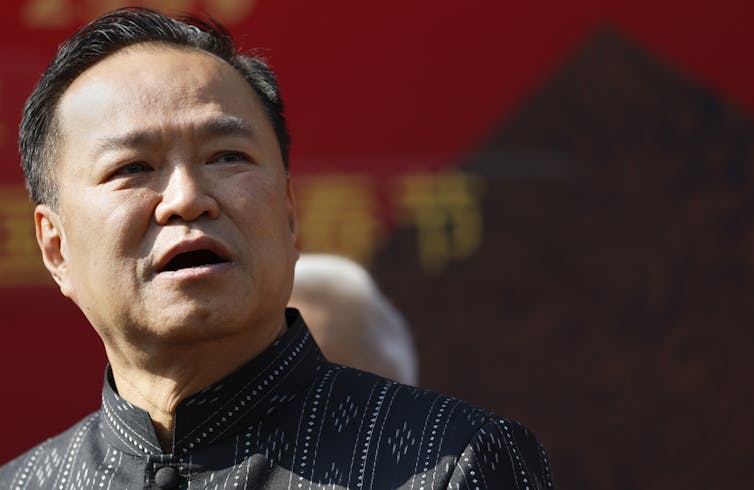
Anutin rose to the premiership last year after the previous prime minister, Paetongtarn Shinawatra, was removed from office for purportedly being too conciliatory towards Cambodia over an ongoing border dispute.
Anutin was elected prime minister in the parliament with the surprise backing of the People’s Party, in exchange for the promise of constitutional reform.
This elevated Anutin’s previously provincial Bhumjaithai Party to be a national-level player. It also allowed him to attract influential defectors from other parties to consolidate his position.
Support for his government dropped in early December due to the mishandling of floods in southern Thailand and alleged connections of his government to transnational scam criminals.
Soon after, Anutin launched preemptive airstrikes against Cambodia over their border dispute. This boosted nationalist sentiment among the public and providing a welcome distraction from domestic pressures.
With the People’s Party looking ready to withdraw support from the ruling coalition, Anutin then dissolved parliament and called early elections.
The airstrikes, drone attacks and ground clashes continued for the next few weeks along the border, ensuring national security would be a key election theme. This worked in favour of the conservatives, but provided challenges for the People’s Party.
Do progressive stand a chance in Thailand?
Many of the People’s Party’s problems are rooted in the struggles of predecessor parties to gain a toehold in Thai politics.
In the last election in 2023, the Move Forward Party won the most seats. But its popular leader was prevented from becoming prime minister by conservative forces in Thai society.
Thailand’s Constitutional Court then dissolved the party. This followed a pattern: its predecessor, the Future Forward party, was dissolved after its strong showing in the 2019 election.
Within 24 hours of the polls closing last week, the National Anti-Corruption Commission unanimously ruled that 44 former lawmakers from the Move Forward party committed gross ethical misconduct by proposing amendments to the Criminal Code’s Section 112. This is the lèse majesté law that carries stiff penalties for insulting or defaming Thailand’s monarchy.
The lawmakers, which include the People’s Party leader, Natthaphong Ruengpanyawut, and 14 other newly elected party MPs, could face lifetime bans from politics.
Did support collapse for the People’s Party?
Although Bhumjaithai handily won the election, capturing nearly 200 seats out of 500 in the lower house, the voting data suggest the People’s Party did not haemorrhage support to Bhumjaithai, as various news headlines made it seem.
Under the military-authored 2017 constitution, Thailand’s lower house elections include 400 individual constituency seats elected by first-past-the-post and 100 party list seats elected by proportional representation.
Bhumjaithai did very well in rural and regional constituency seats, where alleged vote-buying and patronage networks are more prevalent.
Some groups across the country have demanded national recounts following reports of electoral irregularities, in addition to the release of vote counts from polling stations and the re-running of some races.
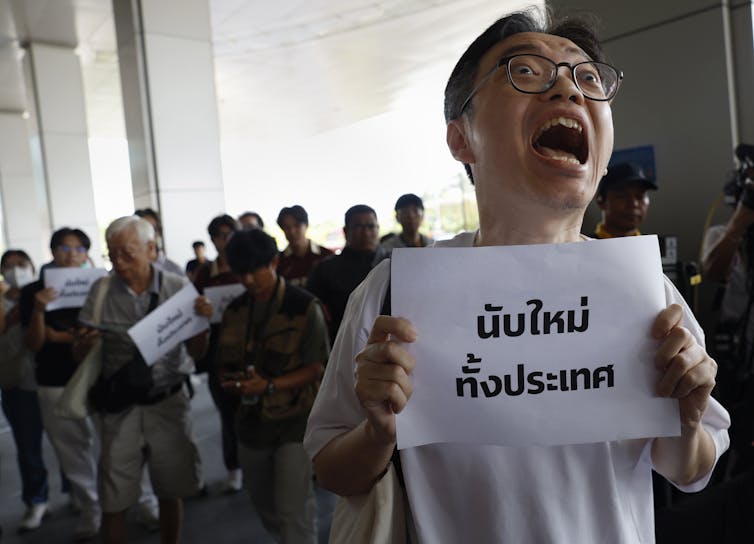
However, the People’s Party leader has acknowledged that even if there were irregularities, they wouldn’t have been substantial enough to change the outcome.
The party’s support in constituency seats was mostly concentrated in cosmopolitan centres with more educated urban voters, such as Bangkok, where it swept all 33 seats. However, it struggled to win seats in rural and regional areas.
In the national party list vote, though, the progressive party emerged clear winners. It earned around 30% of the national vote, compared with only 18% for Bhumjaithai in second place.
This suggests some people split their votes, supporting a Bhumjaithai candidate for their local seat and the People’s Party in the party list. Unfortunately for the People’s Party, the party list MPs only comprise one-fifth of the lower house.
In a small silver lining for progressive forces, a referendum on amending the constitution (held at the same time as the election) passed easily.
But Anutin and the conservatives are now in control of the drafting and approval process, which they could draw out for years. And in their hands, it may not deliver the changes sought by progressives anyway.
Authors: Adam Simpson, Senior Lecturer in International Studies in the School of Society and Culture, Adelaide University


 Daily Bulletin


