

Read The Times Australia

Daily Bulletin

We ate space mushrooms and survived to tell the tale

  • Written by: Sara Webb, Lecturer, Centre for Astrophysics and Supercomputing, Swinburne University of Technology

The mushrooms spread out on the chopping board seemed normal enough. They were rich and dense, and had a strong earthy aroma. In the saucepan, they melted – along with the cheese – to form a creamy pasta sauce.

A quick taste test proved they were delicious. The rich lion’s mane flavour immediately shone through.

This was the first meal we made with these unique mushrooms. They were gourmet, but not from any grocery store you can find on Earth.

These special fungi had travelled to space, lived aboard the International Space Station for more than a month, returned safely to Earth, and eventually came back to Australia in 2025.

We ate space mushrooms and survived to tell the tale
Dr Sara Webb and Dr Rebecca Allen holding the newly grown lion’s mane mushroom. Author provided, CC BY

Mushrooms launch into space

In August 2024, we launched a set of 36 small vials into space aboard a SpaceX Falcon 9 rocket. In these vials were three edible fungi species in the form of mycelium – small file filaments that act like the root network of mushrooms.

The species we tested were lion’s mane (Hericium erinaceus), turkey’s tail (Trametes versicolor) and cordyceps (Cordyceps militaris). These have shown benefits for brain function, gut health, and immune health – all important areas for long term space flight.

This experiment was our sixth payload to the International Space Station (ISS), thanks to the microgravity experimentation program we lead at Swinburne University of Technology.

It was designed and prototyped with the help of 12 high school students from Haileybury College in Melbourne. And it was made possible thanks to professional mushroom growers and suppliers who ensured the fungal strains were not only food grade but healthy enough to survive the extreme environment of space.

Our fungi may have stayed on the ISS with astronauts. But the mushrooms’ experience was very different to the astronauts’. Science experiments have special storage areas depending on what is being done and how much time astronauts have to be involved. Our mycelium was sealed up tight in special packaging to help keep them at a stable temperature and to ensure they weren’t damaged.

They stayed like that for close to a month, before they returned with the change of crew on the ISS.

We didn’t get much in the way of updates while our mushrooms were travelling – just some pictures and videos from NASA of the outside of the safely sealed experiment.

On their return, we waited with bated breath to see if they would survive once opened.
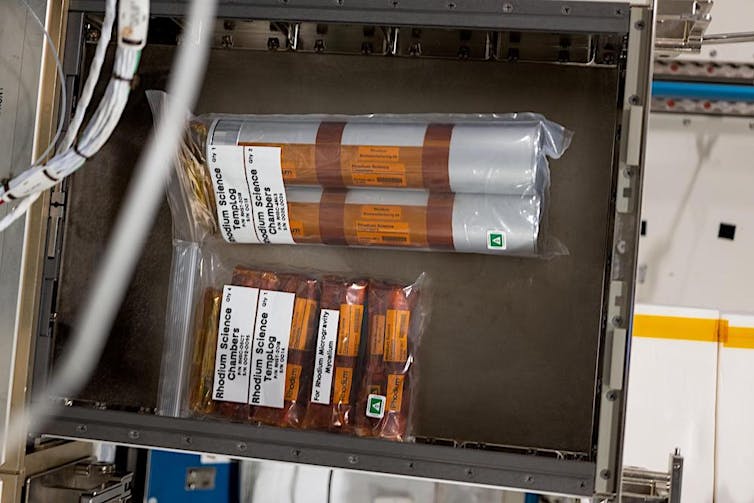
We ate space mushrooms and survived to tell the tale
The mushrooms on board the International Space Station. NASA, CC BY-SA

Mushrooms return to Earth

When our mycelium returned to Earth, and eventually Australia, they got a new home in rich, nutritious substrate. We then moved it into grow kits so we could watch and see whether any fruiting bodies (that is, mushrooms) would appear.

We created several grow boxes and placed them in different environments to see what conditions were best – from kitchen benches, to staff room tables, to laboratory fridges.

To our delight, within a few days we saw signs of the mushrooms emerging and within a week we had beautiful lion’s mane ready to be cooked up and enjoyed. Once they were ready, we harvested them and tried different recipes.

As well as eating these mushrooms, we’re also in the process of analysing them closely. But we can say now that the reduced gravity environment did not negatively impact our mycelium. In fact, they seem to be so happy that they continued to produce several rounds of mushrooms.

Mushrooms for long-term space missions

Artemis II – NASA’s crewed mission to the moon – is right around the corner. But there is still a lot that we need to understand to provide the best conditions for astronauts as they venture further into space than ever before.

For example, how will we continue to nutritionally support astronauts for weeks to months on long duration missions?

We know that a low gravity environment has a profound impact on human bodies, and one of the best ways to support astronauts in orbit is with nutritional foods.

Another outstanding question we need to answer is whether food produced in space environments be affected by radiation and other stresses, rendering it less valuable.

Our work – and these special mushrooms – are helping to provide crucial answers.

Authors: Sara Webb, Lecturer, Centre for Astrophysics and Supercomputing, Swinburne University of Technology

Read more https://theconversation.com/we-ate-space-mushrooms-and-survived-to-tell-the-tale-274112

Business News

Designing Eco-Friendly Custom Water Bottles for Your Next Event

The Evolution of Sustainable Event Merchandise Event planning has undergone a massive transformation over the last decade. Gone are the days when organizers could hand out cheap, single use plastic...

Daily Bulletin - avatar Daily Bulletin

Why Choosing a Professional Florist Melbourne Makes Flower Delivery Impactful

Flowers have a great power to speak when humans cannot express their feelings with right words. Flowers are the best gifts when you are celebrating a birthday or welcoming a newborn child into your fa...

Daily Bulletin - avatar Daily Bulletin

The Business Case for Choosing Australian Fabricators Over Imported Alternatives

For a long time, you might have defaulted to overseas suppliers when sourcing fabricated metal components for a project. The unit price was lower on paper, and the maths seemed straightforward. That...

Daily Bulletin - avatar Daily Bulletin

Australian organisations are relying on business continuity plans built for a far more predictable world

Tariff escalations, supply chain fragility, geopolitical events, and the ongoing threat of cyber disruption have reshaped the risk environment facing Australian organisations. The problem is that ma...

Daily Bulletin - avatar Daily Bulletin

How to Rent a Car for Uber in Melbourne: What Every New Driver Needs to Know

Starting out as an Uber driver in Melbourne is not as complicated as it sounds but getting the vehicle right is where most new drivers get stuck. Uber has strict requirements around vehicle age, condi...

Daily Bulletin - avatar Daily Bulletin

When Should You Speak to a Lawyer About a Legal Issue?

Legal issues can begin with a simple question, then become harder to manage once formal steps are involved. Many people wait until a matter feels urgent before seeking guidance, even though earlier ...

Daily Bulletin - avatar Daily Bulletin

The strategic rise of Bali as Australia’s next essential healthcare support hub

As Australian healthcare providers grapple with unprecedented operational bottlenecks, a new nearshore model is quietly transforming patient care delivery. Forward-thinking organisations,  including...

Daily Bulletin - avatar Daily Bulletin

Cost Savings and Benefits of Using Used Pallets in Logistics

In today’s competitive logistics and supply chain industry, businesses are constantly looking for ways to reduce operational costs without compromising efficiency and reliability. One of the most prac...

Daily Bulletin - avatar Daily Bulletin

How Fulfilment Services in Australia Help Businesses Scale Efficiently

The growth of e-commerce and modern retail has transformed customer expectations. Consumers now expect fast shipping, accurate order processing, and seamless delivery experiences regardless of where...

Daily Bulletin - avatar Daily Bulletin

The Daily Magazine

How to Get a Document Notarised in Sydney: What to Bring, What It Costs and How Long It Takes

If an overseas bank, embassy, university, employer or land registry has asked you for a notarised ...

The 2026 Used-Car Market

For a few strange years, the used-car market rewrote its own rules. Supply shortages sent second-h...

Why CCTV Alone Is Not Enough for Modern Business Security

Cameras are usually the initial step that companies take to strengthen their physical security. If...

Why Every Workplace Should Take Emergency Preparedness Seriously

Emergency planning is one of those things many workplaces know they should think about, but it oft...

Why Clearer Communication Still Matters in a Digital-First Business

It’s never been easier for businesses to communicate, but that doesn’t mean they’re always communica...

What Happens After You Lodge a BYDA Enquiry? The Step Most Excavation Projects Miss

Every excavation project in Australia — from a backyard deck footing to a multi-storey commercial bu...

How to Choose the Right Dentist on the Gold Coast

Finding a dentist you trust is one of those decisions that quietly affects your health for years, ye...

The Hidden Engineering Problem Inside Australia's Older Housing Stock

A significant share of Australian homes were built for a way of living that no longer exists. Houses...

DIY Rodent Control Vs Professional Help: When Is It Time To Call The Experts?

Rodents are one of the most frustrating pest problems for Australian property owners. Rats and mic...