

Read The Times Australia

Daily Bulletin

K'gari’s unique ancient lakes once dried out. Could this happen again?

  • Written by: John Tibby, Associate Professor in Environmental Change, University of Adelaide

The lakes on the world’s biggest sand island, K'gari, are famous. Pivotal to the World Heritage listing of the Queensland island formerly known as Fraser Island, their turquoise waters feature in international tourism campaigns and social media posts.

K'gari has more than 40 unique lakes, some more than 55,000 years old. They range from the photogenic clear waters of Boorangoora (Lake McKenzie), pictured above, which filters through the sand dune it rests in, to the emerald-green waters of Lake Wabby, a window lake which is (very) slowly being swallowed by a giant sand dune.

In fact, K'gari is home to more than half of the world’s perched lakes, more than 50, including Boorangoora. Perched lakes form when sand is cemented together with decomposed organic matter (such as leaves and bark), aluminium and iron. This creates an impermeable layer well above sea level. It’s remarkable these lakes exist, given water usually passes quickly through sand.

Until now, it was believed K'gari’s lakes would have contained water since the last ice age ended, about 11,500 years ago. But our new research found some of the island’s deepest lakes dried out only 7,500 years ago. In the current era of climate change, it’s possible this could happen again.
K'gari’s unique ancient lakes once dried out. Could this happen again?
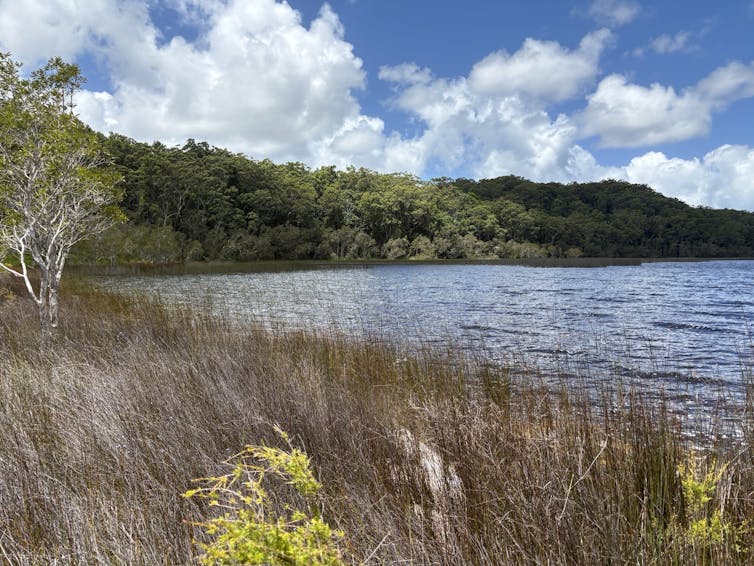
Lake Garawongera is a tannin-stained perched lake, which is isolated from deeper, larger groundwater sources. John Tibby, CC BY-ND

The eyes of K'gari

For the island’s Traditional Owners, the Butchulla people, these lakes are the “eyes of K'gari” and their waters are sacred. The Butchulla believe they have been entrusted with an eternal responsibility: to preserve K'gari’s beauty, spirit, waterways and lakes so future generations may experience the same connection.

K'gari is home to two key types of lakes. Perched lakes (described above) are the best-known type, while window lakes, filled by rain and groundwater, are so named because they offer a “window” to groundwater below the land.

The climate history of these lakes is recorded in their muddy sediment. What happens in and around the lake gets “written” into the layers: plant pollen tells us about local vegetation while greater amounts of sand might indicate erosion.
K'gari’s unique ancient lakes once dried out. Could this happen again?
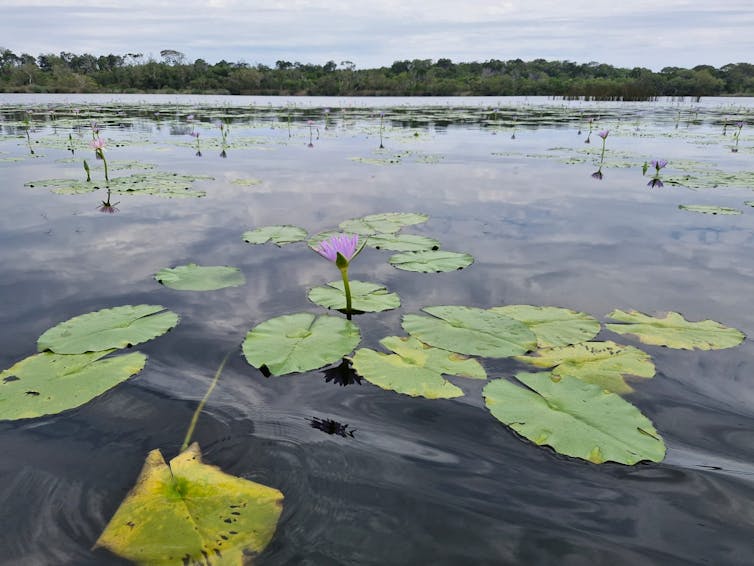
Ocean Lake. In the foreground is a day waterlily, an invasive species on K’gari. Dave Sternberg, CC BY-ND

A gap in the record

In our research we found this sediment was missing from some of K’gari’s oldest lakes between 7,500 and 5,500 years ago. This gap in the record was identified by radiocarbon dating of sediments from K'gari’s Lake Boorangoora, Lake Allom and Basin Lake.

This gap in sediment suggests the lake basins were not then covered by water. This can happen when there is not enough rainfall over decades. Many Australian lakes dried up during more than the decade-long Millennium Drought.

Our findings were unexpected. We would not have expected the lakes to dry up, as the sediment gap happened during the current Holocene geological epoch, during which global temperatures have varied by less than one degree and moisture has been abundant.

Recent sediment research from another major sand island, Minjerribah (or North Stradbroke Island), shows this island was wetter than K'gari during the same period. Why, at a time of relatively mild climate variation, was it generally wetter just 250 kilometres south? We think southeasterly trade winds supplied rainfall to Minjerribah but not K’gari.

K'gari’s unique ancient lakes once dried out. Could this happen again?
Researchers at Lake Garawongera. From left to right are Conway Burns, Caitlin Jones, Margaux Dupuy, Harald Hofmann and Bob Broome. John Tibby, CC BY-ND

Future of a special place

Our findings highlight the pressing need to know much more about K’gari’s beautiful lakes. In a warming climate expected to become drier but punctuated with more intense rainfall, are these lakes at risk of evaporating? At the moment, we simply don’t know.

For most lakes on K'gari, there’s no information about how much water they hold or even how deep they are. The little information available from a few simple surveys hints that lakes were generally deeper in the 1970s.

In response, we have started surveying the underwater depth and topography of the lakes, using automated monitoring devices to measure how much they fill and drop. Gathering data to understand the water inputs and outputs of today’s lakes will help us better interpret the past – and possibly model the future.

While we are concerned about the future of these lakes, K'gari hosts the greatest diversity of fish and amphibians of any Australian island, hinting at a resilience to climate-driven changes.

In our scientific work, we also try to follow Butchulla teachings. These are: what is good for Country comes first; do not touch or take anything that does not belong to you; and if you have plenty, you must share.

“Gung K’gari Marigurim Yaa”: K’gari’s water makes voice strong.

K'gari’s unique ancient lakes once dried out. Could this happen again?
Lake Allom, on K'gari. John Tibby, CC BY-ND

Authors: John Tibby, Associate Professor in Environmental Change, University of Adelaide

Read more https://theconversation.com/kgaris-unique-ancient-lakes-once-dried-out-could-this-happen-again-270371

Business News

The Rise of Digital Marketplaces in the Australian Trade Sector

For decades, the Australian trade and construction sector operated almost entirely on word-of-mouth recommendations and local community networks. Small business owners typically relied on local newspa...

Daily Bulletin - avatar Daily Bulletin

How Immigration Lawyers Can Help

Introduction Visa decisions can shape employment, family life, study plans, travel, and future residence. A small omission can lead to delay, added expense, or refusal. Immigration lawyers assess l...

Daily Bulletin - avatar Daily Bulletin

How Industrial Drying Equipment Supports Efficient Processing

Many industrial processes require moisture to be removed from compressed air, products or process materials before they move to the next stage. Excess moisture can affect equipment performance, produc...

Daily Bulletin - avatar Daily Bulletin

Practical Ways a Whiteboard Can Improve Workplace Communication

Effective communication helps teams stay organised, share ideas and keep track of important information. While digital tools are now common in many workplaces, a whiteboard continues to provide a simp...

Daily Bulletin - avatar Daily Bulletin

Designing Eco-Friendly Custom Water Bottles for Your Next Event

The Evolution of Sustainable Event Merchandise Event planning has undergone a massive transformation over the last decade. Gone are the days when organizers could hand out cheap, single use plastic...

Daily Bulletin - avatar Daily Bulletin

Why Choosing a Professional Florist Melbourne Makes Flower Delivery Impactful

Flowers have a great power to speak when humans cannot express their feelings with right words. Flowers are the best gifts when you are celebrating a birthday or welcoming a newborn child into your fa...

Daily Bulletin - avatar Daily Bulletin

The Business Case for Choosing Australian Fabricators Over Imported Alternatives

For a long time, you might have defaulted to overseas suppliers when sourcing fabricated metal components for a project. The unit price was lower on paper, and the maths seemed straightforward. That...

Daily Bulletin - avatar Daily Bulletin

Australian organisations are relying on business continuity plans built for a far more predictable world

Tariff escalations, supply chain fragility, geopolitical events, and the ongoing threat of cyber disruption have reshaped the risk environment facing Australian organisations. The problem is that ma...

Daily Bulletin - avatar Daily Bulletin

How to Rent a Car for Uber in Melbourne: What Every New Driver Needs to Know

Starting out as an Uber driver in Melbourne is not as complicated as it sounds but getting the vehicle right is where most new drivers get stuck. Uber has strict requirements around vehicle age, condi...

Daily Bulletin - avatar Daily Bulletin

The Daily Magazine

South African Consular Services Expand to Six Australian Cities

South Africans living in Adelaide, Brisbane and Canberra will now be able to access passport, identi...

How Long Does a Solar Home Battery Last? LFP Cycles and Warranty Explained

A battery does not usually reach its advertised cycle count and suddenly stop working. Capacity ch...

How to Hire a Nanny: A Complete Guide for Families

Finding the right childcare professional can make everyday family life easier and give parents gre...

The Blue-Collar Shortage Employers Can't Solve With More Applicants

Australia's hiring market has cooled considerably since the post-pandemic frenzy of 2021 and 2022. F...

The Playground as Classroom: How Line Markings Are Reinforcing What Students Learn Inside

For a long time, the playground was treated as a break from learning rather than part of it. A place...

How Technology Is Changing the Way Gardens Are Maintained

Garden maintenance has always been a hands on ritual. Mowing on a schedule, watering by instinct, an...

One Blocked Drain Can Become a Whole House Plumbing Problem: How It Happens

A blocked hand basin feels local. So does a slow shower. Homeowners naturally focus on the fixture...

AI in Marketing: From Experiment to Everyday Tool

For the past couple of years, artificial intelligence in marketing has mostly lived in the "let's se...

What Businesses Can Do to Make Sustainability More Practical Day to Day

Sustainability can sound like a huge corporate project, something tied to annual reports, long-term ...