

Vaping has slowed progress in cutting teen smoking in NZ – new study
- Written by: Andrew Waa, Associate Professor in Public Health, University of Otago
Smoking rates among adults have declined in Aotearoa New Zealand over recent decades, from 18% smoking regularly in 2011/12 to 8% in 2023/24.
However, marked inequities persist for Māori and Pacific peoples. Consequently, these populations experience much higher rates of tobacco-related illnesses and early death compared to other ethnic groups.
Because tobacco addiction often begins in teenage years, an important way to reduce health inequities due to smoking is to lower adolescent smoking rates.
A previous study had suggested vaping might be displacing smoking among young people in Aotearoa – and in doing so, speed up the decline in youth smoking rates.
However, our recent research challenged this claim. Rather than speeding up the decline in smoking, our work showed that progress in reducing adolescent smoking rates slowed after the emergence of vaping in Aotearoa in 2010.
What our previous research did not examine, however, was whether progress in lowering adolescent smoking was the same across ethnic groups (Māori, Pacific, European and Asian).
This matters because just as vaping and smoking rates differ across these groups, vaping might also influence smoking habits differently across communities.
For instance, it might be that adolescent vaping is displacing smoking in some groups, thus accelerating declines in smoking rates. In other groups, it might be acting as a “gateway” to smoking, thereby slowing progress in reducing smoking rates.
Our new study published in Lancet Regional Health-Western Pacific is the first to examine this issue.
Is vaping linked with smoking among youth?
For each ethnic group – Māori, Pacific, European and Asian – we looked for changes in the rates of decline in smoking among school students aged 14 to 15 following the emergence of vaping in Aotearoa in 2010.
Specifically, we compared smoking trends from 2003 to 2009 (before e-cigarettes were widely available) with those from 2010 to 2024 (when vaping became increasingly common).
Before e-cigarettes emerged in 2010, smoking rates in this age group were rapidly declining across all four ethnic groups.
If the advent and rise of vaping led more adolescents to start smoking (the “gateway” effect), we might reasonably expect the pre-2010 decline in smoking to slow in that group from 2010 onwards. That is, smoking rates might continue to fall, but not as quickly as before vaping became available.
Alternatively, if vaping was displacing smoking, we might reasonably expect the pre-2010 smoking trend to decline even faster from 2010 onwards in that group.
We analysed data from nearly 600,000 school students aged 14 to 15, with 20% identifying as Māori, 9% as Pacific, 58% as European and 13% as Asian.
By 2024, nearly one in three Māori in this age group (29%) were vaping regularly (monthly or more often), compared with 19% of Pacific, 11% of European and 4% of Asian students.
From 2003 to 2024, the rates of 14-15-year-olds smoking regularly declined substantially in all four groups. However, the decline in smoking regularly significantly slowed from 2010 – the year vaping emerged in Aotearoa – for Māori, Pacific and European adolescents. It did not slow significantly for Asian adolescents.
In 2024, regular smoking among 14-15-year-olds was approximately 6.2% for Māori, 3.3% for Pacific and 2% for European adolescents. However, if each group’s pre-2010 trend had continued, the estimated 2024 prevalences would have been 4.2% for Māori, 1.8% for Pacific, and 0.7% for European adolescents.
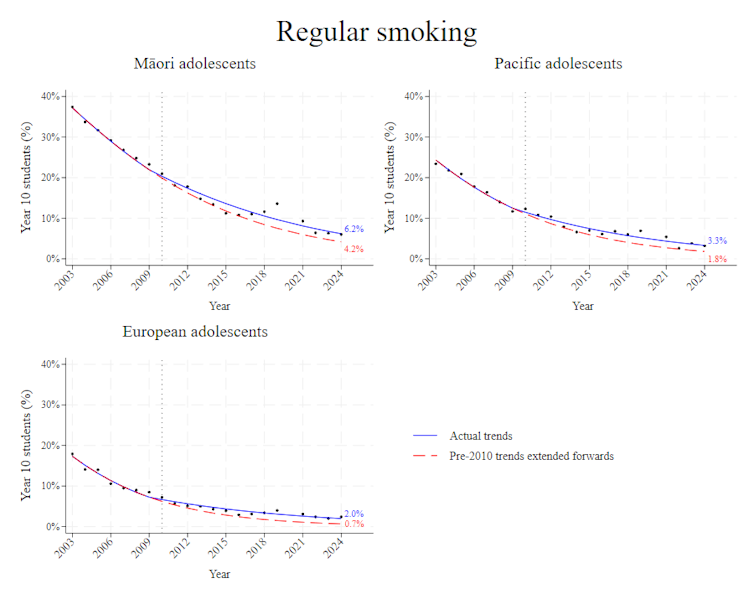
This means that for every 1,000 students in each group, there were 20 more Māori, 15 more Pacific and 13 more European students smoking regularly in 2024 than there would have been if smoking trends had continued along their pre-vaping era trajectories.
We also checked other possible explanations for the slowing of progress in reducing adolescent smoking.
First, we explored whether 2010 was the right “change year” to mark the emergence of vaping, given it was still uncommon then. Second, we looked at whether changes in cigarette affordability could explain the slowing.
However, testing alternative change years from 2008 to 2018 and controlling for affordability made little difference to our findings.
What this means for teens
We found no evidence that vaping is displacing smoking among Māori, Pacific, European or Asian adolescents. On the contrary, we found progress in reducing regular smoking among Māori, Pacific and European adolescents slowed significantly after the emergence of vaping in Aotearoa (with no change for Asian students).
The implications of our findings are more serious for Māori and Pacific youth, who have higher rates of smoking and vaping than their peers. Rather than supporting claims that vaping reduces harms for these young people, it has substantially added to them.
It is a major additional source of nicotine dependence, carries its own health risks and has coincided with more adolescents smoking than if pre-vaping smoking trends had continued.
For Māori communities, nicotine dependence – whether from vapes or tobacco – undermines agency at an individual level and self-determination (tino rangatiratanga) at a collective level. It is a persistent reminder of ongoing colonial impacts, from the introduction of nicotine addiction to its continued entrenchment within society.
Addressing these harms requires the government to uphold its constitutional and World Health Organization tobacco control obligations to engage with and prioritise Māori and Pacific perspectives, and to support approaches grounded in equity, social justice and Indigenous rights.
Authors: Andrew Waa, Associate Professor in Public Health, University of Otago


 Daily Bulletin


