

Cabbage tree palm: a sweet-leafed Australian native that waits 150 years to bloom
- Written by: Gregory Moore, Senior Research Associate, School of Agriculture, Food and Ecosystem Sciences, The University of Melbourne
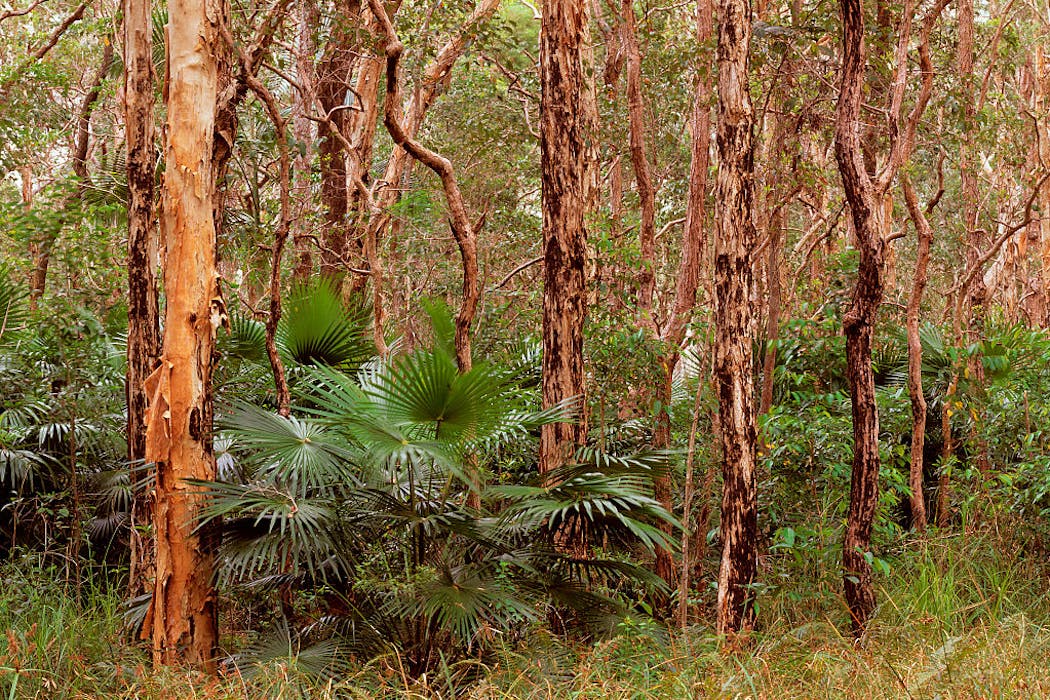
When you think of palms, you might be mentally transported to tropical islands and beaches. But palms are a diverse and interesting group of plants of roughly 180 genera and more than 2,000 species. Most, but not all, grow in the tropics.
Australia has at least 50 native palm species, and one of my favourites is the cabbage tree palm, Livistona australis.
This slender palm can reach 25m or more in height with a stem diameter of 25–35cm. It has an extensive range down the Australian east coast from southern Queensland reaching almost to Orbost in Victoria. It is Victoria’s only native palm.
Strength and beauty
The stem of the cabbage tree palm has a very intricate patterning formed by the old leaf bases, which give the stem its strength.
If the stem is damaged, the cabbage tree palm cannot grow over or heal the damage. So, take care not to harm its stem (or, for that matter, the stem of other palms).
The cabbage tree palm has fan-shaped leaves about 10–30cm long. These occur at the end of leaf stalks (called petioles) that can be 1.5–2m long. Its small (3mm) white flowers are borne on what’s called a panicle (a branching spike), which can be up to 1.5m long.
The fruits are red but turn black when ripe. It’s at this stage they are ready to plant, if you wish to propagate.
Young palms may have little prickles or a rough texture at the base of the leaves. This is a protective mechanism common to many palms – but the long spines on some can really hurt if you’re not careful.
Cabbage tree palms are moderately frost-sensitive, but once they get up to a few metres in height they are quite tough. They’re resilient, drought-tolerant and cope well with full sun.
The older leaves dry out and hang down from the crown and may stay like this for some years. If many accumulate, they can eventually fall. This can be dangerous, so many gardeners have them regularly pruned.
However, in natural sites they are important nesting and feeding sites for birds and small native mammals such as bandicoots. In urban gardens, they may house possums and rodents.
The dead leaves can burn fiercely in a bushfire, but as long as the crown of the stem is not too badly burnt, cabbage tree palms are moderately fire-resistant. New leaves are produced quite quickly as part of the general fire recovery, as seen around Mallacoota and in New South Wales after the 2019–20 fires.
A useful plant
Like other palm species, cabbage tree palms have a long history of human use.
Indigenous people used leaves for basket-weaving, fibres for twines, ropes and fishing lines and medicine.
Young leaves were reported to be quite sweet and were boiled and eaten: hence the name cabbage tree palm.
The fruits are edible, but have to be cooked as they are quite tough. Parts of the stem can also be eaten as the “heart of the palm”. The heart of the palm can also be found in other palm species, such as the coconut palm (Cocus nucifera) or palmetto (Sabal species); the most common heart of the palm species, however, is the cultivated peach palm (Bactris gasipeas).
The crown is the softest part, but consuming it kills the palm.
Like most tall growing palms, the stems are very fibrous, which can make them difficult to cut with a chainsaw; the chain tends to clog.
This fibrous structure makes the stems quite flexible in strong winds, when the palms bend with the wind rather than breaking.

The fibre from cabbage tree palms was used by early European settlers to make a protective sun hat called a cabbage tree hat.
Like many palms, the root systems of cabbage tree palms are shallow, fibrous and very dense, meaning the plants can be readily dug up and transplanted (provided you take a sufficiently large root mass).
This puts natural palm populations at risk if they are dug up and sold without proper regulation.
If you wish to remove a palm, it’s best to dig below the stem and cut the larger fibrous roots. There may be ten or more roots – often 20mm or less in diameter – that can be easily cut, but even one or two can securely anchor the palm.
Patience is a virtue
Like many plants that have an arborescent (meaning tree-like) growth form, Livistona australis takes its time.
Details are sparse, but there are estimates of palms being nearly 400 years old.
Trees operate over much longer time scales than humans do and so when growing cabbage tree palms, you might need to be patient.
The cabbage tree palm can take between 20 and 60 years to develop a proper stem.
If you are keen to see your cabbage tree palm flower, don’t hold your breath. It may take, according to some estimates, 150-170 years before a first flowering. If you can wait that long, it usually happens between August and October.
Authors: Gregory Moore, Senior Research Associate, School of Agriculture, Food and Ecosystem Sciences, The University of Melbourne


 Daily Bulletin


