

Fish ‘fingerprints’ in the ocean reveal which species are moving homes due to climate change
- Written by: Chloe Hayes, Postdoctoral Researcher in Marine Ecology, University of Adelaide
Species across the planet are on the move. Climate change has already caused more than 12,000 species to shift their homes across land, freshwater and the sea. They move to escape unfavourable conditions or to explore ecosystems that were previously inaccessible.
In the ocean, some tropical fish are “packing their bags” and moving into temperate reefs to seek cooler waters. These migrations are already happening along the east coast of Australia, which is considered one of the fastest-warming marine regions on Earth. New coral and fish species are regularly arriving in Sydney’s oceans, and this is expected to increase with future climate change.
These newcomers are traditionally monitored through visual surveys by researchers or citizen scientists. But many of these early arrivals are small, rare, nocturnal or live in caves, which means they can be easily missed. As a result, we may be underestimating the true rate of species on the move.
That is where our new research, published in Diversity and Distributions, comes in. We took off our marine ecologist hats and became forensic scientists, searching the water for clues about species on the move. By analysing fragments of DNA drifting in the ocean, we set out to discover the hidden shifts in fish communities that traditional visual surveys can overlook.
Genetic fingerprints floating in the ocean
Every organism leaves behind traces of itself in the environment. Fish shed mucus, scales and waste – all of which contain DNA. By collecting and filtering samples of seawater, we can extract this environmental DNA – or eDNA, as it’s more commonly known – and identify the species that are there.
The technique works much like forensic science. Just as detectives solve crimes by analysing fingerprints or hair left at a scene, ecologists can build a picture of marine life from the genetic fingerprints floating invisibly in the ocean.

The idea of eDNA began in the 1980s when scientists discovered they could collect DNA directly from soil or water samples. At first it was used to study microbes. But by the early 2000s researchers realised it could also reveal larger animals and plants.
Today, eDNA is being used everywhere – from soil to rivers and oceans – to discover hidden or threatened species, track biodiversity, and even study ancient ecosystems preserved in sediments.
Surveying 2,000km of coastline
To test how well eDNA can reveal species on the move, we surveyed fish communities along 2,000 kilometres of Australia’s east coast. Our sites ranged from the tropical reefs of the Great Barrier Reef, through to subtropical waters, and down to the temperate kelp forests of New South Wales.
At each site, we conducted traditional visual surveys, swimming along defined rectangular areas known as transect belts and recording every fish we saw. These surveys remain the standard for monitoring marine biodiversity and have built decades of valuable data.

Alongside these surveys, we collected bottles of seawater for DNA analysis. A few litres of water might not look like much, but it holds invisible genetic fingerprints of hundreds of species.
Back in the lab, we filtered the samples to capture the DNA, then sequenced them to reveal a snapshot of which species were in the area.
Detecting tropical species in temperate ecosystems
When we compared traditional visual surveys with eDNA water samples, the results were interesting. Each method revealed a somewhat different fish community, but together they gave us a far more complete picture than either method could on its own.
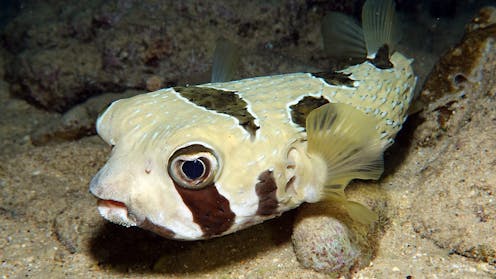
The eDNA detected tropical species in temperate ecosystems that had never been recorded there before. These included herbivores such as the lined surgeonfish (Acanthurus lineatus), the striated surgeonfish (Ctenochaetus striatus), and the common parrotfish (Scarus psittacus), and cryptic species such as the black-blotched porcupinefish (Diodon liturosus), the silver sweeper (Pempheris schwenkii), and the speckled squirrelfish (Sargocentron punctatissimum) that hide in caves or only emerge at night.
These are exactly the kinds of fish divers are most likely to miss.
 The speckled squirrelfish (Sargocentron punctatissimum) is a cryptic tropical species that had never been recorded in temperate ecosystems before.
kueda/iNaturalist, CC BY-NC-SA
The speckled squirrelfish (Sargocentron punctatissimum) is a cryptic tropical species that had never been recorded in temperate ecosystems before.
kueda/iNaturalist, CC BY-NC-SA
For temperate species, this pattern flipped. Divers were often better at detecting them than eDNA was. This showed us eDNA is not a replacement for traditional visual surveys, but a powerful complement. By combining the two, we can better track species on the move, giving us the clearest view yet of how climate change is reshaping our reefs.
These migrations are not unique to Australia. Around the world, species are shifting their ranges as climate change alters temperatures, ocean currents and habitats. While some species may thrive in their new homes, others may struggle to adapt, or be pushed out.
Tracking these shifts is crucial for understanding how climate change is transforming our oceans, and it means we need better ways to detect which species are on the move.
Authors: Chloe Hayes, Postdoctoral Researcher in Marine Ecology, University of Adelaide


 Daily Bulletin


