

Read The Times Australia

Daily Bulletin

Close relatives of emperor penguins lived in NZ some 3 million years ago. What caused their extinction?

  • Written by: Daniel Thomas, Honorary Lecturer in Biological Sciences, University of Auckland, Waipapa Taumata Rau
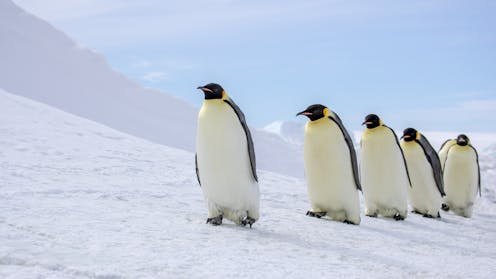
Close relatives of emperor penguins lived in NZ some 3 million years ago. What caused their extinction?

Three million years ago, an extinct relative of todays’s great penguins – emperors and kings – lived in Aotearoa New Zealand.

We know this because our new study describes a spectacular fossilised skull of a great penguin found on the Taranaki coast.

Three images of skulls. Top: Fossil great penguin (Aptenodytes). Middle: King penguin. Bottom: Emperor penguin.
The fossil skull (top) of the extinct great penguin in its estimated original shape, in comparison with skulls from a king penguin (middle) and an emperor penguin (bottom). CC BY-NC-ND

Overall, it is 31% longer than the skull of an emperor penguin (Aptenodytes forsteri), which can be more than a metre tall and weigh upwards of 35 kilograms.

Compared to emperor penguins, however, the Taranaki great penguin had a much stronger and longer beak. It probably looked more like a king penguin (Aptenodytes patagonicus), only much bigger.

At the time, the world was warmer than today. But when the climate cooled, this penguin vanished.

We argue the cold wasn’t to blame because crested and little penguins in New Zealand weathered the same change and remained. Great penguins shifted south and today live in the frozen wastes of Antarctica. So what drove their ancient relative to extinction?

An artistic reconstruction of a fossil penguin
Artist’s impression of the extinct great penguin that lived in New Zealand around three million years ago. Simone Giovanardi, CC BY-SA

The sediments that now form beach-side cliffs in South Taranaki were deposited at a time when global temperatures were about 3°C above those of the pre-industrial era. Fossils from this period are transforming our understanding of how biodiversity might respond to rising temperatures.

For example, Aotearoa was home to box fish and monk seals, both of which are still (sub)tropical species today. In a strange contradiction, they coexisted with great penguins – now only found in much colder climates – in ancient New Zealand.

The northernmost breeding colonies of king penguins today are around latitude 46.1°S in the subantarctic Crozet Islands, where seawater temperatures reach 3-10°C. From there, it only gets colder towards the higher latitudes where emperor penguins live.

Two maps of the southern hemisphere at different times in Earth history. At left, where great penguins live today; at right, where a fossil Aptenodytes penguin was discovered. Sea surface temperature is represented in different colours.
Today, great penguins are limited to subantarctic islands and the coast of Antarctica (map on the left). But ancient New Zealand was home to an extinct species of great penguin around three million years ago, during a period in Earth’s history known as the mid-Piacenzian Warming Period. CC BY-SA

Three million years ago, Aotearoa’s great penguins extended as far north as 40.5°S, where South Taranaki was located then. They foraged in waters that were 20°C, much warmer than their relatives experience today.

This balmy existence ended with the Pleistocene ice ages around 2.58 million years ago. Ice extent and sea level shifted back and forward as temperatures fluctuated and ultimately ratcheted downwards. But why would such cooling eradicate giant penguins, which thrive under polar conditions today, from New Zealand?

Fossil evidence for giant penguins in Aotearoa is limited and the exact reasons for their demise remain unclear. Even so, their sheer presence suggests they were less constrained by sea surface temperatures than previously thought. Another mechanism must be at play.

Up until about 500 years ago, Aotearoa was the hunting ground of the giant Haast’s eagle and the huge Forbes’ harrier. These were big raptors. They included large birds like moa in their diet. Their ancestors arrived from Australia inside the last three million years.

Based on what we see with living great penguins, the Taranaki great penguin almost certainly formed large exposed colonies along the coast. These could have been easy targets for a giant eagle or harrier hunting from the air.

By contrast, the smaller penguins still found in Aotearoa today have more cryptic breeding behaviour. They nest in burrows, natural crevices and dense vegetation, and tend to cross beaches at night, which may have helped them avoid aerial predators.

Predation on land is just one hypothesis, though, to help explain why these penguins became extinct in the region while others survived. Other possibilities include changes in the marine environment.

We know that reduced food availability can be devastating for penguins, but it is challenging to see why this would single out the great penguins.

Importantly, our study provides new insight into the habitat tolerances of great penguins. Both king and emperor penguins today can withstand temperatures up to 20°C higher than those they usually forage in.

Three million years ago, their relative experienced such warmth. As the world continues to warm, we need to remember that the geographic range of a species can change as circumstances change.

The marine ecosystem of Aotearoa will move into the habitable zone of many new species, making investigations of the last warm period more important than ever before.

We would like to acknowledge our research co-author Dan Ksepka from The Bruce Museum, Kerr Sharpe-Young for discovering the fossil, and Ngāti Ruanui and Ngāruahine for supporting the collection and research of fossils from their rohe.

Authors: Daniel Thomas, Honorary Lecturer in Biological Sciences, University of Auckland, Waipapa Taumata Rau

Read more https://theconversation.com/close-relatives-of-emperor-penguins-lived-in-nz-some-3-million-years-ago-what-caused-their-extinction-265585

Business News

How Telematics Helps Australian Companies Improve Productivity

Operating a commercial fleet in Australia is a uniquely demanding endeavour. Between the sprawling urban sprawl of cities like Sydney and Melbourne and the immense, unforgiving stretches of the Outb...

Daily Bulletin - avatar Daily Bulletin

Inside the Icon: The BridgeMuseum Officially Opens at the Sydney Harbour Bridge

A bold new way to experience one of Australia’s most recognisable landmarks has arrived, with BridgeClimb Sydney officially opening the all-new BridgeMuseum.  Located inside the Sydney Harbour Bridge...

Daily Bulletin - avatar Daily Bulletin

Is Your Brand Showing Up in AI Search? Most Melbourne Brands Aren't.

The New Front Door Nobody Told You About Something changed. Quietly. Without a press release. The way buyers find businesses in Australia has been rewired. Not replaced, rewired. Google isn't dead...

Daily Bulletin - avatar Daily Bulletin

How Australian Businesses Can Measure SEO ROI

SEO can feel vague when you are staring at a dashboard full of numbers that do not clearly connect to revenue. The key is to measure the right signals in the right order, then tie them back to outcome...

Daily Bulletin - avatar Daily Bulletin

How Commercial Roller Shutters Improve Site Security Without Slowing Operations

Security upgrades can be frustrating when they make everyday work harder. A door that takes too long to open, creates bottlenecks at shift change, or fails at the worst time can turn “better protectio...

Daily Bulletin - avatar Daily Bulletin

Why a Document Destruction Service Still Matters for Modern Businesses

Businesses generate large volumes of information every day, from staff records and contracts to invoices, reports and customer files. While attention often focuses on how documents are stored, the way...

Daily Bulletin - avatar Daily Bulletin

Bicycle Rack Safety and Space-Smart Storage

Bike storage problems usually show up as small annoyances first: tangled handlebars, scratched frames, and bikes that topple when you pull one out. Over time, those issues become safety risks, especia...

Daily Bulletin - avatar Daily Bulletin

How to Tell if a Childcare Centre Is a Good Fit for Your Child

Choosing childcare can feel like you’re making a huge decision with limited information. Tours are short, centres are often on their best behaviour, and your child might act differently in a new space...

Daily Bulletin - avatar Daily Bulletin

Car Import Timeline: What Usually Happens at Each Stage

Importing a car into Australia can feel confusing because multiple agencies and checkpoints are involved, and the timeline is shaped as much by paperwork quality as it is by shipping speed. The most u...

Daily Bulletin - avatar Daily Bulletin

The Daily Magazine

Gold Migration Lawyers in Liquidation: How the Closure Affects Your ART Appeal

If your appeal was with Gold Migration Lawyers, a recent change to how the Tribunal decides cases ...

The pressure cooker: life in urban Australia in 2026

Australian cities have always been demanding. Long commutes, rising housing costs, busy schedules a...

What Actually Makes a Good Criminal Lawyer in Melbourne

Most people only think about this question once. That is usually too late. Most people charged wi...

Why Working With A Chatswood Tutor Can Improve Academic Performance

Academic expectations continue increasing for students across primary school, high school, and senio...

Is It Worth Getting Solar Panels in Melbourne?

The real question is not whether solar works in Melbourne. It works. The question is what it is co...

How A Diploma Of Project Management Builds Practical Skills For Modern Work Environments

Developing the ability to plan, execute, and deliver outcomes efficiently is a key requirement in to...

How to Choose the Right Football for Every Level

Choosing a football may seem straightforward, but the right option depends on who will be using it a...

What to Ask a Wedding Photographer Before You Book

Booking a wedding photographer can feel deceptively simple: you like the photos, you like the vibe...

Why Stress Relief For Dogs Is Essential For Emotional Balance And Long-Term Wellbeing

Managing emotional health is just as important as physical care when it comes to pets, which is why ...