

How migrant stories and contributions have shaped Australian TV since the 1950s
- Written by: Kate Darian-Smith, Professorial Fellow in History, School of Historical and Philosophical Studies, The University of Melbourne
The introduction of television in Australia in 1956 coincided with mass post-war immigration, initially from Britain and Europe, and later from Asia, the Americas and Africa. Both played a significant role in forming modern society.
Our new book, Migrants, Television and Australian Stories, explores this intertwined history across seven decades, through dozens of interviews with screen creatives, technical staff and migrant viewers.
We provide fresh insight into the ways television introduced migrant audiences to the “Australian way of life”, as well as how the screen industry responded to a need for cultural diversity and inclusion.

Migrants were active audiences
Migrants arriving in Australia after the second world war were keen television viewers, despite the relatively high cost of owning a set.
Vietnamese refugee Cuc Lam told us she purchased a bulky secondhand television from a charity shop soon after arriving in Melbourne in 1978. She watched shows such as Play School (1966–) with her young children, picking up English phrases in the process.
The arrival of SBS television in 1980 (a service dedicated to migrant communities) is often heralded as a landmark initiative in Australian multiculturalism.
However, several earlier music and variety program aimed to showcase migrant groups and “exotic” international entertainers. Some examples included ABC’s Café Continental (1958–61) and Latin Holiday (1961).

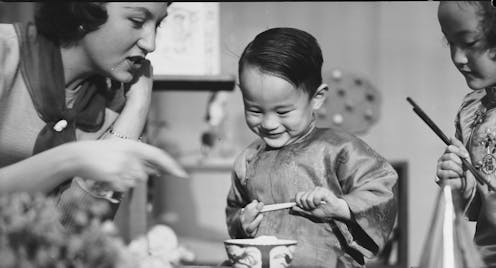
One 1957 episode of the childrens’ show Romper Room (1953–94) featured insights into Chinese culture (pictured in the header image). This was unfamiliar viewing for most Australians at the time.
From the late 1960s, canny entrepreneurs with links to international diasporas produced shows such as the long-running Variety Italian Style (1972–87).
This commercial program featured music, cooking, travel, sport and documentary segments. It was sold to stations in North America and Europe, where it was broadcast to other Italian migrant populations.
 A production meeting takes place on the set of Variety Italian Style, circa 1978. From left: compère John Mahon, director John Adey, compère Anne Luciano and producer Antonio Luciano.
Panorama International Productions Pty Ltd
A production meeting takes place on the set of Variety Italian Style, circa 1978. From left: compère John Mahon, director John Adey, compère Anne Luciano and producer Antonio Luciano.
Panorama International Productions Pty Ltd
Another such show was the Greek Variety Show (1977–84) produced by Greek Cypriot actor Harry Michaels, who also made the internationally successful Aerobics Oz Style (1982–2005). Michaels told us:
I was selling Greece to Australians, and then I ended up selling Australia to the world.
 Harry Michaels’ promotional card for Greek Affair (circa 1978), later called the Greek Variety Show.
Harry Michaels
Harry Michaels’ promotional card for Greek Affair (circa 1978), later called the Greek Variety Show.
Harry Michaels
Representation on- and off-screen
Historically, many Australian-made dramas, comedies and other programs have reduced immigrants and other cultures to crude stereotypes.
In the gritty crime dramas Homicide (1964–77) and Division 4 (1969–75), migrant characters were often portrayed as criminals or victims of crime.
This trend started to change in the 1980s and 1990s. Children of migrants began making their own successful shows that asserted their cultural identities. For example, Acropolis Now (1989–92) centred on the multicultural staff working at a Greek cafe in Melbourne.
 George Kapiniaris, Mary Coustas and Nick Giannopoulos, stars of Acropolis Now, c. 1990.
Crawfords DVD
George Kapiniaris, Mary Coustas and Nick Giannopoulos, stars of Acropolis Now, c. 1990.
Crawfords DVD
Pauline Chan, a refugee of Vietnamese and Chinese backgrounds, worked on the landmark 1986 miniseries Vietnam, which explored the impact of the Vietnam War on a white Australian family.
Despite having worked in Hong Kong’s fast-paced film industry, she struggled to find work after arriving in Australia in 1982. Initially employed on Vietnam as a researcher, the production team quickly realised the value of Chan’s personal expertise. She ended up consulting, acting and working with Vietnamese extras. She said the project “was like going back into the past […] it was a very emotional experience for me”.
 Pauline Chan (left) and Filipina Australian actress Grace Parr in a 1986 promotional photograph for Vietnam.
Kennedy Miller Mitchell
Pauline Chan (left) and Filipina Australian actress Grace Parr in a 1986 promotional photograph for Vietnam.
Kennedy Miller Mitchell
Viewing as a family ritual
Jasmina Pandevski, a Macedonian Australian from Wollongong, told us watching Hey Hey It’s Saturday (1971–99) in the early 1980s was a “bit of an event” for her family. Her father would make rice pudding as a special dessert to eat during the show.
World Championship Wrestling (1964–78) was also popular with viewers during its run on Channel 9. It routinely pitted overseas wrestlers against local stars.
Libnan Ayoub, the son of Lebanese migrant wrestler “Sheik” Wadi Ayoub, went as far as to describe it as Australia’s “first multicultural sport”.
Family viewing changed with the arrival of the video recorder. Tala Jovanovski said her parents would source Macedonian videos of dance concerts and films from a neighbourhood shop. While they watched these videos in one room, she and her siblings were more likely watching Home and Away or Neighbours in another, eager to engage with Australian customs and teen culture.
Three siblings of Malaysian–Chinese background told us their conventional Australian children’s television diet was widened by their parents ownership of a video rental store in Brisbane. This meant they would also watch Jackie Chan’s kung-fu films. Now, they enjoy a new ritual of watching Eurovision with their own families.
 A 2016 photo of The Italian DVD Centre, formerly known as Tempo Video, in Melbourne’s suburb of Coburg. The Italian writing on the right window reads ‘laugh; be moved; have fun; be passionate’.
David Wadelton
A 2016 photo of The Italian DVD Centre, formerly known as Tempo Video, in Melbourne’s suburb of Coburg. The Italian writing on the right window reads ‘laugh; be moved; have fun; be passionate’.
David Wadelton
We found today’s children and young adults of migrant backgrounds prefer the diversity of streaming platforms over commercial television. This corresponds with a wider trend of a preference for streaming.
Inclusion is an ongoing issue
Since the 1980s, a plethora of studies, surveys, forums and reports by media bodies, academics and advocates have suggested Australian broadcast media has been hesitant at best, and racist at worst, in representing cultural difference across scripted and unscripted television.
One 1990 report for the Office of Multicultural Affairs found “mainstream Australian media are neither competent in nor capable of accurately reflecting the diversity of Australian society”.
 Young migrants watch the first episode of You Say The Word at the Fairy Meadow migrant hostel, in 1971. This show was designed to teach English to new migrants.
From the collections of Wollongong City Libraries/Illawarra Historical Society, P21/72578. Image courtesy of Australian Community Media.
Young migrants watch the first episode of You Say The Word at the Fairy Meadow migrant hostel, in 1971. This show was designed to teach English to new migrants.
From the collections of Wollongong City Libraries/Illawarra Historical Society, P21/72578. Image courtesy of Australian Community Media.
The situation has improved with gradual gains in access and opportunity for people from diverse backgrounds, along with significant policy changes – but only somewhat.
Actions to ensure diversity in Australian television remain ongoing. Some media creators use humour to critique the process of these well-meaning yet tokenistic efforts for inclusion.
Pearl Tan’s award-winning 2023 podcast Diversity Work, for instance, explores a fictional television writers’ room trying to tick off all its diversity “boxes”.
Tai Hara’s 2020 web series Colour Blind focuses on a hapless white casting agent navigating cultural sensitivities in the modern Australian screen industry.
Our research demonstrates migrants have always been important in producing and watching television. It also traces the continuing complexities of the question: what makes an Australian story?
Authors: Kate Darian-Smith, Professorial Fellow in History, School of Historical and Philosophical Studies, The University of Melbourne


 Daily Bulletin


