

Read The Times Australia

Daily Bulletin

Autistic students say they want schools to focus on their strengths – not their diagnosis

  • Written by: Jia White, Lecturer in Education, Curtin University
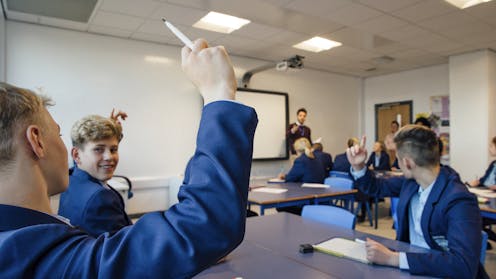
Autistic students say they want schools to focus on their strengths – not their diagnosis

An increasing number of young Australians are autistic. About 4.4% of children aged to 10 to 14 years and 3.4% of older teens have an autism diagnosis.

While research shows including autistic students in mainstream education benefits all students, autistic learners still face academic and social challenges.

Too often, efforts aimed at improving their school outcomes have largely excluded the voices of autistic students and have focused on their challenges.

But what if we listened to autistic students and focused on their strengths?

We did just that in our recent study published in the journal Autism. We interviewed 16 autistic adolescents about their experiences at school, focusing on what helped them thrive.

Our study

We invited young people from Western Australia to take part in our research through community groups, autism events and university programs.

Interviewees were either still in high school or had just left, they ranged in age from 13 to 20. The majority were male.

Students spoke candidly about friendships, learning and future goals, offering reflections and practical insights into what makes school feel meaningful, engaging and empowering.

Students want teachers to understand them

Students told us what mattered most to them was feeling understood by teachers. They wanted their teachers to see them as a whole person, with strengths and interests, rather than focusing on their diagnosis or challenges. Chris* explained:

They just sort of know me and they understand me.

Sometimes shared interests were the bridge. Isabelle appreciated that her teachers liked Harry Potter, which was also her passion. This made her feel more connected and respected. For others, time built understanding. Ben reflected his science teacher “knows me more than most of my new teachers” after three years together.

But not every experience was positive. Jaxton told us:

Teachers are less helpful to me because there’s something wrong with me in their eyes.

Students want to use their strengths

Individual strengths and interests also helped students connect with their classmates. Some found themselves helping their peers, boosting confidence and belonging. Aaron said:

If my friends were having trouble doing the question […] I would help them.

Even less social students said it was easier to connect with peers when talking about something they loved.

Students were also most engaged with school when their learning aligned with their interests. Jack, who loved programming, said:

It’s fun, it’s cool to learn, and it reliably makes sense […] if you write the code correctly, it’ll do what it’s supposed to do.

Rex liked science and maths for the problem-solving, and Aaron enjoyed subjects that involved “doing questions” over memorising content.

Students want clarity

Students told us they needed teachers’ expectations around the classroom and learning tasks to be clear – this helped them self-regulate and feel more secure. As Teo explained:

There needs to be clarity […] stress can come from when there are unexpected things.

Students told us helpful adjustments in the classroom include:

Students want support to follow their dreams

For many students, they thrived when school experiences aligned with their goals. Taylor, who wants to be a Manga artist, described her whole school experience as “gravitating towards my dream”.

Her passion began in the library and grew through creative activities. Rex dreams of being an “IT person or a pilot,” and Teo, drawn to logic and justice, hopes to become a barrister for autistic people.

Students wanted more help connecting their current learning with future pathways, and they wanted this well before they finished school. Taylor (who was 14 and in Year 9) explained:

They should have more stuff on what we want to be […] Everyone should be able to choose their own path […] Not from the end of Year 12 […] I’m talking about now, when we actually have the imagination and freedom.

So what do autistic students want? The young people in our study were not asking for special treatment. They just ask to be seen, heard and supported. Their insights offer clear direction for building inclusive and strengths-based schools, and remind us why student voice matters in shaping education that works for all.

*Names have been changed.

Authors: Jia White, Lecturer in Education, Curtin University

Read more https://theconversation.com/autistic-students-say-they-want-schools-to-focus-on-their-strengths-not-their-diagnosis-264026

Business News

The Rise of Digital Marketplaces in the Australian Trade Sector

For decades, the Australian trade and construction sector operated almost entirely on word-of-mouth recommendations and local community networks. Small business owners typically relied on local newspa...

Daily Bulletin - avatar Daily Bulletin

How Immigration Lawyers Can Help

Introduction Visa decisions can shape employment, family life, study plans, travel, and future residence. A small omission can lead to delay, added expense, or refusal. Immigration lawyers assess l...

Daily Bulletin - avatar Daily Bulletin

How Industrial Drying Equipment Supports Efficient Processing

Many industrial processes require moisture to be removed from compressed air, products or process materials before they move to the next stage. Excess moisture can affect equipment performance, produc...

Daily Bulletin - avatar Daily Bulletin

Practical Ways a Whiteboard Can Improve Workplace Communication

Effective communication helps teams stay organised, share ideas and keep track of important information. While digital tools are now common in many workplaces, a whiteboard continues to provide a simp...

Daily Bulletin - avatar Daily Bulletin

Designing Eco-Friendly Custom Water Bottles for Your Next Event

The Evolution of Sustainable Event Merchandise Event planning has undergone a massive transformation over the last decade. Gone are the days when organizers could hand out cheap, single use plastic...

Daily Bulletin - avatar Daily Bulletin

Why Choosing a Professional Florist Melbourne Makes Flower Delivery Impactful

Flowers have a great power to speak when humans cannot express their feelings with right words. Flowers are the best gifts when you are celebrating a birthday or welcoming a newborn child into your fa...

Daily Bulletin - avatar Daily Bulletin

The Business Case for Choosing Australian Fabricators Over Imported Alternatives

For a long time, you might have defaulted to overseas suppliers when sourcing fabricated metal components for a project. The unit price was lower on paper, and the maths seemed straightforward. That...

Daily Bulletin - avatar Daily Bulletin

Australian organisations are relying on business continuity plans built for a far more predictable world

Tariff escalations, supply chain fragility, geopolitical events, and the ongoing threat of cyber disruption have reshaped the risk environment facing Australian organisations. The problem is that ma...

Daily Bulletin - avatar Daily Bulletin

How to Rent a Car for Uber in Melbourne: What Every New Driver Needs to Know

Starting out as an Uber driver in Melbourne is not as complicated as it sounds but getting the vehicle right is where most new drivers get stuck. Uber has strict requirements around vehicle age, condi...

Daily Bulletin - avatar Daily Bulletin

The Daily Magazine

South African Consular Services Expand to Six Australian Cities

South Africans living in Adelaide, Brisbane and Canberra will now be able to access passport, identi...

How Long Does a Solar Home Battery Last? LFP Cycles and Warranty Explained

A battery does not usually reach its advertised cycle count and suddenly stop working. Capacity ch...

How to Hire a Nanny: A Complete Guide for Families

Finding the right childcare professional can make everyday family life easier and give parents gre...

The Blue-Collar Shortage Employers Can't Solve With More Applicants

Australia's hiring market has cooled considerably since the post-pandemic frenzy of 2021 and 2022. F...

The Playground as Classroom: How Line Markings Are Reinforcing What Students Learn Inside

For a long time, the playground was treated as a break from learning rather than part of it. A place...

How Technology Is Changing the Way Gardens Are Maintained

Garden maintenance has always been a hands on ritual. Mowing on a schedule, watering by instinct, an...

One Blocked Drain Can Become a Whole House Plumbing Problem: How It Happens

A blocked hand basin feels local. So does a slow shower. Homeowners naturally focus on the fixture...

AI in Marketing: From Experiment to Everyday Tool

For the past couple of years, artificial intelligence in marketing has mostly lived in the "let's se...

What Businesses Can Do to Make Sustainability More Practical Day to Day

Sustainability can sound like a huge corporate project, something tied to annual reports, long-term ...