

Paramedics are less likely to identify a stroke in women than men. Closing this gap could save lives – and money
- Written by: Lei Si, Associate Professor in Health Services Management, Western Sydney University
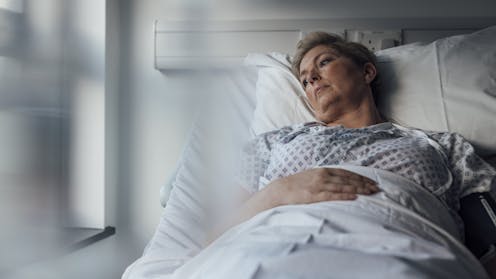
A stroke happens when the blood supply to part of the brain is cut off, either because of a blockage (called an ischaemic stroke) or bleeding (a haemorrhagic stroke). Around 83% of strokes are ischaemic.
The main emergency treatment for ischaemic strokes is a “clot-busting” process called intravenous thrombolysis. But this only works if administered quickly – ideally within an hour of arriving to hospital, and no later than 4.5 hours after symptoms begin. The faster treatment is given, the better the person’s chance of survival and recovery.
However, not everyone gets an equal chance of receiving this treatment quickly. Notably, research has shown ambulance staff are significantly less likely to correctly identify a stroke in women compared to men.
In a recent study, we modelled the potential health gains and cost savings of closing this gap. And they’re substantial.
The sex gap in stroke diagnosis
In Australia, about three-quarters of people who experience stroke arrive at hospital by ambulance. If paramedics suspect a stroke, they can take patients directly to a hospital which specialises in stroke care, and alert the hospital team so scans and treatment can start immediately.
Research has shown women aged under 70 are 11% less likely than men to have their stroke recognised by paramedics before they arrive at the hospital.
While younger men and women experience stroke at a similar rate, the symptoms they present with may be different, with “typical” symptoms more common in men and “atypical” symptoms more common in women.
Research has shown women and men are equally likely to present with movement and speech problems when having a stroke. However, women are more likely to show vague symptoms, such as general weakness, changes in alertness, or confusion.
These “atypical” symptoms can be overlooked, leaving women more vulnerable to misdiagnosis, delayed treatment, and preventable harm.
What we did
In our study, published recently in the Medical Journal of Australia (MJA), we used ambulance and hospital data from a 2022 MJA study in New South Wales. This is the study we mentioned above that showed paramedics correctly identified stroke more often in men than women under 70.
From this dataset, we identified more than 5,500 women under 70 who had an ischaemic stroke between 2005 and 2018. Using this group, we built a model to compare two scenarios:
- the status quo, where women’s strokes are identified at the current rate of accuracy; and
- an improved scenario, where women’s strokes are identified at the same rate as men’s.
We then projected patients’ health over time, including their level of impairment, risk of another stroke, and immediate and long-term survival.
Closing the diagnosis gap would save lives and money
When women’s stroke diagnosis rate was improved to match men’s, each woman gained an average of 0.14 extra years of life (roughly 51 days) and 0.08 extra quality-adjusted life years (QALYs), meaning an additional 29 days in full health.
Scenario two also meant A$2,984 in health-care costs would be saved per woman.
Scaled to the national level based on the number of women under 70 hospitalised with ischaemic stroke each year, closing this gap would mean 252 extra years of life, 144 extra QALYs, and $5.4 million in cost savings annually.
Some limitations
We didn’t have sex-specific data for every aspect of the model, which is in itself a telling sign of the lack of recognition of sex as an important factor in understanding disease. Because of this, we used combined data from both men and women in some parts of our model, which may have affected the results.
Further, the NSW data we used for rates of treatment with intravenous thrombolysis were higher than the national average, so our national figures may be slightly over-estimated.
Beyond stroke – why all this matters
The disparity we found is one example of a broader, systemic issue in women’s health: sex-based differences in diagnosis and treatment that favour men.
Too often, women’s symptoms are misinterpreted or dismissed because they don’t match a “typical” pattern. This can lead to delays, missed opportunities for early treatment, and worse outcomes for women.
In stroke, faster and more accurate diagnosis means people are less likely to die or require long-term care, and more likely to recover better and get back to their daily lives sooner.
So what can we do to close the diagnosis gap?
Investing in better training for paramedics and other emergency responders, so they can recognise a wider range of stroke presentations, could pay off many times over. Public awareness campaigns that highlight atypical stroke symptoms could also help.
Technologies such as mobile stroke units and telemedicine support may be part of the solution, but they must be implemented with attention to sex-specific needs.
Authors: Lei Si, Associate Professor in Health Services Management, Western Sydney University


 Daily Bulletin


