

China’s greening steel industry signals an economic reality check for Australia
- Written by: Christoph Nedopil, Director Griffith Asia Institute, Griffith University
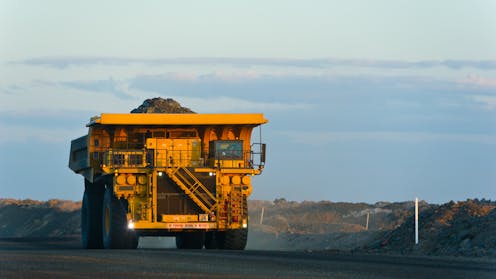
Australia has flourished as an export powerhouse for decades. Much of this prosperity has been driven by the nation’s natural endowment with two important raw products for producing steel the traditional way: iron ore and metallurgical coal.
Worth more than A$100 billion in 2024, Australia’s iron ore shipments to China make up about 55% of everything we export there. But a transformation has been taking place in China’s steel industry, which is under intense pressure to decarbonise.
Earlier this year, Beijing formally expanded its national emissions trading scheme to cover steel production. And just this month, it issued another decree requiring steelmakers to increase their share of green energy in steel production.
Prime Minister Anthony Albanese’s recent visit to China may have looked like a celebration of normalised diplomatic or trade ties. Behind the scenes was a quiet but critical economic pivot.
Australia’s economic future depends on whether it can green its exports fast enough to meet the decarbonisation needs of its biggest market.
A greener China
In China, no new permits for coal-based steelmaking appear to have been issued since early 2024. However, China has been approving new, greener steelmaking capacity, using electric arc furnace (EAF) technology, the main low-emissions technology in steel.
These furnaces use high-voltage electric arcs, powered ideally by green energy, to melt scrap steel or what’s known as direct reduced iron (DRI). Through that process, they limit carbon emissions by reducing the use of thermal coal for electricity and metallurgical coal for iron making in blast furnaces.
In total, China has now installed enough electric arc furnaces to produce more than 160 million tonnes of steel annually. That’s about the same as the total steel output of Japan and the United States combined.
China’s current 10% share of steel production from electric arc furnaces still remains below the country’s 15% target. But overall, China’s total domestic steel production continues to fall. With real estate, infrastructure and heavy industry slowing, steel consumption is forecast to drop by more than 20% this decade.
Rather than prop up its old blast furnaces, rapidly falling green energy prices and increased capacity should allow China to accelerate its shift towards green steel.
Why Australia is so exposed
China’s transition directly threatens two pillars of Australia’s export model: coal and iron ore.
The use of thermal coal is poised to decline as China ramps up renewables and needs to burn less coal for electricity.
The other coal type exported from Australia, metallurgical coal (sometimes called “coking” coal), is needed for the traditional “basic oxygen process” of making steel. This is already being squeezed by lower demand and the shift to green steel production.
In the past five years, Australia’s metallurgical coal exports have already fallen by about 15%, despite persistent predictions for growing demand.
Australian iron ore reserves, meanwhile, are primarily composed of hematite, meaning they’re less suited for green steelmaking. Unprocessed, these reserves lack the grade needed for direct reduction using green hydrogen. That incentivises Chinese mills to move to cleaner inputs from elsewhere.
This transformation won’t be immediate. But the nature of long-term investment cycles means Australia faces a choice: start integrating into these greener supply chains, or face key national assets becoming stranded.
Invest in a green future or face irrelevance
Australia can adjust to this new reality. While coal may not have much of a future, iron ore can be processed to make it suitable for green steel production. Yet, significant investment in research and development is required to produce competitive green iron pellets from hematite.
For some in the industry, this transition is already under way. Fortescue, for example, has committed to real net-zero emissions by 2030, without relying on offsets. It is also investing in the development of green iron products. This is not just for climate leadership, but to preserve competitiveness.
The company is also pushing for Australia to adopt a national 75% emissions reduction target by 2035.
Albanese’s trip might mark a turning point
Ambition alone won’t suffice. Australia also needs demand and policy certainty to attract domestic and international investment — including from China.
That’s where Albanese’s recent trip to our biggest trading partner may mark a turning point. One of the most consequential outcomes of this trip could turn out to be the establishment of a new policy dialogue on steel decarbonisation.
This signals an intent from the Australian and Chinese governments to align on standards, contracts and investment frameworks — not just for iron ore, but for green iron, hydrogen and low-carbon steel.
But talk is cheap. Turning this dialogue into real outcomes will require Australia to address difficult questions. Can Australian companies secure sufficient demand from China to justify investments in green supply contracts — not just for iron ore, but for hydrogen, green iron or even finished steel?
And can Australia attract international investors – including from China – to green energy and iron processing, despite recent decisions by Australia’s Foreign Investment Review Board to block or unwind certain Chinese investments?

Unlocking investment
New financial instruments may also be needed to unlock investment. One option is green steel certificates.
Similar to renewable energy certificates (RECs), green steel certificates would allow producers to generate a credit for producing green steel that can be sold to interested “green” buyers, while the steel itself could be used in close-by markets to avoid emissions related to long-distance transport.
While much of the commentary on Albanese’s trip revolved around diplomacy and geopolitics, its real legacy may be economic.
As China continues – and in all likelihood, accelerates – its transition to a low-carbon model, Australia can no longer count on sustained demand for its coal and iron ore exports.
Authors: Christoph Nedopil, Director Griffith Asia Institute, Griffith University


 Daily Bulletin


