

Women’s rights in the US are in real danger of going back to 1965 – so Jessie Murph’s new song is no laughing matter
- Written by: Prudence Flowers, Senior Lecturer in US History, College of Humanities, Arts and Social Sciences, Flinders University

1965, a trending new song by TikTok sensation and country music rebel Jessie Murph, is prompting heated online conversation about the status of women in the United States.
A retro sound and kitschy 1960s look mark the song and its confusingly pornographic (and age-restricted) music video. 1965 is muddled in its posturing, at turns sarcastic yet simultaneously conveying a wistfulness about the “simpler nature” of heterosexual romance in the 1960s.
Amid the nods to Lana Del Rey and Amy Winehouse, perhaps the most striking aspect is Murph’s visual homage to Priscilla Presley, who began dating Elvis in 1959 when she was 14 years old.
1965’s chorus has attracted particular controversy. Murph croons, in a lilting doo-wop style, about her willingness to “give up a few rights” for a man’s love and affection.
In the US, where hard-won rights are currently under attack, 1965’s seeming fetishisation of submission and female powerlessness has angered many listeners. Murph has claimed the song is “satire” – but a look at the legal and social status of American women in 1965 highlights how misplaced this attempt at irony is.
Women and the law in the US
In 1963 and 1964, federal laws prohibited discrimination in relation to pay or civil rights. But the idea that women might participate fully and equally in society was largely seen as a joke.
Federal and state governments, along with the private sector, had to be compelled through feminist action to take these rights seriously.
Into the 1970s, sex discrimination in education and housing was legal. So was employment discrimination against pregnant women and women with young children.
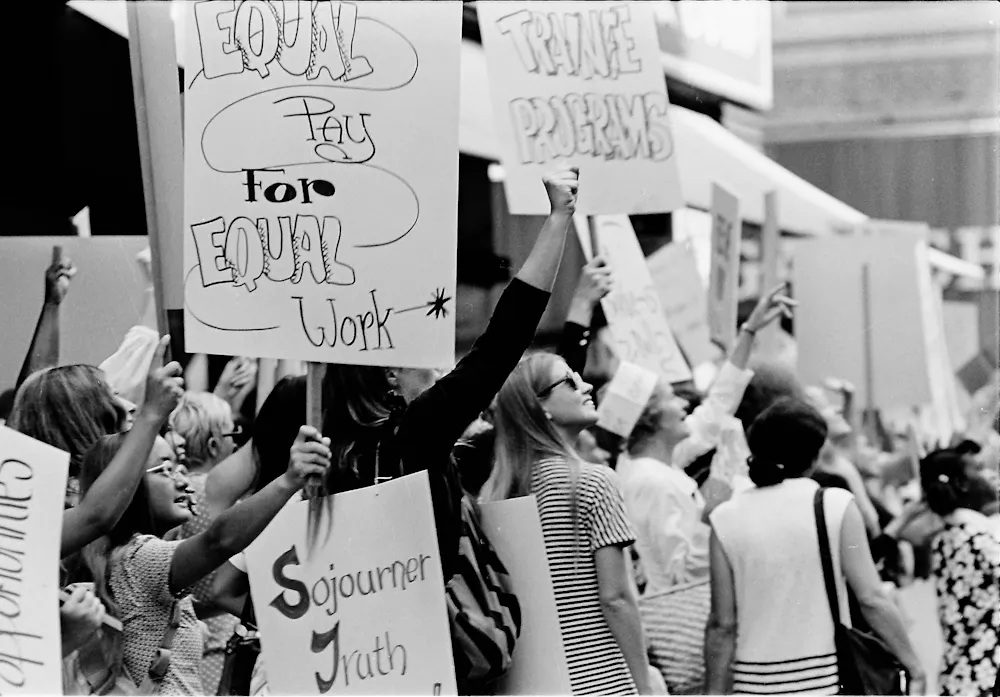
Job advertisements were often sex segregated. Women only gained the right to have a credit card or mortgage in their own name in 1974.
Sex, intimacy, relationships
In the 1960s, reproductive rights and bodily autonomy were in their infancy.
In 1965, married couples gained the right to contraception. This right was extended to unmarried people in 1972.
Although a tiny number of states began repealing abortion laws in the late 1960s, death from illegal and unsafe abortions were a common occurrence until the Supreme Court’s Roe v. Wade decision of 1973.

Between World War II and 1973, approximately 4 million pregnant unmarried mothers placed their children for adoption, many under duress, in a period now called the baby scoop era.
Into the 1970s, Black, Latina and Indigenous women were coercively sterilised, often through eugenics programs.
Divorce was only possible if one spouse could persuade a judge the other had committed cruelty, adultery or desertion. In 1969, California became the first state to legalise no-fault divorce.
Throughout the 1970s and 1980s, feminists demanded that police and the courts stop treating domestic violence as a private matter. Only in 1993 was marital rape considered a crime in all state sexual offence codes.
Even today, the overwhelming majority of perpetrators who commit rape or sexual assault will not face trial.
Race and sexuality
Although women’s suffrage was achieved in 1920, African Americans, Latinos and Native Americans were prevented from voting in many states by literacy tests, poll taxes and violence.
In 1965, after decades of civil rights struggle, federal legislation prohibited racial discrimination in voting, expanding to protect non-English speaking citizens in 1975.
 The Free Bobby! Free Ericka! march was co-sponsored by the Black Panther Party and the Women’s Liberation Movement, held in Connecticut, November 1969.
Bev Grant/Getty Images
The Free Bobby! Free Ericka! march was co-sponsored by the Black Panther Party and the Women’s Liberation Movement, held in Connecticut, November 1969.
Bev Grant/Getty Images
Until 1973, homosexuality was considered a sociopathic personality disorder that might necessitate psychiatric institutionalisation.
In 2003, laws criminalising consensual same-sex activity were found unconstitutional. In 2015, same-sex marriage became legal nationwide.
There are still no federal laws that protect LGBTQI+ people against discrimination in education, housing, employment or public accommodations.
The personal is political
Faced with immediate backlash, Murph has claimed the song is obviously satirical, asking “r yall stupid”.
To Teen Vogue she insisted “On the record, I love having rights […] bodily rights specifically.”
But for satire to work, it requires shared sets of knowledge, values and assumptions. The ironic posturing in 1965 is too muddled – lyrically and sonically – to be effective. Instead, for many it looks and sounds like just another celebration of restrictive gender politics.
Online, many have compared Murph to a “tradwife”, the increasingly popular genre of social media influencer who make content romanticising homemaking, large families and submission to husbands.
Tradwives are primarily white and offer a fantasy version of historical domesticity, often cosplaying a 1950s aesthetic. Some tradwives are overtly far right in their politics, others explicitly reject feminism and the “lie” of equality.
Read more: Far-right 'tradwives' see feminism as evil. Their lifestyles push back against 'the lie of equality'
This vision of family and gender is echoed in contemporary Christian Nationalist and MAGA discourse.
Project 2025, the 900-page conservative wish list for the Trump 2.0 administration, called for government to “replace ‘woke’ nonsense with a healthy vision” of family and sexuality, framed as heterosexual and patriarchal.
The culture wars waged by Donald Trump and Republicans directly target rights relating to gender and sexuality.
Since Roe v. Wade was overturned in 2022, 19 states now ban or restrict abortion.
 A protest was held in Atlanta, Georgia, June 24 2022, to protest the Supreme Court’s decision to overturn Roe v. Wade.
AP Photo/Ben Gray
A protest was held in Atlanta, Georgia, June 24 2022, to protest the Supreme Court’s decision to overturn Roe v. Wade.
AP Photo/Ben Gray
Trans rights are under sustained and devastating attack.
Prominent conservative voices call for an end to no-fault divorce laws and same-sex marriage. Federal Republicans have opposed efforts to codify the right to contraception and in vitro fertilisation (IVF).
The history of social movement activism is a history of struggle. Feminists, women of colour and LGBTQI+ movements fought against considerable resistance to establish rights that are now too often taken for granted.
In this moment of conservative backlash, it is vital that we interrogate any move that frames rights as accessories in a costume rather than foundational to equality.
Authors: Prudence Flowers, Senior Lecturer in US History, College of Humanities, Arts and Social Sciences, Flinders University


 Daily Bulletin


