

Read The Times Australia

Daily Bulletin

Five arms, no heart and a global family: what DNA revealed about the weird deep-sea world of brittle stars

  • Written by: Tim O'Hara, Senior Curator of Marine Invertebrates, Museums Victoria Research Institute
Five arms, no heart and a global family: what DNA revealed about the weird deep-sea world of brittle stars

You may have read that the deep sea is a very different environment from the land and shallow water. There is no light, it is very cold, and the pressure of all the water above is immense.

Plants can’t grow there, and the energy powering life mostly comes from organic matter sinking from the sunlit surface. These facts have been known for more than 150 years.

But I want to tell you something you probably don’t know about the deep sea: for animals on the seafloor, it is a very connected environment. There are few environmental barriers to stop animals slowly expanding their distribution to cover thousands of kilometres. Over a million years, deep-sea animals can spread from Iceland to Tasmania.

In a new study published today in Nature, we map the distribution and relatedness of a single group of marine animals across all ocean seafloors, from the coast down to the abyssal plains of the deep sea, from the equator to the pole.

Australia’s ocean research vessel RV Investigator, operated by the CSIRO Marine National Facility, was used to explore deepsea life around Christmas Island in the Indian Ocean. Chris Bray / CSIRO, CC BY-NC

Five arms, no brain, no eyes or heart

We sequenced the DNA of thousands of animal specimens stored in natural history collections of museums across the globe, deposited from hundreds of research voyages. For the first time, we have enough data to explore how marine life has evolved and dispersed across the oceans over the past 100 million years.

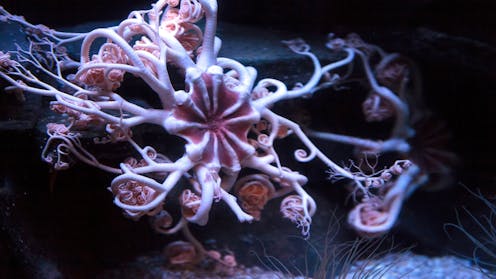
We studied a group of animals called brittle stars, strange spiny creatures with a disc-like body and five sinuous or branched arms. They have a central mouth and gut, but no brain, no eyes and no heart.

Photo of a bleached white tentacular creature.
A branched brittle star (Gorgonocephalus chilensis) specimen taken from Coral Seamount, southwest Indian Ocean. Tim O'Hara / Museums Victoria, CC BY

While these shy animals would not be always familiar to beach combers or snorkelers, they are perfect for our project as they are found in abundance across deep seafloors and frequently surveyed by research expeditions. They have inhabited our planet for more than 480 million years, efficiently consuming and recycling organic matter.

Deep-sea lifestyles

Life in the deep is distributed in a different way to that in shallow seas.

In shallow waters, the temperature differs a lot between the tropics, the temperate regions (mid latitudes) and the poles. This imposes a barrier to the movement of marine life. Animals (and plants) generally adapt to a narrow range of temperatures and only rarely spread to other climates.

So, if you are a tropical shallow-water species, you cannot migrate through frigid waters around South America, or through the Canadian Arctic, to get from the Pacific to Atlantic Ocean. For tens of millions of years, shallow marine species have evolved independently in different oceans and seas.

Tropical shallow-water brittle stars such as Ophiothrix purpurea cannot migrate through cold waters. Julian Finn / Museums Victoria, CC BY-NC

But we found the deep sea is not like that. Species in different regions are much more closely related.

In fact, the age and geographic distribution of species on a family tree of deep-sea brittle stars resembles that of a group of seabirds or marine mammals. Yet these brittle stars don’t have wings or fins to get around.

The deep-sea brittle star Ophiotholia can burrow like a corkscrew into muddy seafloors. Caroline Harding / Museums Victoria, CC BY

How eggs and larvae roam the globe

The secret of how slow-moving brittle stars migrate across oceans appears to be their eggs and larvae.

In warm, shallow waters, a yolk-filled food reserve is rapidly used up by the developing larva. But in the cold deep sea, a yolky larva can survive with very slow metabolic activity, drifting on slow-moving currents for more than a year before settling. This greatly expands the range of a brittle star’s offspring.

Moreover, there are numerous seamounts, ridges and plains on the oceanic seafloor that offer transit points for long-distance migration at different depths. This dispersal across oceans has been going on for a long time.

Deep-sea ‘highways’ where brittle stars disperse across the Atlantic and Indian oceans. Tim O'Hara / Museums Victoria, CC BY

The most prominent of these dispersal highways is across the southern Indian Ocean, transporting deep-sea animals from the Atlantic and Southern Oceans to Australia and New Zealand. In contrast, very few shallow-water animals have traversed such vast distances.

A patchwork of deep-sea life

While brittle star populations show lots of evidence of long-distance connections, deep-sea communities are not uniform around the planet.

Life in the deep is perilous. There is always the threat that a given species may be wiped out in particular regions.

Seawater conditions can change, as can currents and food supplies. New predators or diseases may arrive at any time.

Over time, the combination of high connectivity and high rates of regional extinction has led to a patchwork of deep-sea species distributions across oceans.

To conserve these ecosystems into the future, we will need a much better understanding of the global patterns of deep-sea life.

Authors: Tim O'Hara, Senior Curator of Marine Invertebrates, Museums Victoria Research Institute

Read more https://theconversation.com/five-arms-no-heart-and-a-global-family-what-dna-revealed-about-the-weird-deep-sea-world-of-brittle-stars-261566

Business News

How Telematics Helps Australian Companies Improve Productivity

Operating a commercial fleet in Australia is a uniquely demanding endeavour. Between the sprawling urban sprawl of cities like Sydney and Melbourne and the immense, unforgiving stretches of the Outb...

Daily Bulletin - avatar Daily Bulletin

Inside the Icon: The BridgeMuseum Officially Opens at the Sydney Harbour Bridge

A bold new way to experience one of Australia’s most recognisable landmarks has arrived, with BridgeClimb Sydney officially opening the all-new BridgeMuseum.  Located inside the Sydney Harbour Brid...

Daily Bulletin - avatar Daily Bulletin

Is Your Brand Showing Up in AI Search? Most Melbourne Brands Aren't.

The New Front Door Nobody Told You About Something changed. Quietly. Without a press release. The way buyers find businesses in Australia has been rewired. Not replaced, rewired. Google isn't dead...

Daily Bulletin - avatar Daily Bulletin

How Australian Businesses Can Measure SEO ROI

SEO can feel vague when you are staring at a dashboard full of numbers that do not clearly connect to revenue. The key is to measure the right signals in the right order, then tie them back to outcome...

Daily Bulletin - avatar Daily Bulletin

How Commercial Roller Shutters Improve Site Security Without Slowing Operations

Security upgrades can be frustrating when they make everyday work harder. A door that takes too long to open, creates bottlenecks at shift change, or fails at the worst time can turn “better protectio...

Daily Bulletin - avatar Daily Bulletin

Why a Document Destruction Service Still Matters for Modern Businesses

Businesses generate large volumes of information every day, from staff records and contracts to invoices, reports and customer files. While attention often focuses on how documents are stored, the way...

Daily Bulletin - avatar Daily Bulletin

Bicycle Rack Safety and Space-Smart Storage

Bike storage problems usually show up as small annoyances first: tangled handlebars, scratched frames, and bikes that topple when you pull one out. Over time, those issues become safety risks, especia...

Daily Bulletin - avatar Daily Bulletin

How to Tell if a Childcare Centre Is a Good Fit for Your Child

Choosing childcare can feel like you’re making a huge decision with limited information. Tours are short, centres are often on their best behaviour, and your child might act differently in a new space...

Daily Bulletin - avatar Daily Bulletin

Car Import Timeline: What Usually Happens at Each Stage

Importing a car into Australia can feel confusing because multiple agencies and checkpoints are involved, and the timeline is shaped as much by paperwork quality as it is by shipping speed. The most u...

Daily Bulletin - avatar Daily Bulletin

The Daily Magazine

Gold Migration Lawyers in Liquidation: How the Closure Affects Your ART Appeal

If your appeal was with Gold Migration Lawyers, a recent change to how the Tribunal decides cases ...

The pressure cooker: life in urban Australia in 2026

Australian cities have always been demanding. Long commutes, rising housing costs, busy schedules a...

What Actually Makes a Good Criminal Lawyer in Melbourne

Most people only think about this question once. That is usually too late. Most people charged wi...

Why Working With A Chatswood Tutor Can Improve Academic Performance

Academic expectations continue increasing for students across primary school, high school, and senio...

Is It Worth Getting Solar Panels in Melbourne?

The real question is not whether solar works in Melbourne. It works. The question is what it is co...

How A Diploma Of Project Management Builds Practical Skills For Modern Work Environments

Developing the ability to plan, execute, and deliver outcomes efficiently is a key requirement in to...

How to Choose the Right Football for Every Level

Choosing a football may seem straightforward, but the right option depends on who will be using it a...

What to Ask a Wedding Photographer Before You Book

Booking a wedding photographer can feel deceptively simple: you like the photos, you like the vibe...

Why Stress Relief For Dogs Is Essential For Emotional Balance And Long-Term Wellbeing

Managing emotional health is just as important as physical care when it comes to pets, which is why ...