

Astronomers listened to the ‘music’ of flickering stars – and discovered an unexpected feature
- Written by: Claudia Reyes, Postdoctoral Fellow, Research School of Astronomy & Astrophysics, Australian National University
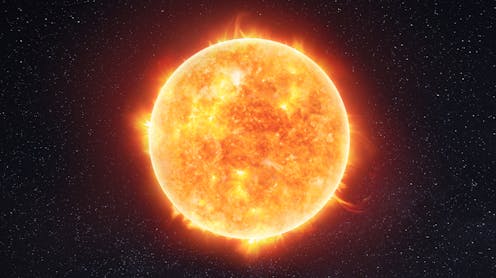
The “music” of starquakes – enormous vibrations caused by bursting bubbles of gas that ripple throughout the bodies of many stars – can reveal far more information about the stars’ histories and inner workings than scientists thought.
In new research published in Nature, we analysed the frequency signatures of starquakes across a broad range of giant stars in the M67 star cluster, almost 3,000 light years from Earth.
Using observations from the Kepler space telescope’s K2 mission, we had a rare opportunity to track the evolution of stars during most of their journey through the giant phase of the stellar life cycle.
In doing so, we discovered that these stars get stuck “playing the same part of their tune” once their turbulent outer layer reaches a sensitive region deep inside.
This discovery reveals a new way to understand the history of stars – and of the entire galaxy.
The sound of starquakes
Starquakes happen in most stars (like our Sun) that have a bubbling outer layer, like a pot of boiling water. Bubbles of hot gas rise and burst at the surface, sending ripples through the entire star that cause it to vibrate in particular ways.
We can detect these vibrations, which occur at specific “resonant frequencies”, by looking for subtle variations in the brightness of the star. By studying the frequencies of each star in a group called a cluster, we can tune into the cluster’s unique “song”.
Our study challenges previous assumptions about resonant frequencies in giant stars, revealing they offer deeper insights into stellar interiors than previously thought. Moreover, our study has opened new ways to decipher the history of our Galaxy.
The melody of a stellar cluster
Astronomers have long sought to understand how stars like our Sun evolve over time.
One of the best ways to do this is by studying clusters – groups of stars that formed together and share the same age and composition. A cluster called M67 has attracted a lot of attention because it contains many stars with a similar chemical makeup to the Sun.
Just as earthquakes help us study Earth’s interior, starquakes reveal what lies beneath a star’s surface. Each star “sings” a melody, with frequencies determined by its internal structure and physical properties.
Larger stars produce deeper, slower vibrations, while smaller stars vibrate at higher pitches. And no star plays just one note – each one resonates with a full spectrum of sound from its interior.
A surprising signature
Among the key frequency signatures is the so-called small spacing – a group of resonant frequencies quite close together. In younger stars, such as the Sun, this signature can provide clues about how much hydrogen the star still has left to burn in its core.
In red giants the situation is different. These older stars have used up all the hydrogen in their cores, which are now inert.
However, hydrogen fusion continues in a shell surrounding the core. It was long assumed that the small spacings in such stars offered little new information.
A stalled note
When we measured the small spacings of stars in M67, we were surprised to see they revealed changes in the star’s internal fusion regions.
As the hydrogen-burning shell thickened, the spacings increased. When the shell moved inward, they shrank.
Then we found something else unexpected: at a certain stage, the small spacings stalled. It was like a record skipping on a note.
We discovered that this stalling appears during a specific stage in the life of a giant star — when its outer envelope, the “boiling” layer that transports heat, grows so deep that it makes up about 80% of the star’s mass. At this point the inner boundary of the envelope reaches into a highly sensitive region of the star.
This boundary is extremely turbulent, and the speed of sound shifts steeply across it — and that steep change affects how sound waves travel through the star. We also found that the stalling frequency is distinctively determined by the star’s mass and chemical composition.
This gives us a new way to identify stars in this phase and estimate their ages with improved precision.
The history of the galaxy
Stars are like fossil records. They carry the imprint of the environments in which they formed, and studying them lets us piece together the story of our galaxy.
The Milky Way has grown by merging with smaller galaxies, forming stars at different times in different regions. Better age estimates across the galaxy help us reconstruct this history in greater detail.
Clusters like M67 also provide a glimpse into the future of our own Sun, offering insight into the changes it will experience over billions of years.
This discovery gives us a new tool – and a new reason to revisit data we already have. With years of seismic observations from across the Milky Way, we can now return to those stars and “listen” again, this time knowing what to listen for.
Authors: Claudia Reyes, Postdoctoral Fellow, Research School of Astronomy & Astrophysics, Australian National University


 Daily Bulletin


