

False economies: the evidence shows higher speed limits don’t make financial sense
- Written by: Timothy Welch, Senior Lecturer in Urban Planning, University of Auckland, Waipapa Taumata Rau
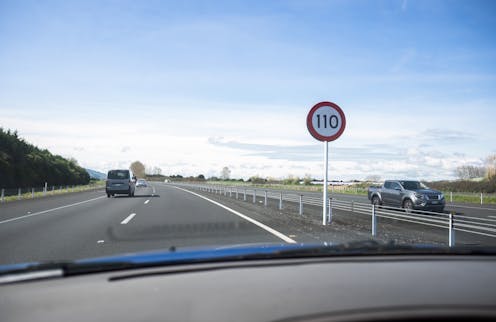
Despite community resistance and legal push-back, the government isn’t slowing down on its plan to roll back speed limit reductions on many roads. In the process, it’s going against expert advice from transport officials and solid economic evidence showing the benefits of slower speeds.
Documents recently released quietly by the New Zealand Transport Agency (NZTA) show Land Transport Director Brent Alderton raised serious concerns in 2024 about the proposed speed limit changes and urged decision makers to rely on evidence rather than ideology:
There is well founded evidence, nationally and internationally, that establishes the link between vehicle speed and the likelihood of a crash occurring, as well as the severity and consequences of any crash.
But the government is also bypassing evidence that contradicts its own justification that raising some speed limits will help increase productivity.
A comprehensive economic assessment prepared by engineering consulting firm WSP for the NZTA in March 2024 (later released under the Official Information Act) analysed the impact of previous speed limit changes implemented between 2020 and 2023 (with one dating back to 2011). It found the reductions delivered substantial economic benefits to New Zealand.
For road corridors with reduced speed limits, nearly 27 fewer deaths and serious injuries per year were recorded: “The crash cost savings generally outweigh the travel time disbenefits by a factor of 2 to 10 (or more).”
In other words, for every dollar lost in slightly increased travel times, the report estimates New Zealand gains between NZ$2 and $10 in reduced crash costs.
Economic benefits of lower speeds
All the road corridors with reduced speed limits in the WSP assessment showed positive benefit-cost ratios using NZTA’s standard methodology. Even under various sensitivity tests, including if crash benefits were reduced or project costs increased, most speed reductions maintained positive ratios.
But despite the local and international evidence showing lower speed limits save lives and money, the government persists in claiming raising some limits will reduce travel times and therefore increase productivity.
In fact, everything points to any productivity gains from faster travel being significantly outweighed by increased crash costs. As of 2023, the Ministry of Transport estimates those costs at $769,400 per serious injury and $14,265,600 per fatality.
When the WSP report was released, it projected traffic would experience mean speed reductions of between 5% and 9% on roads with lowered limits. This projection was based on actual changes in driving speeds recorded using GPS-based traffic data.
The data showed these reductions resulted in actual death and injury savings “much greater than predicted”. While the observed speed reductions aligned with expectations, the projected safety benefits significantly underestimated the actual harm reduction.
For example, on the Blenheim to Nelson stretch of State Highway 6, the predicted death and injury reduction was 22%, but the actual reduction was 82%. On State Highway 51, the reduction was 100% compared to an expected 31%.
Conversely, where speed limits were increased from 100 km/h to 110 km/h, as on the Cambridge section of the Waikato Expressway in December 2017, deaths and serious injuries rose by 133% compared to pre-increase levels.
In Auckland, dozens of urban corridors will soon see speed limits rise from 50 km/h to 60 km/h. The Auckland Transport agency will also raise the limit on one stretch of Te Irirangi Drive from 60 km/h to 80 km/h – exactly the kind of substantial increase the WSP report linked to dramatically higher crash risks.
Expediency vs evidence
Overall, the WSP report shows speed limit reductions worked better than expected at preventing harm, with significantly lower numbers of deaths and serious injuries annually across the studied corridors.
It is likely the number of lives saved from these speed limit reductions are reflected in the 2024 road fatality statistics, where road deaths across New Zealand were below 300 for the first time in a decade.
The director of land transport can only promise to “monitor” the impacts of the speed limit increases. In reality, there has been sufficient monitoring and measuring already to show speed limit reductions reduce harm as well as deliver economic benefits.
But the speed limit issue fits within a broader pattern of transport policy where ideology or political expediency appear to trump expert advice and economic analysis.
The government has frozen funding for cycling and walking projects, cancelled Auckland’s light rail plan, abandoned regional passenger rail initiatives and prioritised new highway construction over maintenance of existing roads.
This is despite economic assessments consistently showing better benefit-cost ratios for public and active transport investments than for new road projects.
Such decisions also contradict the government’s own climate commitments and overlook mounting evidence that car-centric transport planning worsens congestion rather than alleviating it.
Similarly, economic assessment shows unequivocally that the financial benefits of lower speeds and safer roads far outweigh the costs. If economic rationality were the driving force behind transport policy, speed limit reductions would be expanded rather than rolled back.
Authors: Timothy Welch, Senior Lecturer in Urban Planning, University of Auckland, Waipapa Taumata Rau


 Daily Bulletin


