

Penis envy, the Oedipus complex and authentic paths to meaning: 25 writers, from Siri Hustvedt to Colm Toibin, reflect on Freud’s legacy
- Written by: Nick Haslam, Professor of Psychology, The University of Melbourne
One of the more appealing customs of psychoanalysis is that analysts must be analysed. If you are going to put others on the couch you should lie on it first yourself. That way your psychic wrinkles can be identified – maybe even ironed out – before you are let loose on patients.
As the founder of psychoanalysis, Sigmund Freud was exempt from this rule. Generation after generation of analysts have analysed one another, tracing their lineage back to the master. But the master himself was never encouched.
Review: On the Couch: Writers Analyze Sigmund Freud – Andrew Blauner (Princeton University Press)
Freud did submit himself to a self-analysis, however. Throughout the 1890s he interrogated his inner life, in the process forming the views about dreams, slips, symptoms and complexes that would soon make him notorious. In the words of one disciple, “Freud made his own mind his chief laboratory, his untiring self-analysis became the basis for his analytic discoveries.”
But is unaided self-discovery reliable? Can we know ourselves by looking in the mirror? Surely there is a limit to how much insight we can gain without enlisting the help of others. That goes double for discoveries about the unconscious, which, psychoanalysts insist, cloaks itself in disguise and works its mischief in the darkness. Perhaps Freud deserves his own, belated analysis.
American anthologist Andrew Blauner agrees. In On the Couch: Writers Analyze Sigmund Freud, he assembles 25 writers to offer their personal reflections on the man and his ideas. Blauner’s contributor list leans transatlantic, literary and grey-headed but their essays present a diverse and deeply thoughtful collection of views.

The first question this exercise raises is “why bother”? Freud, who died in 1939, has been dead for longer than he lived, and the influence of psychoanalysis has dwindled. As a treatment, it has been displaced by biological psychiatry and newer schools of talk therapy.
As a set of ideas, it has suffered wave upon wave of conceptual and scientific attack by philosophers and psychologists. Its intellectual territory has largely shrunk to a few remnant pockets of the academic humanities.
If this book is to be believed, however, Freud’s influence lingers more than we might imagine. It may even be undergoing a revival. Despite all the eulogies and good-riddances, “are we not all Freudians now?”, asks essayist Phillip Lopate.
The contributors to On the Couch assess that suggestion in very different ways, from critique to appreciation, often with a large measure of ambivalence. As the cartoonist Sarah Boxer writes, “I do not hate Freud, nor do I worship him.”
The critics
Haters are outnumbered by worshippers in Blauner’s collection. The bones they pick are generally specific elements of Freud’s theoretical system. Jennifer Finney Boylan writes of the absurdity of penis envy from her standpoint as a transwoman.
“If you have a theory that does not bring kindness and compassion to people who are suffering”, she argues, “what you really need, more than anything else, is a new theory”.
The idea that psychological theories should comfort rather than confront would be anathema to Freud, but it remains true that some of his ideas, such as homosexuality being a form of perversion, have been actively hurtful.
 Goodreads
New Yorker fixture Adam Gopnik objects not to the unkindness of specific Freudian ideas but to the flimsiness of the entire theoretical apparatus. “As a system builder, Freud, like Marx, can no longer convince us,” he writes. So many of Freud’s claims about child development, the nature of human motivation, and the origins of mental illness have been found scientifically wanting that the edifice is on shaky ground.
If there is something to be learned from Freud, Gopnik argues, it is not a set of claims and concepts but a general stance towards the experience of being human. There is more to Freud than early-20th century Freudian dogma.
Even dubious, much-ridiculed ideas may have merit, though. Biographer David Michaelis contributes an amusing recollection of his own Oedipus complex and his “lunar longing” for his stylish mother.
Freud as a writer
Among the more appreciative contributors, a consistent theme is Freud’s skill as a writer. Novelists Sheila Kohler and David Gordon independently remark on how Freud’s famous case studies resemble works of detective fiction.
Readers of the cases of Dora or the Rat Man, whose obsessive-compulsive disorder involved images of people being gruesomely eaten by rats, are drawn in by Freud’s command of mystery and suspense and are rewarded by a Holmesian cracking of the case. Instead of solving crimes, Freud brilliantly unravels the origins of symptoms.
Freud’s gifts as an essayist also come in for high praise, Lopate commending him for his “glints of aphoristic sublimity.” This verdict was shared by Thomas Mann, who nominated Freud for the Nobel Prize in Literature. Unsuccessful, Freud had to make do with Germany’s Goethe Prize in 1930.
Novelist Colm Tóibín finds Freudian resonances in the works of Mann and Henry James, as David Gordon does in the work of Proust. These contributors make a strong case for appreciating Freud as a writer of fiction, regardless of the standing of his theories.
Freud as a neuroscientist
Other appreciative contributors dwell on Freud’s pioneering but relatively unknown work in neuroscience and anatomy. Psychoanalyst Mark Solms tells the story of Freud’s first scientific article, published at the tender age of 20, on the search for testicles in the eel.
Science writer Richard Panek adds to this portrait of a biological scientist. He extols Freud’s skills in laboratory science and clinical neurology, and his aspirations to unite the mental and the physical.
Panek pays special attention to Freud’s “Project for a Scientific Psychology”, written in 1895, which offered a neurophysiological model of the mind. However much psychoanalysis became an interpretive art, it emerged from a natural scientific worldview.
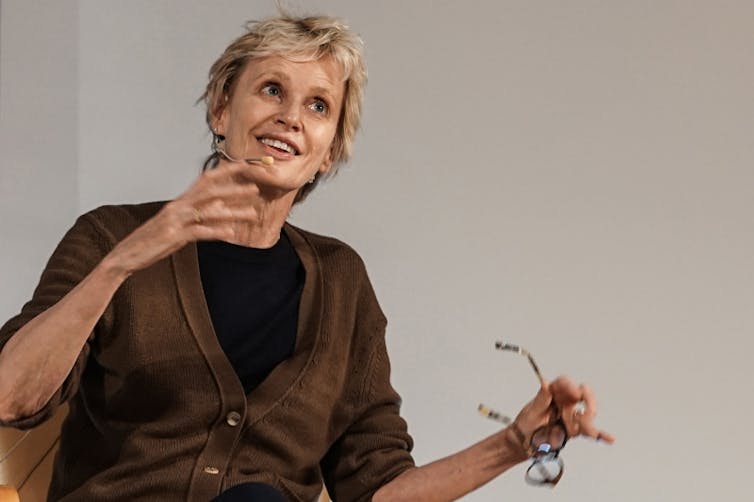
The extent to which that early alignment with science has shifted is evident in an essay by novelist Siri Hustvedt, who launches a counterattack against Freud’s critics. She condemns the “neuromania” and genetic determinism of modern day psychiatry which, she argues, reduce patients to machines and carry a whiff of eugenics.
Contemporary psychology’s supposed “physics envy,” obsession with quantitative measurement and “scientific pretensions” also come in for punishment. Hustvedt’s partisan defence of Freud’s legacy reveals an equivocal approach to science: derided when it challenges psychoanalytic ideas but celebrated when it backs them.
Goodreads
New Yorker fixture Adam Gopnik objects not to the unkindness of specific Freudian ideas but to the flimsiness of the entire theoretical apparatus. “As a system builder, Freud, like Marx, can no longer convince us,” he writes. So many of Freud’s claims about child development, the nature of human motivation, and the origins of mental illness have been found scientifically wanting that the edifice is on shaky ground.
If there is something to be learned from Freud, Gopnik argues, it is not a set of claims and concepts but a general stance towards the experience of being human. There is more to Freud than early-20th century Freudian dogma.
Even dubious, much-ridiculed ideas may have merit, though. Biographer David Michaelis contributes an amusing recollection of his own Oedipus complex and his “lunar longing” for his stylish mother.
Freud as a writer
Among the more appreciative contributors, a consistent theme is Freud’s skill as a writer. Novelists Sheila Kohler and David Gordon independently remark on how Freud’s famous case studies resemble works of detective fiction.
Readers of the cases of Dora or the Rat Man, whose obsessive-compulsive disorder involved images of people being gruesomely eaten by rats, are drawn in by Freud’s command of mystery and suspense and are rewarded by a Holmesian cracking of the case. Instead of solving crimes, Freud brilliantly unravels the origins of symptoms.
Freud’s gifts as an essayist also come in for high praise, Lopate commending him for his “glints of aphoristic sublimity.” This verdict was shared by Thomas Mann, who nominated Freud for the Nobel Prize in Literature. Unsuccessful, Freud had to make do with Germany’s Goethe Prize in 1930.
Novelist Colm Tóibín finds Freudian resonances in the works of Mann and Henry James, as David Gordon does in the work of Proust. These contributors make a strong case for appreciating Freud as a writer of fiction, regardless of the standing of his theories.
Freud as a neuroscientist
Other appreciative contributors dwell on Freud’s pioneering but relatively unknown work in neuroscience and anatomy. Psychoanalyst Mark Solms tells the story of Freud’s first scientific article, published at the tender age of 20, on the search for testicles in the eel.
Science writer Richard Panek adds to this portrait of a biological scientist. He extols Freud’s skills in laboratory science and clinical neurology, and his aspirations to unite the mental and the physical.
Panek pays special attention to Freud’s “Project for a Scientific Psychology”, written in 1895, which offered a neurophysiological model of the mind. However much psychoanalysis became an interpretive art, it emerged from a natural scientific worldview.
The extent to which that early alignment with science has shifted is evident in an essay by novelist Siri Hustvedt, who launches a counterattack against Freud’s critics. She condemns the “neuromania” and genetic determinism of modern day psychiatry which, she argues, reduce patients to machines and carry a whiff of eugenics.
Contemporary psychology’s supposed “physics envy,” obsession with quantitative measurement and “scientific pretensions” also come in for punishment. Hustvedt’s partisan defence of Freud’s legacy reveals an equivocal approach to science: derided when it challenges psychoanalytic ideas but celebrated when it backs them.
 Siri Hustvedt: a counterattack against Freud’s critics.
Wikimedia Commons, CC BY
What to salvage?
Among the more ambivalent voices in On the Couch there is a preoccupation with deciding which aspects of Freudian thinking are worth keeping and which can be let go. Recognising the limitations of psychoanalysis as a theoretical system and the weakness of its claims to scientific validity, contributors frame its virtues in a variety of ways.
From a clinical standpoint, therapist Susie Orbach argues that psychoanalytic therapy enables us to find meaning in ways that are healthier than the superficial and self-undermining, happiness-chasing consumer culture encourages.
Siri Hustvedt: a counterattack against Freud’s critics.
Wikimedia Commons, CC BY
What to salvage?
Among the more ambivalent voices in On the Couch there is a preoccupation with deciding which aspects of Freudian thinking are worth keeping and which can be let go. Recognising the limitations of psychoanalysis as a theoretical system and the weakness of its claims to scientific validity, contributors frame its virtues in a variety of ways.
From a clinical standpoint, therapist Susie Orbach argues that psychoanalytic therapy enables us to find meaning in ways that are healthier than the superficial and self-undermining, happiness-chasing consumer culture encourages.
 Susie Orbach.
Penguin
It can help people live authentically by reconciling them to “ordinary unhappiness” and being “good enough” rather than making frantic attempts to attain unachievable goals.
Psychiatrist Peter Kramer is less enthusiastic, describing his disillusionment with psychoanalytic therapy despite a lifelong engagement with Freudian ideas. Nevertheless, he values it as the basis for a humane approach to psychiatry that swims against the pharmacological tide.
From a wider intellectual perspective, several contributors point to the continuing relevance and timeliness of psychoanalytic ideas. Adam Gopnik is no uncritical advocate of the Freudian system: “the revolutionary bits now look obvious and the false bits just look false.”
Nevertheless, Gopnik values psychoanalysis as a form of scepticism, an under-miner of “pious fictions.” Phillip Lopate shares this view, lauding the psychoanalytic vision “of puncturing false hopes as a path to stoical wisdom.”
In a standout essay, social theorist Sherry Turkle goes further, proposing that Freud continues to matter not just as a purveyor of radical doubt but also as a humanising force. Psychoanalysis is a cultural corrective in a time of technological dominance, she argues.
A Freudian sensibility helps us value human relationships over the cold instrumentality of treating each other as apps.
“Technology demands a return to Freud,” Turkle writes, because we increasingly devalue the inner life, the body, and social connection. We overlook the messiness and complexity of individual minds and lives, and the healing potential of being fully present with others through listening and conversation.
If there is a pattern in these contributions, it is that what is worth retaining from the Freudian tradition is not the abstract theoretical system or the concrete practices of clinical treatment, but a more general sensibility. At its best, these writers argue, Freud’s legacy is a humanistic antidote to inauthentic trends in modern life.
At this point a sceptical reader might ask whether what remains after so much has been stripped away can still be meaningfully considered Freudian. If all that is left is a psychologically informed humanism, is the salvageable core of psychoanalysis still distinctively psychoanalytic?
Other Freuds
Although Sigmund is the focal point of On the Couch, several contributors explore his family. In doing so they help to put his private life in context and challenge the idea that he was a solitary genius.
Science writer Casey Schwartz offers a sympathetic treatment of Freud’s daughter Anna, herself a pivotal figure in the psychoanalysis of children known for her steadiness and common sense.
Susie Orbach.
Penguin
It can help people live authentically by reconciling them to “ordinary unhappiness” and being “good enough” rather than making frantic attempts to attain unachievable goals.
Psychiatrist Peter Kramer is less enthusiastic, describing his disillusionment with psychoanalytic therapy despite a lifelong engagement with Freudian ideas. Nevertheless, he values it as the basis for a humane approach to psychiatry that swims against the pharmacological tide.
From a wider intellectual perspective, several contributors point to the continuing relevance and timeliness of psychoanalytic ideas. Adam Gopnik is no uncritical advocate of the Freudian system: “the revolutionary bits now look obvious and the false bits just look false.”
Nevertheless, Gopnik values psychoanalysis as a form of scepticism, an under-miner of “pious fictions.” Phillip Lopate shares this view, lauding the psychoanalytic vision “of puncturing false hopes as a path to stoical wisdom.”
In a standout essay, social theorist Sherry Turkle goes further, proposing that Freud continues to matter not just as a purveyor of radical doubt but also as a humanising force. Psychoanalysis is a cultural corrective in a time of technological dominance, she argues.
A Freudian sensibility helps us value human relationships over the cold instrumentality of treating each other as apps.
“Technology demands a return to Freud,” Turkle writes, because we increasingly devalue the inner life, the body, and social connection. We overlook the messiness and complexity of individual minds and lives, and the healing potential of being fully present with others through listening and conversation.
If there is a pattern in these contributions, it is that what is worth retaining from the Freudian tradition is not the abstract theoretical system or the concrete practices of clinical treatment, but a more general sensibility. At its best, these writers argue, Freud’s legacy is a humanistic antidote to inauthentic trends in modern life.
At this point a sceptical reader might ask whether what remains after so much has been stripped away can still be meaningfully considered Freudian. If all that is left is a psychologically informed humanism, is the salvageable core of psychoanalysis still distinctively psychoanalytic?
Other Freuds
Although Sigmund is the focal point of On the Couch, several contributors explore his family. In doing so they help to put his private life in context and challenge the idea that he was a solitary genius.
Science writer Casey Schwartz offers a sympathetic treatment of Freud’s daughter Anna, herself a pivotal figure in the psychoanalysis of children known for her steadiness and common sense.
 Anna Freud with her father in 1913.
Wikimedia Commons, CC BY
The memoirist Daphne Merkin shines a welcome light on Freud’s wife Martha, an apparently “featureless” figure who provided the untroubled domesticity that enabled his success, but at some personal cost.
Actress Esther Freud, Sigmund’s great-granddaughter, describes what it is like being related to an ancestor – known within the family as “The Grapefruit” – “who had revolutionized the human self-image.” Although barely mentioned, he had a abiding presence that attracted wide-eyed interest from strangers.
Rivka Galchen writes movingly of Freud’s beloved dogs, which frequently accompanied him in his consulting room. One, he thought, wagged its tail when a patient had an insight and could signal the end of each session so well he didn’t require the traditional analyst’s clock.
Summing up
In his Preface, Blauner expresses his hope
that the book leaves you with a sense of Freud as a fully realized person: not an anachronism or a punch line, but instead a gateway to better understanding ourselves, one another, and our world.
On the Couch succeeds in this task, plumping up the flattened versions of Freud that continue to dominate the contemporary thought-scape. This elegant book will enrich and complicate any open-minded reader’s views on one of the last century’s great thinkers.
Authors: Nick Haslam, Professor of Psychology, The University of Melbourne
Anna Freud with her father in 1913.
Wikimedia Commons, CC BY
The memoirist Daphne Merkin shines a welcome light on Freud’s wife Martha, an apparently “featureless” figure who provided the untroubled domesticity that enabled his success, but at some personal cost.
Actress Esther Freud, Sigmund’s great-granddaughter, describes what it is like being related to an ancestor – known within the family as “The Grapefruit” – “who had revolutionized the human self-image.” Although barely mentioned, he had a abiding presence that attracted wide-eyed interest from strangers.
Rivka Galchen writes movingly of Freud’s beloved dogs, which frequently accompanied him in his consulting room. One, he thought, wagged its tail when a patient had an insight and could signal the end of each session so well he didn’t require the traditional analyst’s clock.
Summing up
In his Preface, Blauner expresses his hope
that the book leaves you with a sense of Freud as a fully realized person: not an anachronism or a punch line, but instead a gateway to better understanding ourselves, one another, and our world.
On the Couch succeeds in this task, plumping up the flattened versions of Freud that continue to dominate the contemporary thought-scape. This elegant book will enrich and complicate any open-minded reader’s views on one of the last century’s great thinkers.
Authors: Nick Haslam, Professor of Psychology, The University of Melbourne


 Daily Bulletin


