

Trump’s tariffs are nothing new – NZ’s real problem is the failing free trade system itself
- Written by: Jane Kelsey, Emeritus Professor of Law, University of Auckland, Waipapa Taumata Rau
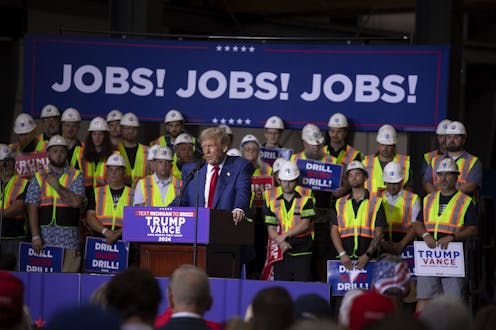
Headlines following Donald Trump’s election victory focused largely on the influence of personalities, such as Elon Musk or Robert Kennedy junior, and single issues, such as how US tariff hikes would affect New Zealand’s exports.
But this oversimplifies and diverts attention from the more systemic challenges a second Trump presidency will pose for Aotearoa New Zealand’s economy.
Yes, Trump is an unpredictable authoritarian and an economic disruptor. But his policies are not novel and need to be understood in a broader context.
Many of Trump’s trade policies are an extension of recent US-centric strategies to dismantle the global free trade model. Ironically, the US largely created this model, but it no longer serves US objectives.
The international trade regime, and the neoliberal model of free trade in general, now face an existential crisis that New Zealand cannot ignore.
Free trade backlash
Trump’s tool of choice for trade policy is high tariffs or border taxes, which make imports more expensive. His agenda is driven by two factors:
increasing production and jobs in the US domestic economy and incentivising foreign firms to invest within the US border to avoid tariffs
geopolitically, using super-tariffs to undercut China’s rise as a competing power.
Neither objective is new. The tariffs Trump imposed in his previous term, especially on China, were largely continued under Joe Biden. They were part of a broader backlash against free trade agreements in the US.
Trump withdrew the US from the Trans-Pacific Partnership Agreement (TPPA). The Biden administration did not rejoin and eschewed the Democrats’ traditional approach to free trade.
Biden’s Indo-Pacific Economic Framework (IPEF) promoted non-tariff strategies designed to boost US industrial, investment and security interests in Asia. Its “friend-shoring” approach aimed to strengthen economic and foreign policy alliances, including with New Zealand, while eroding China’s influence, especially over critical supply chains in the region.
Interestingly, Trump condemned the IPEF (incorrectly) as a reincarnation of the TPPA, so its fate remains uncertain.
WTO in crisis
There has been a similar cross-party convergence on US challenges to the “rules-based” international trade regime. Both Democrat and Republican administrations have systematically undermined the World Trade Organization (WTO), claiming it no longer serves US interests.
Successive US administrations, starting with Barack Obama’s, have paralysed the WTO’s two-tier dispute system by refusing to appoint new Appellate Body members. This means they can break the WTO rules with impunity – including by imposing unilateral tariff sanctions.
At this year’s WTO Public Forum in September, people were openly discussing the existential crisis in the organisation and possible responses if the US disengages completely.
Breakdown of rules
This is just one part of the WTO’s institutional disintegration. The Doha Development Round, launched in 2001, had effectively collapsed by 2008.
In large part, this was over the Agreement on Agriculture. Its foundations were laid in 1993 by the so-called Blair House Accord, which ensured the US and European Union did not have to reduce (and could continue to increase) subsidies for their farmers. They insisted that continue.
Meanwhile, the US and EU stymied demands from developing countries for alternative “safeguard” and “public stockholding” arrangements to support their farmers and ensure food security.
The US, EU and others blocked a waiver of intellectual property rights that would have ensured affordable access to vaccines, diagnostics and supplies during the COVID-19 (and future) pandemics.
Subsets of members, including New Zealand, have ignored the WTO’s own rules to negotiate plurilateral agreements without a mandate, and seek to dilute the “consensus” rule to have them adopted. Ironically, the main opponents, India and South Africa, are labelled the “blockers” for standing up for the WTO rules.
New Zealand’s challenge
So, the crises in the international trade regime (and the neoliberal model of free trade) predate Trump’s first term.
But successive New Zealand governments have put all their eggs in the “free trade” basket of the WTO and regional and bilateral trade agreements.
Current Trade Minister Todd McClay seems determined to secure new agreements as rapidly as possible, illustrated by the 100-day negotiation of a recent deal with the United Arab Emirates under strict secrecy and with minimal scrutiny.
The previous Labour government pragmatically engaged in the IPEF more as a geopolitical alliance with the US than as a trade forum, despite New Zealand’s export dependency on China and the lack of any clear economic benefits.
So far, the reaction to Trump’s re-election from government ministers, business, farmers and news media has given an impression of business as usual, albeit with the threat of unhelpful US tariffs. But what is really needed is a far-reaching debate about the risks of a failing international trade system.
New Zealand’s export share of GDP has not changed meaningfully over the past few decades, despite more than two-thirds of New Zealand’s exports being covered by free trade agreements. The primary problem is not a lack of markets, but rather firms’ export capability, weak innovation, and an over-reliance on low-value-added commodities.
The now-disbanded Productivity Commission’s work on improving economic resilience urged New Zealand to tackle head-on the challenges of an increasingly uncertain and volatile economic and geopolitical world.
That apparently fell on deaf ears. But Trump’s re-election is an opportunity to open that debate and confront those challenges.
Authors: Jane Kelsey, Emeritus Professor of Law, University of Auckland, Waipapa Taumata Rau


 Daily Bulletin


