

215 million hectares of forest – an area bigger than Mexico – could grow back by itself, if we can just leave it alone
- Written by: Brooke Williams, Research Fellow, School of Biology & Environmental Science, Queensland University of Technology
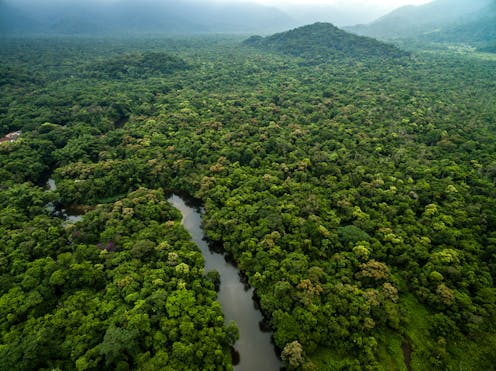
About 215 million hectares of land – an area bigger than Mexico – could be reforested naturally and without costly manual planting, our new research shows.
This would allow us to offset around 23.4 gigatonnes of global carbon emissions over the next three decades. That’s about 50 years worth of Australia’s carbon emissions (assuming 2023 emission rates continue).
Extensive and effective forest restoration is crucial to mitigating climate change and conserving biodiversity.
It’s vital we find cost-effective ways to get and keep more trees in the ground. One way to do this is just to let forests grow back by themselves. However, this isn’t possible in all deforested lands, as certain environmental conditions are needed for this approach to work.
Our research identified land where this approach had strong potential.

The benefits of natural regeneration
Globally, 65% of original tropical forest extent has been lost to make way for human development such as agriculture, roads, and urbanisation. Deforestation has contributed to climate change and biodiversity loss.
We’ve also lost a worrying amount of what researchers call “ecosystem services”, meaning the benefits people derive from nature, such as clean water.
Forest restoration is an important strategy for reversing the damage.
Our paper, published in the journal Nature, looked at where natural regeneration is likely to be successful due to the surrounding environmental conditions.
Natural regeneration is important because it is sometimes better than manual tree planting, which includes the costs of saplings, manual labour, fertilisation and maintenance.
Using manual techniques in degraded landscapes can be expensive. It can also be less effective in terms of native biodiversity recovery and keeping water systems functioning well.
Natural regeneration is a less costly alternative. That means allowing forests to grow back on their own or with carefully planned human intervention.
For example, natural reforestation may cost between $US12 and $3,880 per hectare. By contrast, active regeneration methods in the tropics would cost between $105 and $25,830 per hectare.
Natural regeneration restoration methods often have better long-term success and biodiversity outcomes than full manual tree-planting.
Studies have found that biodiversity “success” – meaning richer biodiversity and more species – can be up to 56% higher when natural regeneration approaches were used (rather than manual planting projects).
 It’s vital we find cost-effective ways to get and keep more trees in the ground.
Richard Whitcombe/Shutterstock
It’s vital we find cost-effective ways to get and keep more trees in the ground.
Richard Whitcombe/Shutterstock
Where might natural reforestation projects succeed?
Until now, it’s not always been clear how to predict areas where natural regeneration is most likely to occur. That’s made it hard to do large-scale natural regeneration projects.
Our research addresses this gap. We identified the best areas to roll out natural approaches in the tropics.
We focused on tropical forested regions because they are particularly important.
Their biodiversity is unparalleled and they provide vast economic, cultural, and recreational services to people.
They also grow much faster than other forest types, and many large tropical forests have already been cleared and degraded.
Factors that make a forest likely to regenerate naturally include:
- the amount of surrounding forest
- distance to existing forest and
- soil organic carbon content
This suggests areas with higher levels of landscape degradation and intensive land uses would be less likely to regenerate naturally.
We found suitable environmental conditions for natural regeneration occur across:
98 million hectares in the Neotropics (which includes many areas in South and Central America)
90 million hectares in the Indomalayan tropics (which includes many areas in Southeast Asia, Malaysia, and India)
25.5 million hectares in the continent of Africa
Up to 52% of this natural regeneration could occur in just five countries: Brazil, Indonesia, China, Mexico, and Colombia.
This suggests these countries would be excellent candidates for large scale natural regeneration projects.
We also found that 29 other countries have at least one million hectares each that could be naturally reforested.
We identified 400,000 hectares of deforested lands with potential for natural forest regeneration in the Australian tropics.
 Fixing forests will also improve biodiversity.
Martin Prochazkacz/Shutterstock
Fixing forests will also improve biodiversity.
Martin Prochazkacz/Shutterstock
The world has committed to fixing forests
The world has committed to ambitious forest restoration targets in order to substantially increase the area of forest ecosystems by 2050.
These commitments include the Bonn Challenge, which aims to restore 350 million hectares by 2030.
Another is Target 2 of the recently adopted Global Biodiversity Framework, which calls for 30% of the area of degraded ecosystems to be restored by 2030.
Achieving these targets, especially for nations with emerging economies, will not be possible using active restoration techniques alone. This due to cost and feasibility constraints.
To assist with this global task, we have made our dataset publicly available and free to use.
Local communities at the centre
Encouraging natural regeneration remains a major challenge, particularly on privately held and communally managed land because it can mean reduced land available for other uses.
Providing local people with training and support to grow, harvest and market products sourced from naturally regenerating forests is also crucial. This could help keep young naturally regenerating forests standing and growing.
This income could supplement or replace payments landowners and local people currently receive to look after land and prevent it from being deforested. Payment-based approaches are not always sustainable in the long term.
Currently, many forests are controlled and managed by central or national governments. Giving local and Indigenous communities control over their forests would help encourage restoration that meets local needs.
However, this requires appropriate technical support and monitoring.
Importantly, our analysis does not define where restoration activities should or should not occur. We only show where natural forest regeneration is possible or more likely to succeed.
We echo calls to ensure restoration occurs as equitably as possible, and foregrounds the needs of local people.
 Forest restoration should be as equitable as possible, and foreground the needs of local people.
WNDR Worlds/Shutterstock
Forest restoration should be as equitable as possible, and foreground the needs of local people.
WNDR Worlds/Shutterstock
Let’s give it a chance
Natural forest regeneration presents an opportunity to restore vast areas of forest cheaply and effectively. It can help mitigate the effects of climate change and help countries meet their emissions reduction targets.
Other benefits include conserving biodiversity, regulating water resources, reducing erosion, and making ecosystems more resilient.
Recognising the massive regeneration capacity of tropical forests is key.
It’s also crucial it occurs alongside protecting intact forests, and reducing deforestation.
Authors: Brooke Williams, Research Fellow, School of Biology & Environmental Science, Queensland University of Technology


 Daily Bulletin


