

Feminist politics and investigative journalism combine in a moving story of a sister murdered
- Written by: Liz Evans, Adjunct Researcher, English and Writing, University of Tasmania
Liliana Rivera Garza first met Angel Gonzalez Ramos while she was still at high school in Toluca, Mexico, in 1984. Obsessive from the start, Angel spent months winning her over, then suddenly took up with an old girlfriend, breaking her heart.
When Liliana moved to Mexico City to study architecture, her free-spirited nature flourished. She attracted friends and lovers alike. But Angel began turning up at weekends, hovering silently on the edge of her social life, unable to leave her alone.
A marginalised, threatening presence, Angel was not welcomed by Liliana’s circle. She began to shrug him off, but his jealousy bloomed into murderous rage. On the night of July 16, 1990, he broke into her apartment and killed her. She was just 20 years old.
Almost 30 years later, Liliana’s older sister, award-winning author Cristina Rivera Garza, found the courage to confront her grief and write about the crime that devastated her family. The result is Liliana’s Invincible Summer, a deeply moving, powerfully haunting work that defies genre with a rare combination of poetic and scholarly sensibilities.
Review: Liliana’s Invincible Summer: A Sister’s Search for Justice – Cristina Rivera Garza (Bloomsbury)
Shattering and unforgettable
Some of the most poignant memoirs I have read are by women struggling to come to terms with the death of their sisters. Clover Stroud’s The Red of My Blood: A Death and Life Story (2022) takes a raw, quivering plunge into the emotional battlefield of bereavement. Justine Picardie’s If the Spirit Moves You: Life and Love After Death (2001) follows the author on a desperate quest to try and find her dead sister in the world of the living.
Both writers watched their sisters succumb to cancer. Their wild, brave, impossibly tender books are attempts to work out what to do with the parts of themselves that once existed within a relationship that is now gone forever.
When a sister is murdered, the already unbearable loss is disrupted by unthinkable horror. In her extraordinary meditation on forgiveness, If You Sit Very Still (2012), Marian Partington recounts the terrible story of her sister Lucy, who was missing for 21 years before her remains were found buried beneath the house of British serial killers, Fred and Rosemary West. Buddhism helped Partington withstand an experience that would break most of us, and she ended up viewing the Wests with pathos.

Liliana’s Invincible Summer is equally shattering and unforgettable, and at times reads similarly like a fever dream. But the main point of difference is that it is not solely a story about Liliana. It is also a story by her.
A trove of painstaking and clearly painful research, Rivera Garza’s hybrid narrative embeds personal memories and reflections within a collated archive of police reports, architectural plans, interviews with Liliana’s friends and lovers, and, most importantly, her private letters and notebooks.
By threading her sister’s words into her own text, Rivera Garza gives Liliana a voice. She analyses each of Liliana’s handwritten words for clues, meticulously attempting to piece together an insight into her brilliant mind and generous heart. Every tiny pen stroke, every change of ink colour, takes on peculiar significance in the wake of Liliana’s death.
This is primarily a story about connection, in life and beyond. “Grief is the end of loneliness,” Rivera Garza states at the end of a particularly poignant passage about the constant presence of the dead.
A deeply personal account, the book is also driven by a wider political purpose. Femicide is now a recognised global scourge. Liliana’s tragic story refuses the facelessness of crime statistics and proves there is no such thing as just another victim.
The scourge of femicide
The term “femicide” – the gender-based killing of a woman or a girl – has been in use since 1801. In 1976, it was publicised by South African feminist Diana E.H. Russell to distinguish the specific nature of the crime from a broader understanding of homicide. According to the United Nations, the African continent has the highest rates of femicide in the world, but the Americas are not far behind, with Brazil, El Salvador and Mexico being the most badly afflicted.
In August this year, Britain’s new Home Secretary, Yvette Cooper, ordered a review of the UK’s counter-extremism strategy to deal with threats arising from harmful ideological beliefs. Aligning violence against women with terrorism, the study will include extreme misogyny in acknowledgment of the severity of the issue.
Days after this announcement, in her address to the National Press Club, Australia’s Domestic, Family and Sexual Violence Commissioner Micaela Cronin declared that violence against women and children should be taken as seriously as terrorism. This year alone, 35 Australian women have been killed within a domestic or family setting, and a further 17 because of violent men.
Campaigners including Jess Hill, Laura Bates and Joan Smith have long been calling for femicide to be treated as terrorism. Such killings are often reported as “isolated incidents” by police who don’t want a riot on their hands, but the truth is that all gender-based murders are the product of systemic misogyny, no matter where they occur.
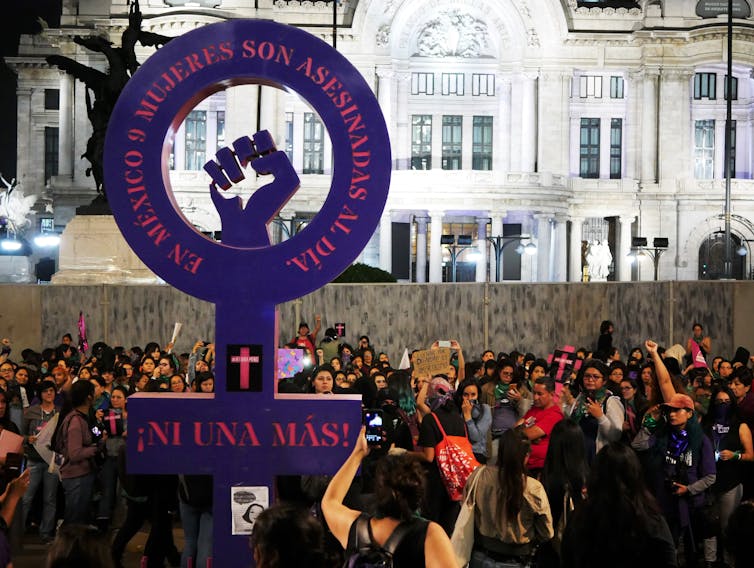
In Mexico, where gender discrimination has been historically severe, the concept of femicide was officially recognised by the country’s federal code in 2012. In 2020, Mexico City appointed an attorney general to deal with femicide cases. Prior to this, intimate partner murders were known as “crimes of passion”. Victims were described as “loose” and “wayward”, and effectively blamed for their fate.
Despite the legal changes, misogynistic attitudes remain entrenched. Intimate partner abuse is on the rise in Mexico. A recent national survey showed that just over 70% of women have experienced domestic violence. It is estimated that as many as 10 women and girls are killed each day by male perpetrators.
Change for women in Mexico has been slow and intermittent, but it is occurring. International Women’s Day is now marked by huge protests calling for political and social measures to protect women. In June, the country elected its first woman president, Claudia Sheinbaum. Organised crime and structural discrimination present very real challenges for the new leader, but her appointment brings a measure of hope for the female population.
 Claudia Sheinbaum was recently elected as Mexico’s first woman president.
Jose Mendez/AAP
Claudia Sheinbaum was recently elected as Mexico’s first woman president.
Jose Mendez/AAP
Progress and heartache
Rivera Garza believes her book is a sign of social progress. On March 8 this year, more than 30 women, including Rivera Garza, participated in an online reading of Liliana’s story as a call to justice and to raise awareness of gender-based violence.
“I had to wait for us as a community and a society to produce a language through which I could tell this story from my sister’s point of view,” she told the New York Times following the publication of the original Spanish edition, El invencible Verano de Liliana.
Rivera Garza is a Hispanic Studies professor and creative writing academic, who has translated the book into English herself. She is better positioned than most to judge the evolving relationship between words and ideas. When it comes to emotional linguistics, her skills are equally astonishing.
 The book opens with Rivera Garza returning to the scene of Liliana’s unsolved murder where she finally confronts her grief, and berates herself for not having visited earlier. On learning that Liliana’s police file has been destroyed, she deals with her resulting anger and frustration by building her own case study of her beloved sister. And she confronts unimaginable pain and horror when detailing the horrific way in which Liliana was murdered by a violent ex-boyfriend who couldn’t live with rejection.
Finally, towards the end of the book, Rivera Garza delves into her parents’ enduring heartache, asking them to reminisce about their beloved youngest child. Their memories and reflections, so full of pride and pain, involve occasional comparisons between the two daughters. I did wonder how Rivera Garza has lived with this particular shadow, though she never alludes to it. It is simply not her focus.
When Liliana died, Rivera Garza was in Houston. Her parents were flying through a storm over the North Sea in a small plane, on the trip of a lifetime. Before she was killed, Liliana was also planning to travel.
About a month before her murder, her diary entries describe an emotional rollercoaster. Several men, including Angel, were playing a part. On June 25, Liliana wrote the words of Albert Camus in her diary: “In the midst of winter, I found there was, within me, an invincible summer.”
Camus had once used this line to console a girl who had been betrayed and it clearly resonated with Liliana. With summer underway, she was reconnecting with an old boyfriend, Manolo Casillas Espinal, and looking forward to continuing her studies overseas. She had finally resolved to throw off Angel’s long and menacing shadow.
The book opens with Rivera Garza returning to the scene of Liliana’s unsolved murder where she finally confronts her grief, and berates herself for not having visited earlier. On learning that Liliana’s police file has been destroyed, she deals with her resulting anger and frustration by building her own case study of her beloved sister. And she confronts unimaginable pain and horror when detailing the horrific way in which Liliana was murdered by a violent ex-boyfriend who couldn’t live with rejection.
Finally, towards the end of the book, Rivera Garza delves into her parents’ enduring heartache, asking them to reminisce about their beloved youngest child. Their memories and reflections, so full of pride and pain, involve occasional comparisons between the two daughters. I did wonder how Rivera Garza has lived with this particular shadow, though she never alludes to it. It is simply not her focus.
When Liliana died, Rivera Garza was in Houston. Her parents were flying through a storm over the North Sea in a small plane, on the trip of a lifetime. Before she was killed, Liliana was also planning to travel.
About a month before her murder, her diary entries describe an emotional rollercoaster. Several men, including Angel, were playing a part. On June 25, Liliana wrote the words of Albert Camus in her diary: “In the midst of winter, I found there was, within me, an invincible summer.”
Camus had once used this line to console a girl who had been betrayed and it clearly resonated with Liliana. With summer underway, she was reconnecting with an old boyfriend, Manolo Casillas Espinal, and looking forward to continuing her studies overseas. She had finally resolved to throw off Angel’s long and menacing shadow.
 Protestor at the International Women’s Day march, Guadalajara, Mexico, March 8, 2022.
Francisco Guasco/AAP
Early in the morning of July 17, 1990, Manolo arrived early to collect Liliana from her apartment. They had been up late working on a university project together. Instead of finding her ready to leave, he discovered her lifeless body beneath the sheets on her bed.
The nightmare was set in motion. Liliana’s landlord arrived, followed by an ambulance and detectives, who, with the help of witnesses, were able to identify her attacker. Despite a warrant being put out for his arrest, Angel vanished. His family denied all knowledge of his whereabouts. He was never detained.
When her book was published, Rivera Garza opened an email account so people could contact her with any new information about Angel Gonzalez Ramos. She discovered that he had died in 2020. He had been living in California under an assumed identity.
While Liliana’s murderer escaped justice, the global reach and purpose of her story continues to resonate. We talk of the personal being political. Rivera Garza’s book is the very embodiment of that phrase. In recognition of her incredible feat, she was awarded a Pulitzer Prize, on the strength of her integration of feminist politics and investigative journalism into a beautifully crafted non-fiction narrative.
It is the least she deserves. And no doubt she will think of this prize as belonging equally to Liliana.
Authors: Liz Evans, Adjunct Researcher, English and Writing, University of Tasmania
Protestor at the International Women’s Day march, Guadalajara, Mexico, March 8, 2022.
Francisco Guasco/AAP
Early in the morning of July 17, 1990, Manolo arrived early to collect Liliana from her apartment. They had been up late working on a university project together. Instead of finding her ready to leave, he discovered her lifeless body beneath the sheets on her bed.
The nightmare was set in motion. Liliana’s landlord arrived, followed by an ambulance and detectives, who, with the help of witnesses, were able to identify her attacker. Despite a warrant being put out for his arrest, Angel vanished. His family denied all knowledge of his whereabouts. He was never detained.
When her book was published, Rivera Garza opened an email account so people could contact her with any new information about Angel Gonzalez Ramos. She discovered that he had died in 2020. He had been living in California under an assumed identity.
While Liliana’s murderer escaped justice, the global reach and purpose of her story continues to resonate. We talk of the personal being political. Rivera Garza’s book is the very embodiment of that phrase. In recognition of her incredible feat, she was awarded a Pulitzer Prize, on the strength of her integration of feminist politics and investigative journalism into a beautifully crafted non-fiction narrative.
It is the least she deserves. And no doubt she will think of this prize as belonging equally to Liliana.
Authors: Liz Evans, Adjunct Researcher, English and Writing, University of Tasmania


 Daily Bulletin


