

Wondering what AI actually is? Here are the 7 things it can do for you
- Written by: Sandra Peter, Director of Sydney Executive Plus, University of Sydney

You know we’ve reached peak interest in artificial intelligence (AI) when Oprah Winfrey hosts a television special about it. AI is truly everywhere. And we will all have a relationship with it – whether using it, building it, governing it or even befriending it.
But what exactly is AI? While most people won’t need to know exactly how it works under the hood, we will all need to understand what it can do. In our conversations with global leaders across business, government and the arts, one thing stood out – you can’t fake it anymore. AI fluency that is.
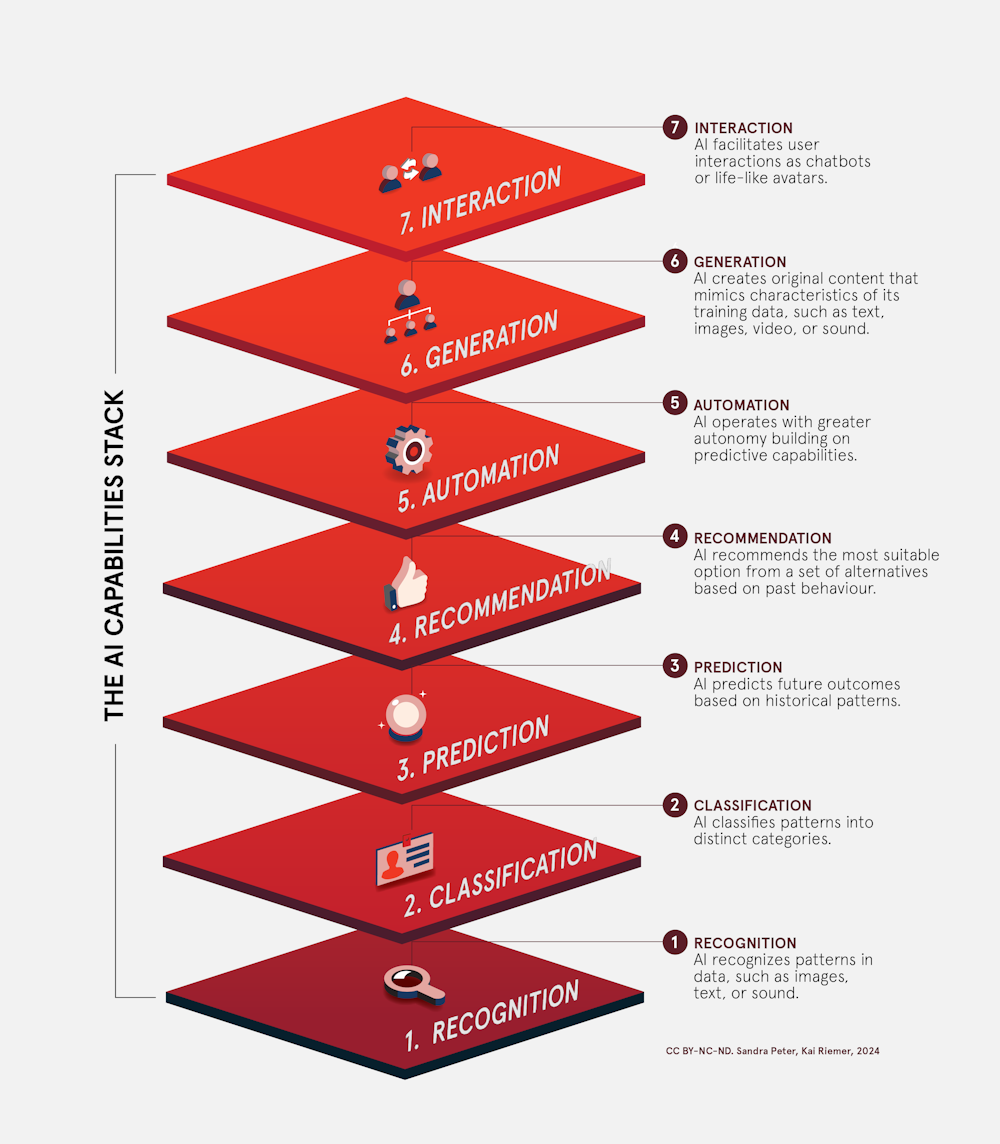
AI isn’t just about chatbots. To help understand what it is about, we’ve developed a framework which explains the broad broad range of capabilities it offers. We call this the “capabilities stack”.
We see AI systems as having seven basic kinds of capability, each building on the ones below it in the stack. From least complex to most, these are: recognition, classification, prediction, recommendation, automation, generation and interaction.
Recognition
At its core, the kind of AI we are seeing in consumer products today identifies patterns. Unlike traditional coding, where developers explicitly program how a system works, AI “learns” these patterns from vast datasets, enabling it to perform tasks. This “learning” is essentially just advanced mathematics that turns patterns into complex probabilistic models – encoded in so-called artificial neural networks.
Once learned, patterns can be recognised – such as your face, when you open your phone, or when you clear customs at the airport.
Pattern recognition is all around us – whether it’s license plate recognition when you park your car at the mall, or when the police scan your registration. It’s used in manufacturing for quality control to detect defective parts, in health care to identify cancer in MRI scans, or to identify potholes by using buses equipped with cameras that monitor the roads in Sydney.
Classification
Once an AI system can recognise patterns, we can train it to detect subtle variations and categorise them. This is how your photo app neatly organises albums by family members, or how apps identify and label different kinds of skin lesions. AI classification is also at work behind the scenes when phone companies and banks identify spam and fraud calls.
In New Zealand, non-profit organisation Te Hiku developed an AI language model to classify thousands of hours of recordings to help revitalise Te Reo Māori, the local indigenous language.
Prediction
When AI is trained on past data, it can be used to predict future outcomes. For example, airlines use AI to predict the estimated arrival times of incoming flights and to assign gates on time so you don’t end up waiting on the tarmac.
Similarly, Google Flights uses AI to predict flight delays even before airlines announce them.
In Hong Kong, an AI prediction model saves taxpayer money by predicting when a project needs early intervention to prevent it overrunning its budget and completion date. And when you buy stuff on Amazon, the ecommerce giant uses AI to predict demand and optimise delivery routes, so you get your packages within hours, not just days.
Recommendation
Once we predict, we can make recommendations for what to do next.
If you went to Taylor Swift’s Eras tour concert at Sydney’s Accor stadium, you were kept safe thanks to AI recommendations. A system funded by the New South Wales government used data from multiple sources to analyse the movement and mood of the 80,000 strong crowd, providing real-time recommendations to ensure everyone’s safety.
AI-based recommendations are everywhere. Social media, streaming platforms, delivery services and shopping apps all use past behaviour patterns to present you with their “for you” pages. Even pig farms use pig facial recognition and tracking to alert farmers to any issues and recommend particular interventions.
 AI was used for crowd safety purposes at Taylor Swift’s recent concerts in Sydney.
Dean Lewins/AAP
AI was used for crowd safety purposes at Taylor Swift’s recent concerts in Sydney.
Dean Lewins/AAP
Automation
It’s a small step from prediction and recommendation to full automation.
In Germany, large wind turbines use AI to keep the lesser spotted eagle safe. An AI algorithm detects approaching birds and automatically slows down the turbines allowing them to pass unharmed.
Closer to home, Melbourne Water uses AI to autonomously regulate its pump control system to reduce energy costs by around 20% per year. In Western Sydney, local buses on key routes are AI-enabled: if a bus is running late, the system predicts its arrival at the next intersection and automatically green-lights its journey.
Generation
Once we can encode complex patterns into neural networks, we can also use these patterns to generate new, similar ones. This works with all kinds of data – images, text, audio and video.
Image generation is now built into many new phones. Don’t like the look on someone’s face? Change into a smile. Want a boat on that lake? Just add it in. And it doesn’t stop there.
Tools such as Runway let you manipulate videos or create new ones with just a text prompt. ElevenLabs allows you to generate synthetic voices or digitise existing ones from short recordings. These can be used to narrate audiobooks, but also carry risks such as deepfake impersonation.
And we haven’t even mentioned large language models such as ChatGPT, which are transforming how we work with text and how we develop computer code. Research by McKinsey found that these models can cut the time required for complex coding tasks by up to 50%.
Interaction
Finally, generative AI also makes it possible to mimic human-like interactions.
Soon, virtual assistants, companions and digital humans will be everywhere. They will attend your Zoom meeting to take notes and schedule follow-up meetings.
Interactive AI assistants, such as IBM’s AskHR bot, will answer your HR questions. And when you get home, your AI friend app will entertain you, while digital humans on social media are ready to sell you anything, any time. And with voice mode activated, even ChatGPT gets in on the inter-action.
Amid the excitement around generative AI, it is important to remember that AI is more than chatbots. It impacts many things beyond the flashy conversational tools – often in ways that quietly improve everyday processes.
Authors: Sandra Peter, Director of Sydney Executive Plus, University of Sydney


 Daily Bulletin


