

Holy moly! Scott Morrison has plans for your (and his) own good
- Written by: Joshua Black, Political Historian and Administrator Officer, Australian Historical Association, Australian National University
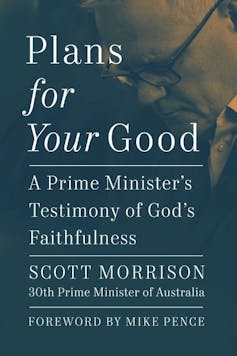
If Scott Morrison’s Plans for Your Good is a memoir, it is in the tradition of Christian autobiography. But unlike St Augustine – the author of the most famous example – Morrison does not have anything to say about a sinful youth. Indeed, confession – so often a feature of the genre – is rather hard to find.
Scott meets his eventual wife, Jenny, at Luna Park on a religious youth group excursion while they are still at primary school. They begin dating towards the end of high school, and marry when he is 21. After 14 painful years of infertility, including unsuccessful IVF treatment, they are blessed with two daughters, who are “the faces of God’s goodness”.
Review: Plans for Your Good: A Prime Minister’s Testimony of God’s Faithfulness – Scott Morrison (Thomas Nelson)
In reality, Morrison’s book, targeted at an explicitly Christian market, belongs more comfortably in the modern motivational or self-help field of publishing. And while he weaves some elements of political memoir around a narrative replete with biblical stories and scriptural quotations, he is coy about any sins he might have committed in politics.
He tells us the political world he faced as prime minister was “a malevolent and often toxic” environment, but there are few hints of any role he might have played in making it that way.

 Scott Morrison reading during Good Friday Easter services at St Charbel’s Catholic Maronite Church, Punchbowl, April 19, 2019.
Mick Tsikas/AAP
God’s plan
Politics aside, Plans for Your Good is a very strange book. The chapters take for their titles major existential questions, but not in an especially compelling order, and not according to any theological rationale. The prose is at once childish (in the manner of the books of bible stories one used to find in doctors’ waiting rooms), evangelical, unconvincingly folksy and uncomfortably jingoistic.
It also contains some of the clumsiest literary segues we have seen. The following example is indicative:
whenever we pray, we have entered a sacred and holy space. In some ways, it is like when I was prime minister and I would go to meet the Queen.
Not even that transition trumps Morrison’s accounts of his conversations with his maker, some of them “pretty heated”. “Why are You letting my enemies get the better of me?” Morrison enquires after his election defeat, to which the Lord replies:
Scott, I get it. I’ve been there and worse […] I did it all for you, because I really love you.
That dialogue (and much else like it) belies the real nature of Morrison’s conception of faith. Denominational differences are mere earthly irrelevances in which one must not get bogged down. It is the stories of Daniel and David, of Moses and Joshua, the psalms and the gospels that really matter.
Morrison wants to be seen like Moses, who trusts God by raising his staff before the Red Sea is parted. It is God’s plan and power that parts the sea, but it is a leader – a Moses or a Morrison – who becomes His instrument in the world: a neat way for a Christian believer such as Morrison to think about political action.
But his version of Christianity comes across as corporate and individualistic. Morrison expects good works, loyalty and faithfulness from God, as he did from his political colleagues. “Christianity is the only religion in the world that is based on God reaching out to us,” he explains. The book is, to use his own words, an account of what “God has done” for the former prime minister “through His faithfulness”.
The only other Australian prime minister whose writings suggest they saw the world in such spiritual terms was Alfred Deakin, thrice prime minister in the first decade of federation. As a young man, Deakin wrote A New Pilgrim’s Progress, which he believed had been dictated to him by the spirit of John Bunyan, the author of the original Pilgrim’s Progress.
Scott Morrison reading during Good Friday Easter services at St Charbel’s Catholic Maronite Church, Punchbowl, April 19, 2019.
Mick Tsikas/AAP
God’s plan
Politics aside, Plans for Your Good is a very strange book. The chapters take for their titles major existential questions, but not in an especially compelling order, and not according to any theological rationale. The prose is at once childish (in the manner of the books of bible stories one used to find in doctors’ waiting rooms), evangelical, unconvincingly folksy and uncomfortably jingoistic.
It also contains some of the clumsiest literary segues we have seen. The following example is indicative:
whenever we pray, we have entered a sacred and holy space. In some ways, it is like when I was prime minister and I would go to meet the Queen.
Not even that transition trumps Morrison’s accounts of his conversations with his maker, some of them “pretty heated”. “Why are You letting my enemies get the better of me?” Morrison enquires after his election defeat, to which the Lord replies:
Scott, I get it. I’ve been there and worse […] I did it all for you, because I really love you.
That dialogue (and much else like it) belies the real nature of Morrison’s conception of faith. Denominational differences are mere earthly irrelevances in which one must not get bogged down. It is the stories of Daniel and David, of Moses and Joshua, the psalms and the gospels that really matter.
Morrison wants to be seen like Moses, who trusts God by raising his staff before the Red Sea is parted. It is God’s plan and power that parts the sea, but it is a leader – a Moses or a Morrison – who becomes His instrument in the world: a neat way for a Christian believer such as Morrison to think about political action.
But his version of Christianity comes across as corporate and individualistic. Morrison expects good works, loyalty and faithfulness from God, as he did from his political colleagues. “Christianity is the only religion in the world that is based on God reaching out to us,” he explains. The book is, to use his own words, an account of what “God has done” for the former prime minister “through His faithfulness”.
The only other Australian prime minister whose writings suggest they saw the world in such spiritual terms was Alfred Deakin, thrice prime minister in the first decade of federation. As a young man, Deakin wrote A New Pilgrim’s Progress, which he believed had been dictated to him by the spirit of John Bunyan, the author of the original Pilgrim’s Progress.
 Caricature of Alfred Deakin in Vanity Fair, September 1908.
Leslie Ward, Public domain, via Wikimedia Commons
Deakin’s private writings are full of his sense of providential history, of a world organised according to God’s plan, and of his own poor self as unworthy, sinning and needful of God’s help.
There is some of this in Morrison’s book, but his religion has more of an off-the-shelf feel about it. It is something that can be bought on the internet to help in achieving success, or at least provide consolation in life. Believers can just “set up a meeting with God” where “everything is on the agenda” and “transfer ownership” of their worries to God. This is not the late-Victorian agonising of Deakin over the purpose of existence, nor the Protestant ethic Max Weber wrote about, but something altogether more banal and transactional.
There are contradictions in Morrison’s faith and his political record, but that is not to say his belief is anything other than sincere. When he says it is not for Christians to judge others, he has presumably forgotten about his brutal humiliation of Australia Post chief executive Christine Holgate on the floor of parliament. But much the same could be said of Deakin in his day: the high-minded phrases went hand-in-hand with opportunism and deceit when it suited his purposes.
Much commentary around Plans for Your Good has thus far focused on a very brief passage in which Morrison reveals he was medicated for anxiety during the pandemic. This disclosure is brave and well-meaning, though not as unprecedented as some are making out. Turnbull and former minister Andrew Robb have also written about their struggles with mental health, and there have been instances of suicide and attempted suicide by politicians in this country.
Optimistic outlook
Still, there are at least two positive qualities worth recognising in this book.
First, even allowing for God’s hand in his policy-making processes, Morrison is candid about the uncertainties he encountered when responding to the pandemic. He is probably right to say that, in 2020, “there were no easy calls”. He describes the data (ranging from infection rates to bond yields) on which he and others depended as they made a “large number of decisions” each day. Though unapologetic about opposing school closures and vaccine mandates, he does acknowledge public unhappiness with the vaccine strollout and the “trouble obtaining rapid antigen tests”. He admits personal regret for supporting Clive Palmer’s legal assault on Western Australia’s border closure.
Second, the book has an astonishing and admirable lack of vindictiveness. There is virtually no score-settling, and any criticism of others is latent or implied. His outlook stands in stark contrast to that of his successor Peter Dutton. The present leader of the opposition presents the world in Manichean terms, as a place where goodness and decency require protection from the very worst lurking among us and their evil instincts.
Morrison has a more optimistic outlook: the world is a sunny upland where grace, love, joy and friendship are embodied in family, faith and community. He loves his wife and daughters, and feels the need to keep telling us so: no other Australian political memoir is so uxorious. He has good friends – mainly from outside politics – and he holds them tight. He meets good people on life’s journey and they became his friends and, sometimes, advisers and mentors – an ever-present help in trouble, as the psalm says.
There are some moving stories of love and forgiveness, which (with God’s help) will overwhelm pride and bitterness. God – always with His plan – will do us good, even if there is suffering and failure along the way.
As we would expect of Morrison, this performance of selflessness and grace is also calculated to achieve certain results. Plans for Your Good is the equivalent of a round of door-knocking in a new neighbourhood to which one has just moved. The prose is littered with clumsy cultural translations to help US readers understand this knockabout Aussie’s words. Quite literally: “How good is God?”
Published under a specifically Christian imprint, the book seems designed to ingratiate Morrison with conservative evangelical fellow travellers in the US corporate and defence scenes. Theirs is a world led by people who, like Morrison, worry over the threats to the dominance of Judeo-Christian values. The least optimistic aspect of his account is his belief that Christians are now a beleaguered minority who, in a world of receding religiosity, “will increasingly face trials, discrimination, mocking, and persecution”.
As he did during his political career, Morrison condemns identity politics. But in passages such as this one, he discloses that he intends a post-prime-ministerial career as a proud cultivator of Christian identity politics, and in more fertile soil than Australia’s. Optimism’s Promised Land beckons.
Authors: Joshua Black, Political Historian and Administrator Officer, Australian Historical Association, Australian National University
Caricature of Alfred Deakin in Vanity Fair, September 1908.
Leslie Ward, Public domain, via Wikimedia Commons
Deakin’s private writings are full of his sense of providential history, of a world organised according to God’s plan, and of his own poor self as unworthy, sinning and needful of God’s help.
There is some of this in Morrison’s book, but his religion has more of an off-the-shelf feel about it. It is something that can be bought on the internet to help in achieving success, or at least provide consolation in life. Believers can just “set up a meeting with God” where “everything is on the agenda” and “transfer ownership” of their worries to God. This is not the late-Victorian agonising of Deakin over the purpose of existence, nor the Protestant ethic Max Weber wrote about, but something altogether more banal and transactional.
There are contradictions in Morrison’s faith and his political record, but that is not to say his belief is anything other than sincere. When he says it is not for Christians to judge others, he has presumably forgotten about his brutal humiliation of Australia Post chief executive Christine Holgate on the floor of parliament. But much the same could be said of Deakin in his day: the high-minded phrases went hand-in-hand with opportunism and deceit when it suited his purposes.
Much commentary around Plans for Your Good has thus far focused on a very brief passage in which Morrison reveals he was medicated for anxiety during the pandemic. This disclosure is brave and well-meaning, though not as unprecedented as some are making out. Turnbull and former minister Andrew Robb have also written about their struggles with mental health, and there have been instances of suicide and attempted suicide by politicians in this country.
Optimistic outlook
Still, there are at least two positive qualities worth recognising in this book.
First, even allowing for God’s hand in his policy-making processes, Morrison is candid about the uncertainties he encountered when responding to the pandemic. He is probably right to say that, in 2020, “there were no easy calls”. He describes the data (ranging from infection rates to bond yields) on which he and others depended as they made a “large number of decisions” each day. Though unapologetic about opposing school closures and vaccine mandates, he does acknowledge public unhappiness with the vaccine strollout and the “trouble obtaining rapid antigen tests”. He admits personal regret for supporting Clive Palmer’s legal assault on Western Australia’s border closure.
Second, the book has an astonishing and admirable lack of vindictiveness. There is virtually no score-settling, and any criticism of others is latent or implied. His outlook stands in stark contrast to that of his successor Peter Dutton. The present leader of the opposition presents the world in Manichean terms, as a place where goodness and decency require protection from the very worst lurking among us and their evil instincts.
Morrison has a more optimistic outlook: the world is a sunny upland where grace, love, joy and friendship are embodied in family, faith and community. He loves his wife and daughters, and feels the need to keep telling us so: no other Australian political memoir is so uxorious. He has good friends – mainly from outside politics – and he holds them tight. He meets good people on life’s journey and they became his friends and, sometimes, advisers and mentors – an ever-present help in trouble, as the psalm says.
There are some moving stories of love and forgiveness, which (with God’s help) will overwhelm pride and bitterness. God – always with His plan – will do us good, even if there is suffering and failure along the way.
As we would expect of Morrison, this performance of selflessness and grace is also calculated to achieve certain results. Plans for Your Good is the equivalent of a round of door-knocking in a new neighbourhood to which one has just moved. The prose is littered with clumsy cultural translations to help US readers understand this knockabout Aussie’s words. Quite literally: “How good is God?”
Published under a specifically Christian imprint, the book seems designed to ingratiate Morrison with conservative evangelical fellow travellers in the US corporate and defence scenes. Theirs is a world led by people who, like Morrison, worry over the threats to the dominance of Judeo-Christian values. The least optimistic aspect of his account is his belief that Christians are now a beleaguered minority who, in a world of receding religiosity, “will increasingly face trials, discrimination, mocking, and persecution”.
As he did during his political career, Morrison condemns identity politics. But in passages such as this one, he discloses that he intends a post-prime-ministerial career as a proud cultivator of Christian identity politics, and in more fertile soil than Australia’s. Optimism’s Promised Land beckons.
Authors: Joshua Black, Political Historian and Administrator Officer, Australian Historical Association, Australian National UniversityRead more https://theconversation.com/holy-moly-scott-morrison-has-plans-for-your-and-his-own-good-229104
-own-good&media=https://dailybulletin.com.au/https://images.theconversation.com/files/591916/original/file-20240502-18-wb7h1o.jpg?ixlib=rb-4.1.0&q=45&auto=format&w=237&fit=clip&description=Holy%20moly!%20Scott%20Morrison%20has%20plans%20for%20your%20(and%20his)%20own%20good "Pin It")

 Daily Bulletin


