

Friday essay: ‘mourning cannot be an endpoint’ – James Bradley on living in an Age of Emergency
- Written by: James Bradley, Honorary Associate, Sydney Environment Centre, The University of Sydney., University of Sydney

One morning in September 2023 I leave my home and drive to the beach. Although it is early, the day is already unseasonably warm, the sky hazy with smoke from hazard-reduction burns to the south and north of the city.
Despite the weather the beach is quiet. Walking to the water’s edge I wade out and dive, then stroke outwards until my breath gives out and I surface with a gasp. Although I have not swum all that far, I am already out past the break, so instead of heading on I turn back towards the beach and tread water slowly. Closer in, a few people are waiting for the waves that roll in now and then, behind me three or four swimmers are stroking their way across the bay, but otherwise I am alone.
There is something very particular about looking back towards the shore from deeper water. When I was younger, and my friends and I would slip away from work in the late afternoons to surf, I always loved drifting out beyond the break as evening approached – the way the colour would bleed out of the world, until it was just you and the movement of the swell. Today, though, it seems enough to just float here.
I suppose that in some part of myself I am taking stock. The past few years have had many challenges, not just the disruptions of the pandemic and its effects on my children, but also other losses, in the form of family illness and death, all of which have left me older, less confident, more aware of the constant proximity of disaster.
The world has also been transformed. Amid the convulsions of COVID, a hastening wave of calamity has made it clear that the first stages of climate breakdown are upon us. After three years in which floods, heatwaves, fires and storms devastated communities and ecosystems around the world, July and August 2023 were the hottest months ever recorded. In Asia, Europe, North America and North Africa, records have been shattered over and over again.
Sanbao in China hit 52.2°C; near the Arctic Circle in Canada temperatures reached almost 38°C; and in Phoenix in the United States, where temperatures exceeded 43°C for 30 days straight, hospitals were crowded with people who had suffered burns from falling onto the pavement.

Fires consumed tens of millions of hectares of forest in Canada, Russia, Greece, Spain, Algeria and even Hawaii, while floods and storms have devastated communities across Asia, Europe and North Africa. Meanwhile, ocean temperatures have also moved into uncharted territory, rising half a degree above previous records in the North Atlantic and reaching more than 38°C off Florida, with catastrophic implications for corals and other marine organisms in the region.
Some have taken to calling this wave of rolling disaster the new normal. But what the world has experienced over the past months and years is not a new normal – it is just the beginning. Combined with the legacies of centuries of colonial violence and extractive processes, the reckless burning of fossil fuels has pushed the planet into a dangerously unstable new state. We now live in an Age of Emergency that will not end in my lifetime.
Read more: Burning fossil fuels is responsible for most sea-level rise since 1970
The brutal reality is that the world has already heated 1.2°C, and in 2023 at least, has already temporarily exceeded 1.5°C of heating, increasing the possibility we may crash through the 1.5°C guardrail within a decade. Even if implemented in full, the emission-reduction targets announced to date by nations around the world will not prevent this; instead they place the planet on a path to 2°C of heating. The level of real-world action falls even further short of what is needed, committing the world to a temperature increase of 2.5–3°C by the end of the century.
A temperature rise of just 2°C will have catastrophic effects on the planet and human life. Heatwaves and extreme weather events will increase significantly. More than half the world’s population will be affected by water scarcity. Food production will decline markedly, especially in regions such as sub-Saharan Africa, Southeast Asia and Central and South America. The distribution and incidence of tropical diseases such as malaria and dengue fever will increase significantly.
The impacts on the non-human world will be even more drastic. Extinction rates will soar. Collapses in insect populations will accelerate, severely disrupting ecosystems and food production. Coral reefs will all but disappear. Warming and acidifying waters will severely impact the fisheries that provide one-third of the world with their principal source of protein.
 The southern reaches of the Great Barrier Reef have been hit hard by the ecosystem’s fifth mass coral bleaching event in eight years.
The Undertow Ocean & Divers for Climate/AAP
The southern reaches of the Great Barrier Reef have been hit hard by the ecosystem’s fifth mass coral bleaching event in eight years.
The Undertow Ocean & Divers for Climate/AAP
Worse yet, with each fraction of a degree of heating, the likelihood of sudden and non-linear change increases. In 2008 scientists identified nine global tipping points, boundaries beyond which the process of change becomes self-perpetuating, leading to rapid and irreversible breakdown. In 2022 a new study added seven more regional tipping points, and produced evidence suggesting we may have already pushed the planet past the threshold of five of them.
The effects of this process are already transforming the world. More than half of the 60 million internally displaced people who were forced to flee their homes in 2022 did so as a result of natural disasters such as cyclones, flooding and drought. In the words of United Nations secretary-general António Guterres, without rapid action to curb emissions and reshape the world economy we face “a mass exodus of entire populations on a biblical scale”, and “ever-fiercer competition for freshwater, land and other resources”.
A shift
This crisis is so immense, so complex and so seemingly intractable, that it sometimes seems impossible to make sense of. But the ocean provides a way of thinking about these questions, of seeing the currents and tidal forces that have borne us here, the way the waves of migration and encounter and exploitation flow across continents and timescales. Attempting to comprehend its immensity and fluid multiplicity alters us, making it possible to glimpse new continuities and connections.
Simultaneously, though, the ocean reveals that the roots of the crisis we inhabit lie deep in the patterns of violent exploitation and extraction that have shaped the modern world.
For those like myself who are the beneficiaries of these historical processes, acknowledging the truth of this violence and its legacies can be confronting, but it is necessary. As the late Sven Lindqvist observes in his interrogation of the racist and genocidal foundations of European imperialism, “It is not knowledge we lack. It is the courage to understand what we know and draw conclusions.”
In other words, the path through involves more than just a shift in energy sources. It begins in a reckoning with the past, and demands a far more fundamental reorganisation of the global economy, a shift to a model that operates within planetary boundaries and shares resources for the benefit of all. The technological and economic tools necessary to achieve this already exist; what is needed is for those solutions to be put in place.
Such a shift is not impossible. The body of economic and social theory outlining how such a world might operate is extensive. Social experiments exploring sustainable systems are underway in cities and communities around the world. Treaties and agreements to control the spread of plastics, and to address problems such as overfishing and pollution, the burning of fossil fuels and other destructive activities, are gradually being brought into being.
Read more: We now have a treaty governing the high seas. Can it protect the Wild West of the oceans?
There is also increasing recognition of the need for adaptation and support for poorer nations. These reforms have not come from nowhere: they are the result of decades of sacrifice by activists, scientists and local and Indigenous communities.
 A pair of northern gannets. Scientists are tracking the threats to seabirds, like gannets, from climate change, overfishing and other perils wrought by humans.
Carolyn Kaster/AP
A pair of northern gannets. Scientists are tracking the threats to seabirds, like gannets, from climate change, overfishing and other perils wrought by humans.
Carolyn Kaster/AP
These victories are only a beginning. The influence of fossil fuel companies and other corporations over governments continues, as the increasing use of state power to curtail protest makes clear. The wealth of the richest continues to grow, as does the rate at which industrialised society is burning through the planet’s reserves. But while these forces can seem overwhelming, unstoppable, they are not.
Only a few years ago, the world was on track for temperature rises of 4°C or more. The fact the temperature increases currently predicted are only slightly more than half that is partly the result of a dizzyingly fast uptake of green technologies.
But it is also a testament to the environmental movement’s tireless efforts to force governments and corporations to alter course, and a reminder that the transformation that is needed will come to pass only through campaigns of mass engagement and civil disobedience.
 Environmental activists stage a protest against the East African Crude Oil Pipeline project in front of TotalEnergies headquarters in Brussels, Belgium, in November.
Frederic Sierakowski/AAP
Environmental activists stage a protest against the East African Crude Oil Pipeline project in front of TotalEnergies headquarters in Brussels, Belgium, in November.
Frederic Sierakowski/AAP
Beauty and astonishment
So much is being lost, and so fast, it is difficult not to feel deranged by it. How do we make sense of the disappearance of coral reefs, of dying kelp and collapsing ecosystems? How do we imagine a world in which the massing life that once inhabited not just the oceans but the earth and the sky is largely gone?
One solution is to simply turn away. The cognitive dissonance of this choice is all around us, as visible in the insistence of politicians that it is possible to keep burning fossil fuels as in the increasingly frantic displays of wealth by the powerful. At a more practical level it is also simply delaying the inevitable: if the past few years have taught us anything, it is that nobody is safe. But it is also to do a kind of violence, for by denying the reality of what is going on we do violence to ourselves, by cauterising our capacity for empathy and grief.
The other alternative, to try to accommodate what is happening, is a far more confronting prospect. The anthropologist and philosopher Deborah Bird Rose, who died in 2018, wrote of the impossibility of bridging the gap between our limited ability to affect what is taking place around ourselves and the cost of facing it.
Yet she also recognised that to turn our backs to it was also to turn our backs on ourselves. “To face others is to become a witness, and to experience our incapacity in this position.” It is also an ethical imperative, a way to “remain true to the lives within which ours are entangled, whether or not we can effect great change”.
To bear witness in this way is to make ourselves vulnerable, to open ourselves up to loss and sadness. Nonetheless, as the philosopher Thom van Dooren has observed, it is also an act of hope, a refusal to ignore the bonds of care that connect us to the world around us. And, perhaps no less importantly, it embodies a preparedness to absorb the lessons of history and to recognise the reality of the past.
More than that, however, the act of openness creates the possibility of love and joy and – improbably – wonder.
However much has been lost, the world still hums with beauty and astonishment. We share the planet with whales that sing across oceans and navigate by watching the stars, with fish that pass ways of knowing across generations, in webs of culture spreading back millions of years, with turtles that follow invisible patterns of magnetism back to the beaches where they were born.
Read more: Space tracking reveals turtles' record-breaking ocean swim
 A humpback whale calf.
Joost van Uffelen/Shutterstock
A humpback whale calf.
Joost van Uffelen/Shutterstock
To contemplate the strangeness and wonder of these other ways of being is to begin to understand our place in the world very differently, to be reminded that we are not separate, or different, but part of a much larger system of impossible magnificence and complexity.
No less importantly, it is to recognise that despair is also a form of turning away. A few months ago I spoke to a scientist in Tasmania who is working to regenerate the giant kelp that has been almost wiped out by rising temperatures by selectively breeding specimens that have demonstrated higher thermal tolerance.
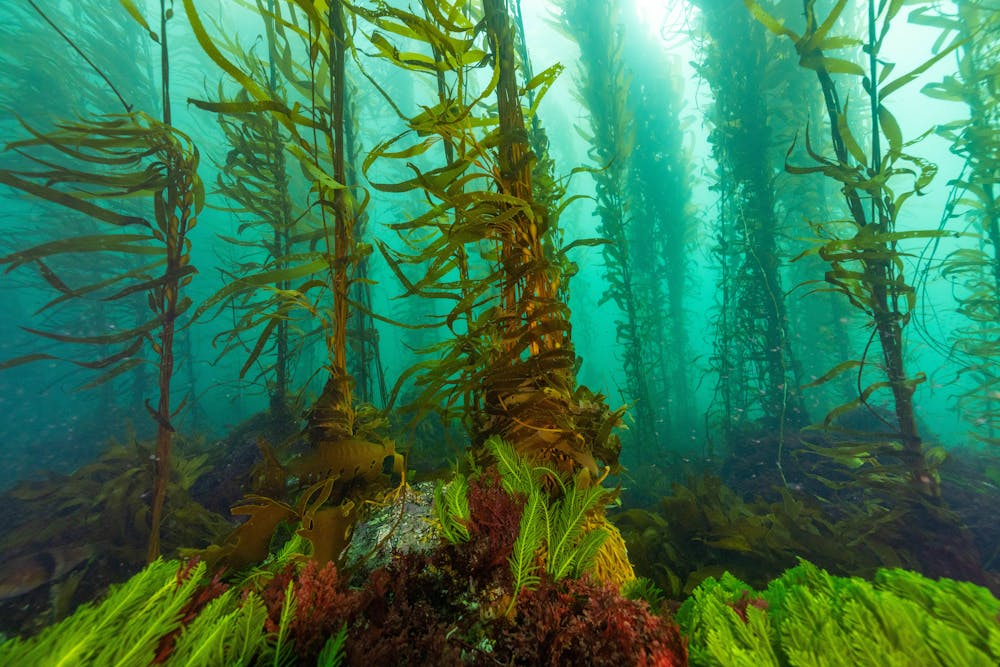 Giant kelp at Port Davey in southwest Tasmania.
AAP Image/Supplied by Great Southern Reef Foundation, Stefan Andrews
Giant kelp at Port Davey in southwest Tasmania.
AAP Image/Supplied by Great Southern Reef Foundation, Stefan Andrews
While we were talking, he grew emotional as he conceded it was possible the seemingly unstoppable upward arc of ocean temperatures will wipe out even these more thermally tolerant species. Yet, like the scientists working to save coral reefs, he said he did not know what else he could do.
 Penguin
The hope he described is a fragile thing but it is also an investment in the future, a refusal to give up. It offers a reminder that mourning cannot be an endpoint. Instead, grief must be part of a larger recognition that there is no longer any way back, that the only route now is forward. That we must find ways to live in a world on fire. And ways to fight that will ensure the survival of all.
The storm that is upon us will leave nobody untouched. Surviving it demands we build a world that treats everybody – human and non-human – as worthy of life and possibility.
I have times when I think it is possible to see that world taking shape in the distance. Times when it is possible to convince myself we will get there because we have no choice. Because however much is lost, there is still more to save.
I turn to look out to the horizon, its fading margin between sea and sky a space of grief, but also possibility. Around me the water extends outwards, its embrace holding me, its fluidity connecting me to the planet’s systems, to myriad other lives – past, present and future. And putting my face down I start to swim, outwards, towards the unknown.
This is an edited extract from Deep Water: the world in the ocean by James Bradley (Hamish Hamilton).
Authors: James Bradley, Honorary Associate, Sydney Environment Centre, The University of Sydney., University of Sydney
Penguin
The hope he described is a fragile thing but it is also an investment in the future, a refusal to give up. It offers a reminder that mourning cannot be an endpoint. Instead, grief must be part of a larger recognition that there is no longer any way back, that the only route now is forward. That we must find ways to live in a world on fire. And ways to fight that will ensure the survival of all.
The storm that is upon us will leave nobody untouched. Surviving it demands we build a world that treats everybody – human and non-human – as worthy of life and possibility.
I have times when I think it is possible to see that world taking shape in the distance. Times when it is possible to convince myself we will get there because we have no choice. Because however much is lost, there is still more to save.
I turn to look out to the horizon, its fading margin between sea and sky a space of grief, but also possibility. Around me the water extends outwards, its embrace holding me, its fluidity connecting me to the planet’s systems, to myriad other lives – past, present and future. And putting my face down I start to swim, outwards, towards the unknown.
This is an edited extract from Deep Water: the world in the ocean by James Bradley (Hamish Hamilton).
Authors: James Bradley, Honorary Associate, Sydney Environment Centre, The University of Sydney., University of Sydney


 Daily Bulletin


