

Horses, camels and deer get a bad rap for razing plants – but our new research shows they’re no worse than native animals
- Written by: Erick Lundgren, Adjunct Lecturer, Queensland University of Technology
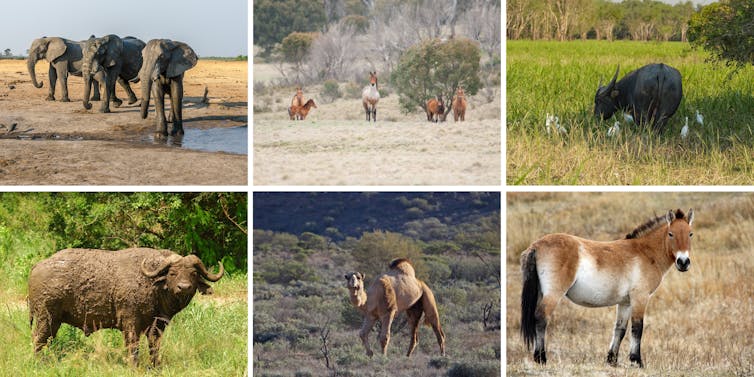
Large introduced herbivores such as feral horses and camels are often seen as “invasive” species which damage native plants.
My colleagues and I published new research in Science testing this assumption and found it isn’t true. Instead, both native and introduced species of plant-eating megafauna (weighing over 45 kilos) have similar impacts on plants.
The effects of introduced megafauna on plants can drive negative public sentiment towards the species. It’s time to change how we think of these animals.
Megafauna over millennia
For the last 35-55 million years, megafauna have shaped Earth’s terrestrial ecosystems. Present-day plant and animal species in Australia evolved on a continent dominated by earth-trampling beasts. They include hoofed horse-like kangaroos, tree-thrashing marsupial tapirs and migratory two-tonne diprotodons resembling womabts.

Sadly, much of the world’s megafauna went extinct as humans radiated out from Africa. Australia lost all its land megafauna with an average weight over 45kg.
This drove radical changes in Australian ecosystems. Ancient megafauna were uniquely able to eat large volumes of fibrous low-nutrient plants. With them gone, fires may have intensified and once-widespread rainforests shifted to fire-prone eucalypt forest.
But now, the megafauna have returned – introduced by humans.
Australia, for instance, now has the world’s only wild herd of dromedary camels, extinct in the wild in their native range. Water buffalo wallow in the Top End, though they’re endangered in their native range. And feral horses, also endangered in their native range, roam the Australian Alps.
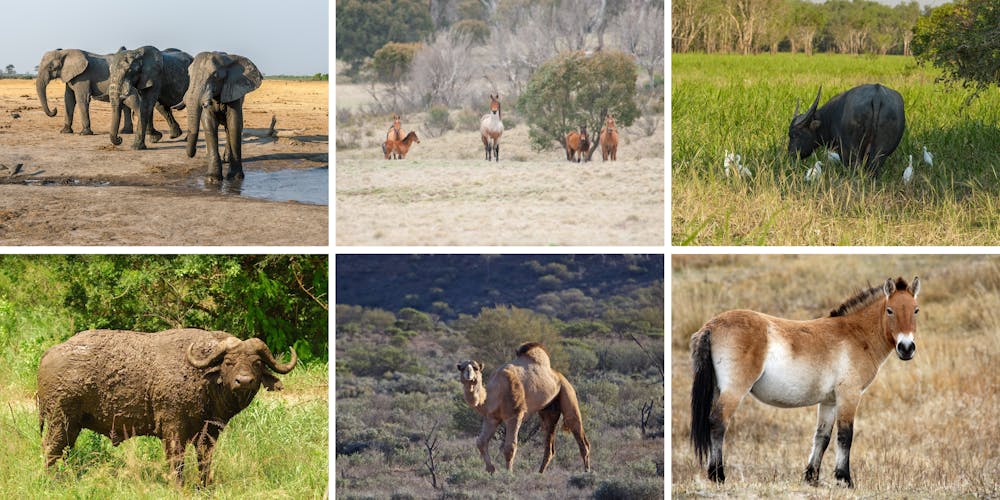 Would an extraterrestrial ecologist be able to tell which of these megafauna is introduced based on their ecological impacts?
Steven dosRemedios/Flickr, Cowboy Dave/Flickr, Geoff Whalan/Flickr, Pär Söderquist/Author provided, Caroline Jones/Flickr, Daniela Hartmann/Flickr, CC BY-ND
How megafauna affects plants
Our research set out to evaluate the effects of megafauna on plant abundance and plant diversity. To do this, we reviewed all literature available on the impacts of native and introduced megafauna and extracted all available data comparing the effects of megafauna between an excluded area and a control site.
We found no evidence that introduced, “invasive”, or “feral” megafauna have different impacts on native plants than native megafauna. Nor was there evidence that the effects of introduced megafauna in biologically distinct places such as Australia are different from their effects in their native ranges.
Our study adds to a growing body of research that has looked for differences between the impacts of native and introduced species and failed to find them.
Yes, there are outliers. Some introduced species have novel effects very different what they do in their native ranges, such as introduced diseases and insect herbivores such as emerald ash borer, those with novel defences such as cane toads, or those introduced to islands. But extrapolating to all introduced species may be unjustified.
Megafauna traits determine their impact
We found ecological explanations – rather than whether an animal was native or not – explained the effects of both native and introduced megafauna.
In particular, we found the effects of megafauna were determined by their traits. Larger and less-picky species tended to have more positive effects on plant diversity.
This suggests that studying introduced megafauna simply as wildlife rather than as an ecological problem can help us respond to situations where megafauna — native and introduced — come into conflict with conservation goals.
Let’s say there is high abundance of introduced sambar deer eating rare plants in a national park. A typical response is to start shooting.
But if you look at this as an ecological conflict rather than as an introduced species problem, the real issue might be that dingoes are routinely poisoned in the area.
Dingoes, as the top terrestrial predator, create landscapes of fear, meaning deer and kangaroos can’t eat their way through everything because they have to watch for predators and often flee. The solution may be to stop killing dingoes.
Read more: Australia should enlist dingoes to control invasive species
The double standard of ‘harm’
It can be a shock to see the impact of feral pigs, deer, camels and buffalo. They eat plants, trample vegetation, or root around in the ground.
These animals do the same thing in their native ranges, where it is not generally considered a bad thing, ecologically. Elephants tear down trees to eat or to make a path. That’s bad for the tree, but gives other species a chance to grow.
Australia’s extinct megafauna would have also trampled sensitive plants and eaten huge volumes of vegetation. Large animals suppress some species and benefit others. For example, buffalo can actually increase plant diversity by chowing down on dominant plant species.
The debate over native versus introduced species can create a double standard when assessing the harm they cause. This is a longstanding blind spot in how we think about and study introduced species.
The world could look quite different if we relax cultural beliefs about “belonging” and nativeness.
Authors: Erick Lundgren, Adjunct Lecturer, Queensland University of Technology


 Daily Bulletin


