

Who was Leonard Bernstein, the man at the centre of Bradley Cooper's Maestro?
- Written by: Joseph Toltz, Honorary Associate, Hebrew, Jewish and Biblical Studies, University of Sydney
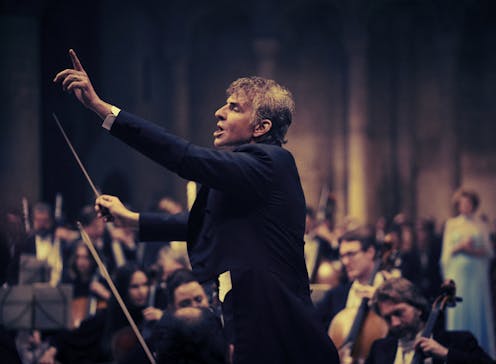
“Maestro” is a word that resonates across concert music. From the Italian word for master, it is applied most frequently to a respected and established conductor of operas and orchestras but can also be used to refer to virtuoso instrumentalists.
Despite its gendered form (male), the term has been regularly applied to female conductors, instrumentalists and others who have achieved significant artistic recognition.
Leonard Bernstein, the character at the centre of Maestro, a new film from director (and star) Bradley Cooper, was not just a great conductor. While the word maestro certainly sums up his career, ego and personality, early in the film Lenny (as he was affectionately known) lists all his achievements, then somewhat dryly sums himself up as “a musician”.
The life of ‘a musician’
Bernstein is recognised as one of the most significant forces in 20th century American music. Starting as an accomplished concert pianist, Bernstein reached the pinnacle of success as a brilliant and effulgent conductor, the first American-born to direct the New York Philharmonic, and the first American-born to conduct the London Symphony, Royal Concertgebouw and Berlin Philharmonic orchestras.
Throughout his career, Bernstein championed the work of American composers, including those of his close friend and mentor Aaron Copland, as well as works by Marc Blitzstein, Lukas Foss, Samuel Barber and others. Encouraged by Copland, Bernstein revived interest in the music of Gustav Mahler and restored the Austrian composer as a regular feature on the international concert hall stage.
Bernstein was a successful composer. His styles traversed popular and formal genres, often synthesising traditional Jewish melodic and modal elements with jazz and Latin American rhythms and melodies. He composed to great acclaim for concert, dance and theatre stages.
He was a notable educator. Throughout his life, Bernstein gave regular masterclasses in conducting at Tanglewood, the Boston Symphony Orchestra’s summer academy for elite musicians.
In 1954 Bernstein appeared for the first time on Omnibus, an educational entertainment television show on CBS, where he discussed and played diverse musical genres to millions of American homes.
Bernstein’s educational work culminated with the televising of his Young People’s Concerts with the New York Philharmonic on CBS in 1964–5, eventually syndicated across 40 countries.
Read more: Explainer: what exactly do musical conductors do?
A resolutely Jewish artist
Born in Massachusetts in 1918 to Jewish immigrants from Berezdiv and Shepetivka in Western Ukraine, Bernstein entered the hallowed halls of Harvard in 1935. After graduating, he enrolled at the Curtis Institute of Music in Philadelphia, to be supervised by another mentor (and refugee from quasi-fascist Hungary), Fritz Reiner.
Graduating from Curtis in 1941, Bernstein arrived on the American music scene at a time where persecution had caused many Jewish musicians and composers to flee the tentacles of Nazi Germany and its neighbours.
It was also a time of endemic antisemitism throughout American society. At one point in the movie, Serge Koussevitsky, the iconic Russian-born (and formerly Jewish) conductor and music director of the Boston Symphony Orchestra, suggests to the young Bernstein he change his name to Leonard S. Burns in order to achieve a successful conducting career.
Bernstein refused. Having conquered antisemitism at Harvard and elsewhere by being resolutely himself, Bernstein revealed not only a deep abiding commitment to Judaism, but a desire to forge a path of freedom for Jewish musical artists in the 20th century.
Cooper chooses symbolic representations of Judaism throughout Maestro to reinforce this. What looks like a tallit (a prayer shawl) hangs in Bernstein’s flat in Carnegie Hall. Traditional rye bread is featured on the lunch table with Koussevitsky. When returning to his home in Connecticut after rehearsing a chorus from Candide, Lenny is seen wearing a Harvard sweatshirt, its letters emblazoned in the Hebrew spelling of his Ivy League alma mater.
The music playing over the credits at the end of the film highlight the Jewish aspects of his work. They begin with the Psalm 23 Hebrew words from the second movement of Bernstein’s Chichester Psalms, and conclude with the second movement of his Symphony No. 3, Kaddish. This is a particularly interesting choice, as the narration of this movement invokes the Jewish tradition of a pious individual calling God to account for the suffering of the Jewish people, known as a din torah.
A complicated relationship
Maestro is particularly interested in the relationship between Bernstein and his wife, actor Felicia Montealegre Cohn (Cary Mulligan). She arrives as a young woman in a hauntingly beautiful cinematic moment to the party where she was to meet her future husband. We last see her in her final moments of life with Bernstein and their three children, dancing to the tune of Shirley Ellis’s 1965 hit, The Clapping Song.
Maestro depicts Lenny’s hedonistic whirlwind of a life. Bernstein’s mastery did not extend to human relationships. His bisexuality and its effects on his marriage are more a focus of the film than his Jewishness, but Cooper is at pains to acknowledge that Felicia enters the relationship with eyes wide open – as she says when he proposes to her in a hedge maze, “let’s give it a whirl”.
Anger and frustration rise and fall as Lenny cavorts with impunity, bringing lovers home, lying (on instruction) to his daughter about the nature of his affairs, and generally doing what he wants.
Cooper has brought together many disparate elements to weave a fresh story of the life of Bernstein. Sometimes his use of symbolism is overly obvious, at other times beautifully subtle. Watch it for the cinematography, for the settings, for the music, and especially for the moment where Bernstein is conducting Mahler’s Symphony No. 2 at Ely Cathedral in the United Kingdom. It is an absolute highlight in the two hours.
Read more: I'm going to a classical music concert for the first time. What should I know?
Authors: Joseph Toltz, Honorary Associate, Hebrew, Jewish and Biblical Studies, University of Sydney


 Daily Bulletin


