

From meerkat school to whale-tail slapping and oyster smashing, how clever predators shape their world
- Written by: Eamonn Wooster, Postdoctoral Research Fellow, Gulbali Institute, Charles Sturt University
In the 1980s a single humpback whale in the Gulf of Maine developed the “lobtail feeding method”. This unique hunting method of slapping the water’s surface appears to drive fish into dense schools, making it easier to consume them. Lobtail feeding caught on. Now many humpback whales are doing it.
Ecologists have long thought animals acted on instinct alone. But a growing body of evidence shows many animals, much like us, have complex brains and social lives.
In our new research, we argue the science of ecology can learn a great deal from the study of animal cognition and culture. Cognition is what goes on in the mind, which determines how animals perceive and respond to the world around them. Culture is the development and spread of socially learned behaviours. These are important – but generally overlooked – mechanisms influencing ecosystems.

Read more: The smarter the magpie, the better they can handle our noisy cities
More than cogs in the eco-machine
Research shows prey are adept at learning from previous encounters with predators. They remember what predators look like, what they smell like and the locations and times they are active.
This means every time an animal encounters a predator they can gather knowledge about how to improve their chances of survival.
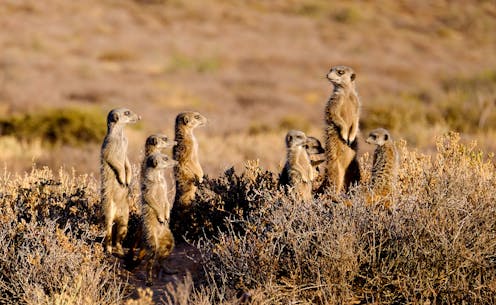
Predators learn as well. Meerkat pups go to meerkat “school”. Eating dangerous prey such as scorpions is challenging because scorpion toxin can be fatal. To overcome this, meerkat teach their young how to remove scorpion stingers, allowing them to safely eat them.
 Meerkats school their children in scorpion hunting.
Keegan Currier
Meerkats school their children in scorpion hunting.
Keegan Currier
Animal cognition and social learning allow problems solved and lessons learned during predatory encounters to be shared with friends and family. The development of these cultural behaviours can spread across entire populations.
Shaping how ecosystems function
Past experience and lessons learned from friends and family inform an animal’s capacity to make complex decisions.
When wolves were reintroduced to Yellowstone National Park in 1995, elk and deer had to learn how to avoid being eaten. While initially naive, elk and deer shifted to new locations and changed the times they were active. As a result, these herbivores concentrated their foraging in specific areas, altering the variety of plants and even the physical environment.
Predator hunting cultures can also shape ecosystems. In Thailand’s Khao Sam Roi Yot National Park, long-tailed macaques use heavy rocks as stone tools to smash the shells of oysters and other shellfish open and access the food inside. Macaques can become so proficient at shellfish hunting they have driven island-wide declines.
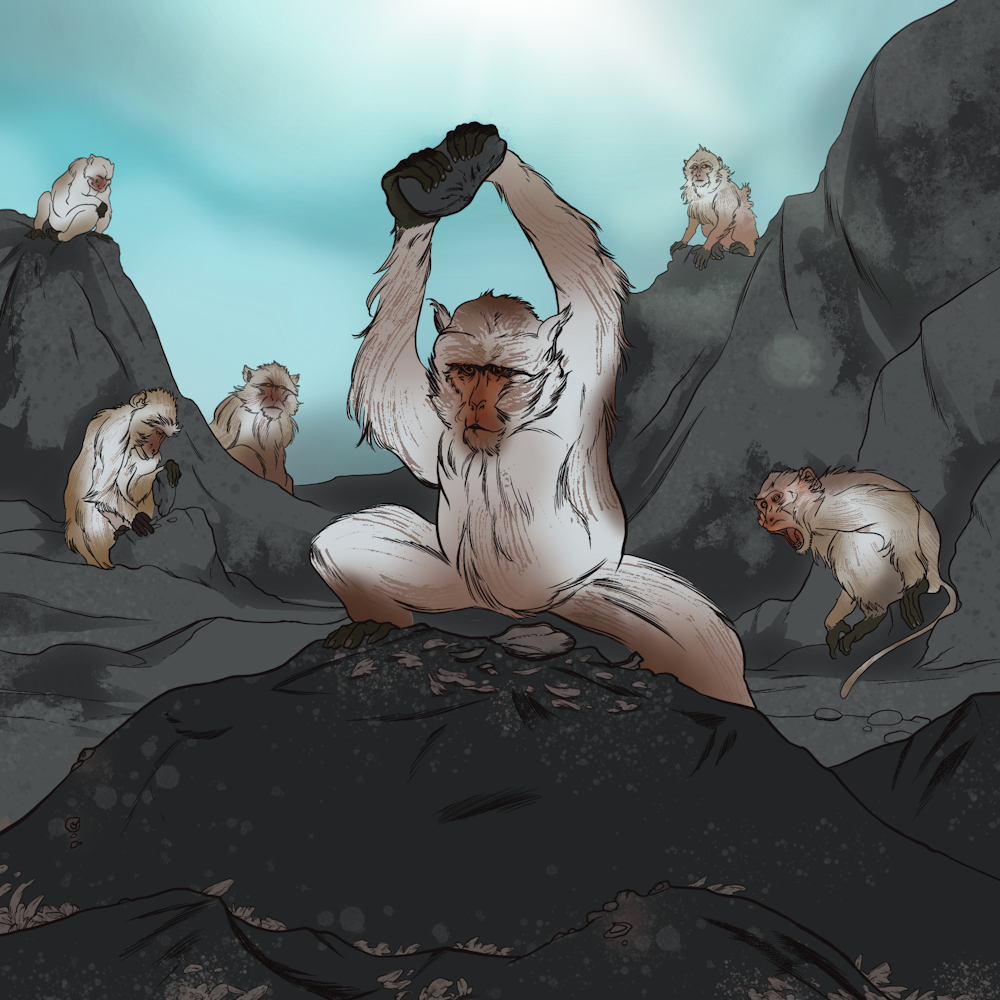 Stone tool use in long-tailed macaques allows them to eat oysters.
Keegan Currier
Stone tool use in long-tailed macaques allows them to eat oysters.
Keegan Currier
Humans can erode animal culture
Rapid environmental changes such as urbanisation, climate change and hunting or poisoning can influence animal cognition and animal culture.
Just as trauma, such as from war, influences human cognition and culture, the targeted killing of animals can disrupt their cognition and culture. This has consequences for ecosystems.
Killing dingoes, Australia’s only mainland mammalian apex predator, disrupts their family groups. This can result in the loss of important behaviours, including pack hunting. This can then prevent dingoes from hunting prey larger than themselves, such as water buffalo and foxes and cats. In this way, the loss of pack hunting can drive changes in how ecosystems operate and highlights the importance of animal culture as a unit of nature worth conserving.
Changing our perceptions of ecology
Longstanding notions in ecology and conservation biology claim ecosystems function due to evolutionary history alone. In this view, organisms evolve traits to allow them to coexist with each other, so newly arrived species can be fundamentally disruptive. The inner lives of animals complicate this worldview.
Recognising many animals possess and act upon their awareness of time, self and others, and may even have language, invites us to reconsider ecological relationships might not be so static. Acknowledging animal cognition and culture in ecology means understanding ecological relationships are always changing and shifting.
By studying how the cognition and cultures of animals shape their ecology, we may shed light on the origins of animal intelligence and culture, their importance to life on Earth and how best to preserve non-human culture in an ever-changing world.
Read more: Organisms without brains can learn, too – so what does it mean to be a thinking creature?
The research behind this article was co-authored with Dr Kaitlyn Gaynor, Dr Alexandra Carthey, Dr Arian Wallach, Dr Lauren Stanton and Dr Daniel Ramp who all substantially contributed to the ideas presented throughout.
Authors: Eamonn Wooster, Postdoctoral Research Fellow, Gulbali Institute, Charles Sturt University


 Daily Bulletin


