

Morocco earthquake: experts explain why buildings couldn’t withstand the force of the 6.8 magnitude quake
- Written by: Dee Ninis, Earthquake Scientist, Monash University
As locals continue to mourn the loss of more than 2,100 people, a mammoth search and rescue effort is underway in quake-struck Morocco.
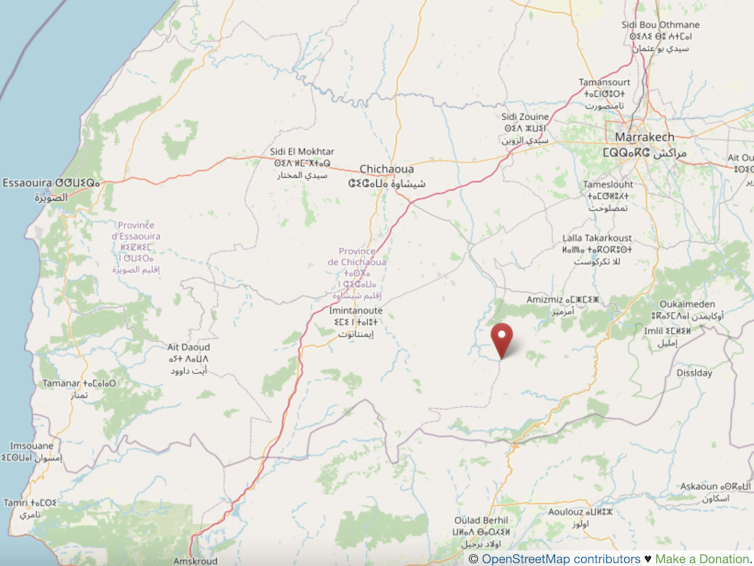
The 6.8 magnitude earthquake struck at 11:11 pm on Friday night, local time, with an epicentre in the Atlas Mountains about 75km southwest of Marrakech. The quake shook the northeast African and southwest Mediterranean region, with reports of shaking felt as far away as Oran in Algeria, and Porto in Portugal, at a distance of more than 1,000km.
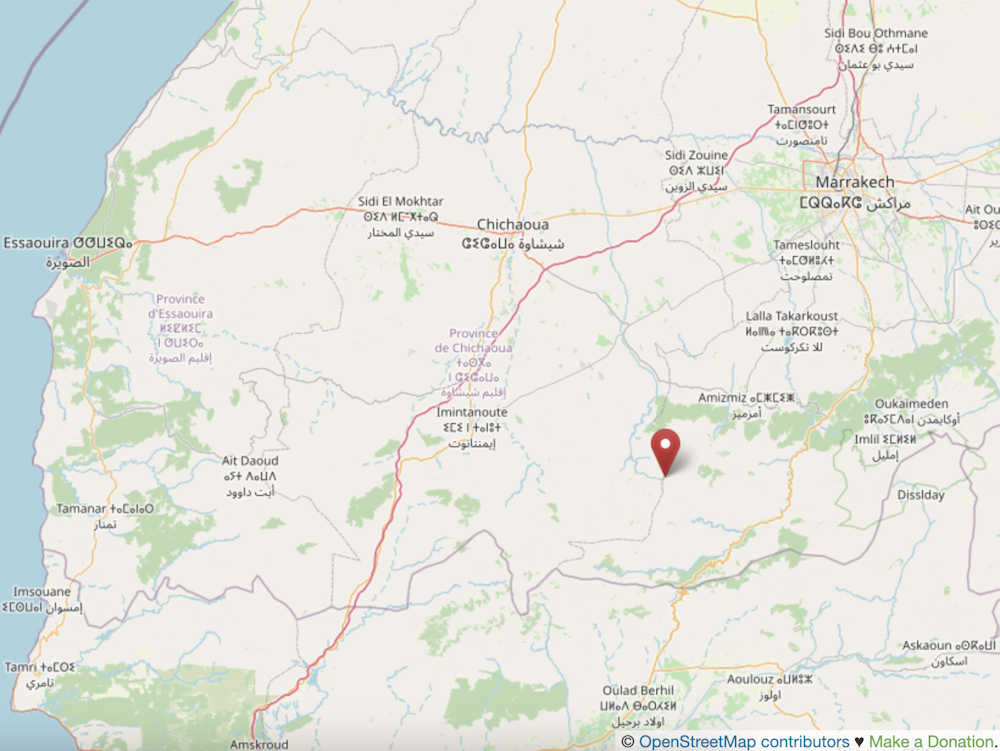
At a relatively shallow depth of about 20km, “severe” ground-shaking intensities were reported around the quake’s epicentre, where several remote villages are located.
The ground shaking associated with the earthquake resulted in the total collapse of many dwellings near its epicentre, a great number of which were traditional mud brick constructions. Rockfalls and landslides have buried villages in the remote, mountainous region.
There has also been substantial damage to buildings further away, including in Marrakech – a city which houses close to a million people. At the time of publishing this article, at least 2,122 people had been killed and more than 2,421 injured.
Sadly these numbers will probably increase. Significant aftershocks are possible in the weeks and months following an earthquake of this magnitude. These may result in the collapse of buildings which were damaged – but remained standing – during the main shock.
Brittle buildings crumbled from the impact
The earthquake in Morocco occurred as a result of the collision between two tectonic plates: the Nubian tectonic plate (which the country itself sits on top of) and the Eurasian tectonic plate, about 500km north of the epicentre. These two plates converge at a grinding pace of about 4mm-6mm per year.
Slower tectonic rates are naturally more difficult to observe, and produce less frequent earthquakes. And since earthquake hazard estimates are strongly influenced by historical records, it’s often difficult to predict the hazard level in regions which have “low seismicity” and no record of strong earthquakes.
In fact, the recent earthquake is the largest on record for Morocco. Near the epicentral region, the second-largest event on record is the magnitude 5.8 Agadir earthquake which struck in 1960, and during which at least 12,000 lives were lost. It showed that even moderate earthquakes can result in devastating loss of life if buildings aren’t made to withstand intense shaking.
Sobering photos and videos have emerged from Morocco, showing a level of structural damage and destruction that’s hard to comprehend. Close to the epicentre in the mountains, villages with rural dwellings, largely constructed from mud brick and stone, seem to have been pulverised. These types of structures are extremely brittle and essentially provide little, if any, seismic resistance.
In more densely populated areas, including the city of Marrakech, various types of damage can be observed, from small local failures to complete building collapses. Much of this can be linked to structures made from stone and masonry – materials known for their brittleness and limited resistance to the strong horizontal shaking generated by a major earthquake.
 The UN Office for the Coordination of Humanitarian Affairs has said more than 300,000 people have been affected by the disaster.
Tiago Petinga/EPA
The UN Office for the Coordination of Humanitarian Affairs has said more than 300,000 people have been affected by the disaster.
Tiago Petinga/EPA
Although it’s too early to gauge the full extent of the impact, initial reports suggest some of the city’s historical treasures, including the 12th-century Koutoubia Mosque and the renowned red walls, may have suffered some damage.
Much of the damage observed to new construction appears to be attributed to reinforced concrete frame buildings infilled with brittle, hollow red clay bricks. The mortar holding the bricks together quickly cracks, which greatly reduces the stiffness of the overall structure.
To compensate, the reinforced concrete frame will attempt to resist the large horizontal loads. But without an abundance of carefully-placed reinforcing steel embedded in the concrete (particularly where the beams meet the columns) it’s unlikely such a structure will survive a large earthquake. Other lateral load-resisting systems could be employed, such as walls, but these also require careful steel reinforcements – which increases the cost of construction.
A lack of building codes and regulations
Other reasons behind the extensive damage include poor-quality residential construction and ineffective enforcement of building codes and regulations.
These are the same issues we saw earlier in the year following the Turkey-Syria earthquakes. Unfortunately, poor construction is a recurring theme in places where building materials are generally more expensive than labour costs.
 The earthquake damaged buildings from villages and towns in the Atlas Mountains to Marrakech, according to the country’s Interior Ministry.
Yoan Valat/EPA
The earthquake damaged buildings from villages and towns in the Atlas Mountains to Marrakech, according to the country’s Interior Ministry.
Yoan Valat/EPA
Areas that have more stringent building codes and regulations, and that enforce the use of appropriate building materials, generally weather seismic events better. This is particularly true for regions that also apply simple design philosophies, such as the “capacity design” approach.
In essence, this approach compels engineers to carefully consider how and where damage will occur, enabling certain components of a building to absorb and dissipate energy, while ensuring structure doesn’t collapse. It was this simple design philosophy that can be credited for the impressive performance of most reinforced concrete buildings constructed after the 1980s in Christchurch, New Zealand, during and after the 2010-2011 Canterbury earthquake.
Some engineers advocate even stricter performance goals, such as aiming for buildings that remain nearly undamaged after an earthquake. But the recent events in Morocco and Turkey serve as a stark reminder there are much more pressing needs – particularly in regions with limited economic growth and an insufficient enforcement of standards.
Read more: Why are shallow earthquakes more destructive? The disaster in Java is a devastating example
Authors: Dee Ninis, Earthquake Scientist, Monash University


 Daily Bulletin


