Parents may wait up to 40 years to join family in Australia. Is a visa lottery the answer?
Written by: Peter Mares, Adjunct senior research fellow at Monash University's School of Media Film and Journalism, Monash University
“Providing an opportunity for people to apply for a visa that will probably never come seems both cruel and unnecessary”.
This was the view of an expert panel, commissioned by Home Affairs Minister Clare O'Neil, on Australia’s dysfunctional parent migration system. Parents wanting to migrate to Australia to join their children face extreme delays, even if they can afford a contributory visa, which costs almost $50,000 per person.
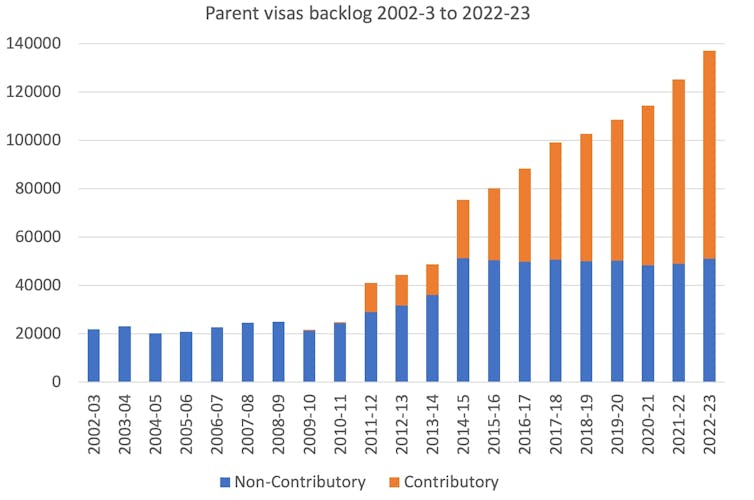
My report for the Scanlon Foundation Research Institute, published today, finds the backlog of applications for permanent parent visas is approaching 140,000 and has tripled in a decade. Wait times for a contributory visa are at least 12 years, or at least 30 years for a cheaper visa.
How can we fix this? Whichever way the government turns, it faces unpalatable policy choices with unwanted electoral consequences.
The parent visa conundrum
The parent visa pipeline includes 86,000 applications for so-called “contributory” visas, and 51,000 for “non-contributory” visas.
These are first- and second-class migration options, with price tags to match.
The $47,955 per person charge for a contributory visa is justified on the basis that these first-class parents “contribute” to the cost of the public services they will access as they age. But the Productivity Commission argues the revenue raised is “a fraction of the fiscal costs” that parents will impose, especially by drawing on health services.
The charge is better understood as a premium paid in return for “quicker” processing. Initially, this worked. When the Howard government first introduced contributory visas in 2003, well-off families were able to swiftly settle parents in Australia, usually within two years. But program numbers were capped from the start, and demand rapidly outstripped supply.
Data to 2021-22 is from Home Affairs and its predecessor departments via annual reports on the migration program and the serial publication Population Flows: Immigration Aspects. Data for 2022-23 is to 30 May 2023, all other data is for 30 June, Author provided
In 2022-23, the Albanese government almost doubled the quota from 3,600 to 7,000 places.
Yet even with this higher cap, Home Affairs advises that a new application “may take at least 12 years to process” (their emphasis). The expert migration panel thought this an underestimate – its March report put the wait time at 15 years.
The cheaper, non-contributory visa has a far lower cap – just 1,500 places last financial year – and so the wait for a visa is even longer. Home Affairs advises that a new application “may take at least 29 years to process”. Again, the expert panel reckons this is optimistic. It estimates processing time at more than 40 years.
Such waiting times are ludicrous.
Parents are generally at least 60 years old when they apply. About 60% of parent migrants are women and often want to settle in Australia while they’re still fit and healthy, so they can enjoy time with young grandchildren and support their Australian children as they build careers.
Alternatively, parents may be recently widowed, isolated or in need of care themselves.
In either scenario, even the shortest wait time of 12 years defeats the purpose of the visa.
Can we fix it?
The panel recommended the government shift to a ballot system as New Zealand is now doing now, and as Canada did in 2015.
In Canada, for a limited time each year, families can lodge an expression of interest to sponsor a parent or grandparent to migrate to Canada. Immigration authorities then pull enough names from the hat to fill the annual intake quota. Once an application is accepted, the processing time for a visa is about 2.5 years, and costs are modest.
In 2022, Canada offered about 23,000 places from a pool of about 155,000 expressions of interest, meaning the odds of a winning ticket were about one in seven.
Is a lottery preferable to a queue? A ballot would be a fairer system than the two-tiered approach Australia operates, which provides a fast lane for the wealthy and a slow lane for everyone else (even though that “fast” lane is now clogged too).
The expert panel argued a ballot could eliminate massive application backlogs because the number of applicants chosen from the lottery would align with the number of available visa places. This obscures the fact that there are likely to be tens of thousands of families that enter the draw and fail to win.
Those families will try again the following year, and again in the years after that, but their chances of success will decline as ever more new hopefuls throw names into the hat.
These families may not be stuck in a queue, but they’re stuck in a disordered heap hoping to get lucky. Their situation wouldn’t be so different from the “cruel and unnecessary” plight of those families currently waiting for a visa that may never arrive. They would also be condemned to living with a mixture of hope, anxiety and uncertainty, unable to plan for the future.
In the outline of its migration strategy, the Albanese government focused on skilled migration, and promised reform of the family program “will be considered separately”.
The current system is failing, but there are no easy answers for the government.
It could abolish permanent parent migration altogether, and upset overseas-born Australians, many of whom vote in key marginal seats.
Or it could attempt to clear the backlog by increasing the cap on permanent parent migration by about 20,000 places annually. Amid an intractable housing crisis and unprecedented pressure on Australia’s health- and aged-care systems, this would hand the Coalition an emotive “big Australia” campaign stick to beat it with at the next election.
A ballot might look like a neat way of avoiding these two extremes, but it fails the key test of clarity. The slim chance of winning the visa lottery will leave families banking on dreams, rather than adjusting to the realities of their situation and fully settling in Australia.
Authors: Peter Mares, Adjunct senior research fellow at Monash University's School of Media Film and Journalism, Monash University
Power failures can occur quickly. The supply may be interrupted by bad weather, issues with the electricity network, damaged equipment or local construction work. This can be just a hassle for a fam...
Create a Predictable Weekly Structure
A consistent weekly routine can make study easier to manage when students are balancing several subjects. Chatswood tutoring can provide a fixed learning point a...
For decades, the Australian trade and construction sector operated almost entirely on word-of-mouth recommendations and local community networks. Small business owners typically relied on local newspa...
Introduction
Visa decisions can shape employment, family life, study plans, travel, and future residence. A small omission can lead to delay, added expense, or refusal. Immigration lawyers assess l...
Many industrial processes require moisture to be removed from compressed air, products or process materials before they move to the next stage. Excess moisture can affect equipment performance, produc...
Effective communication helps teams stay organised, share ideas and keep track of important information. While digital tools are now common in many workplaces, a whiteboard continues to provide a simp...
The Evolution of Sustainable Event Merchandise
Event planning has undergone a massive transformation over the last decade. Gone are the days when organizers could hand out cheap, single use plastic...
Flowers have a great power to speak when humans cannot express their feelings with right words. Flowers are the best gifts when you are celebrating a birthday or welcoming a newborn child into your fa...
For a long time, you might have defaulted to overseas suppliers when sourcing fabricated metal components for a project. The unit price was lower on paper, and the maths seemed straightforward. That...




 Daily Bulletin


