

Kicking the gas can down the road: why a gas price cap is the worst way to protect energy consumers.
- Written by: Ariel Liebman, Ariel Liebman Director, Monash Energy Institute and Professor of Sustainable Energy Systems, Faculty of Information Technology, Monash University
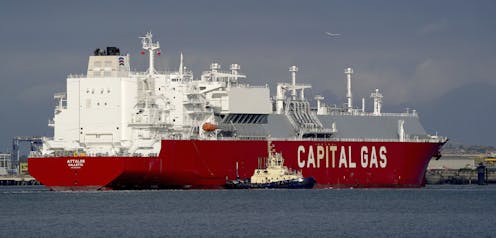
The federal government’s plan to extend the gas price cap is not surprising, given fundamental market issues remain.
For as long as the war in Ukraine continues, Australian gas will attract premium prices overseas. So the “temporary” $12 per gigajoule cap on wholesale domestic prices – intended to protect local energy users – will no longer be lifted in December, but will stay for a further 18 months at least.
This is just kicking the can down the road, rather than developing a coherent energy policy.
A price cap is the worst of all credible options to establish market or price stability. It creates perverse incentives to continue with inefficient industry and residential energy use practices. It also delays progress towards emissions reduction and transition to renewable energy.
The optimal regulation of natural gas markets has been well studied and applied internationally, and state and commonwealth governments would be well advised to learn from such expertise. The government should, at the very least, consult a range of experts and develop a variety of policy options.
These options should include a gas reservation policy and a new tax on excess gas industry profits that would be shared among consumers.
In tandem, the government should also institute a first principles review of all energy market frameworks, as this issue (among others) shows the fundamental assumptions underpinning current energy market frameworks no longer hold.
Read more: Surging energy prices are really going to hurt. What can the government actually do?
Introducing a code of conduct
The extension of the gas price cap is just one part of the Albanese government’s proposed mandatory code of conduct (gas code).
It’s worth noting the consultation paper, released on April 26 states the gas code “will ensure domestic prices are reasonable by establishing a price anchor through:
- a price cap, initially set at $12/GJ
- conditional exemptions from the price cap for producers on the basis of satisfactory voluntary enforceable supply commitments or being a small producer who exclusively supplies the domestic market.
So large gas producers can apply to exceed the price cap. That might explain the term "price anchor”.
Read more: Yes, the government's price cap is overly generous to gas producers. But it was necessary
The draft code has already been subject to consultation with gas producers and big industrial users over recent months. Energy and Climate Change Minister Chris Bowen told the ABC this was about striking “the right balance”.
Large gas producers are being asked to make submissions on the supply and price commitments they would be prepared to make in the context of the proposed exemption framework by May 8.
Submissions on the second and final round of consultation will close on May 12.
Wholesale electricity prices have come down since caps on coal and gas price caps were introduced. (The wholesale electricity price is heavily influenced by the gas price).
But the wholesale gas price for the first quarter of this year is still the highest Q1 price on record. The average price across all Australian Energy Market Operator markets in March was $9.43/GJ, the lowest since January 2022 which was $8.81/GJ. The quarterly average price across all AEMO markets was $11.86/GJ, compared to $9.93/GJ in Q1 2022.
Retail prices for electricity and gas continue to increase.
A fragile framework in need of repair
The relatively minor reduction in gas supply, due to sanctions on Russia, exposed the delicate balance of supply and demand, and the fragility of the global fossil energy system. In the long term, the solution is clear: move to renewables that are not subject to short term supply-demand shocks, and are now cheaper than coal and gas.
The switch to renewables also has another significant benefit – decentralising the production of electricity from concentrated sources of fossil fuels. This can start to address some of the key sources of geopolitical instability related to oil and gas in the middle east, Russia and similar sources.
However, in the short term, the Australian government must curb the worst excesses of the unfettered free market in natural gas and retail electricity. We must give Australians short term relief by decoupling the Australian natural gas market from global markets for a limited period.
The price cap is a poor attempt to do this, but the only sure way is a domestic reservation policy. This would reserve a proportion of gas produced on the east coast for the domestic market.
Western Australia already has one, which mandates 15% of the gas extracted in the state must stay there. That’s why WA gas prices are cheaper. Now the east coast of Australia needs a strong gas reservation policy.
A double whammy
Coupling domestic gas and electricity markets to the extremely volatile and constrained international market is not in the national interest.
It is a double whammy, because not only are power prices overinflated, the resulting profits are not taxed appropriately.
We must fix this, properly.
Authors: Ariel Liebman, Ariel Liebman Director, Monash Energy Institute and Professor of Sustainable Energy Systems, Faculty of Information Technology, Monash University


 Daily Bulletin


