

What The Jetsons got right, and very wrong, about the future of work
- Written by: Agustin Chevez, Workplace Futures Research Lead, Centre for the New Workforce., Swinburne University of Technology
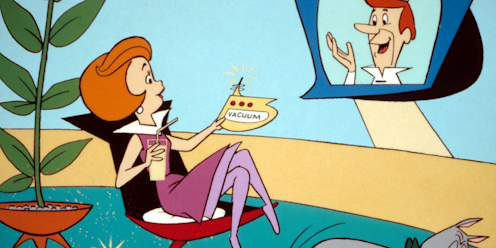
Sixty years ago the animated series The Jetsons finished its first and only season before being cancelled. Just 24 episodes were broadcast between September 1962 and March 1963. Despite this the cartoon has achieved huge influence in popular culture, with countless reruns, a reboot in the mid-1980s (51 episodes over two seasons) and a feature-length movie in 1990.
The Jetsons was created by the Hanna-Barbara animation studio in Los Angeles as a futuristic version of the studio’s hit series The Flintstones, the first cartoon series to gain a prime-time slot.
But whereas The Flintstones was set in a distant, mythical stone age thousands of years in the past, The Jetsons was set in a very near future – in 2062.
Like The Flintstones, the show was aimed mostly at children, and played with ideas about the future for laughs. It’s not a serious work of futurology. Even so, it’s still an interesting cultural artefact, helping us appreciate our present and our expectations of the future.
The first episode was broadcast just a few weeks after US president John F. Kennedy gave his famous “Moon speech”, promising “to go to the Moon in this decade and do the other things, not because they are easy, but because they are hard”.
The Jetsons’ title sequence.While that promise was motivated by fears of the Soviet Union winning the Space Race, the future depicted is mostly optimistic. Technology holds the promise of a better world.
Among the whimsical technology imagined are flying cars, robot maids, video calls, smartwatches, food printing and space tourism. Some of this seems far-sighted. But there are big blind spots. Those flying cars, for example, still need a driver.
There are three things its creators got glaringly wrong: the place of women in the workforce, how much we will work, and where we work.
Gender stereotypes
Like the Flintstones, The Jetsons revolves around a nuclear family in mid-20th century industrialised society. There’s George (aged about 40), his wife Jane (about 33), their teenage daughter Judy (15), younger son Elroy, a dog named Astro, and a robot maid.
We can calculate that Jane was still in her teens when she became a mother. She’s the head of a recycling company but it doesn’t seem to involve much work. For most part she’s typical TV homemaker.
This is now the norm in only a small number of societies. It seems unlikely the trend in women’s workforce participation will reverse in the next 40 years.
Had the show been made a decade later it’s possible the influence of the women’s liberation movement and books such as Germain Greer’s The Female Eunuch (published in 1970) would have altered this vision of 2062.
In the 1990 movie, for example, Jane is an environmental activist. In a 2017 relaunched comic she is a scientist working on the International Space Station.
Working hours
One explanation as to why Jane doesn’t work is that George, the breadwinner, barely has to work either.
He goes to work just two days a week, for one hour a day, as a “digital index operator”. This involves him pushing buttons to maintain an atomic supercomputer named RUDI (short for “Referential Universal Digital Indexer”).
George’s working hours reflect the optimism of the 1960s that gains made by workers in the first half of the 20th century – with a 40-hour, five-day workweek becoming the norm by the 1950s – would continue in the second half of the century. Optimists hoped productivity gains from automation would mean a “leisure society” by the year 2000.
This has not proved the case, with only marginal reductions in working hours for most since then.
As US economist and sociologist Juliet Schor noted in her 1991 book The Overworked American: The Unexpected Decline of Leisure, the idea technology alone can lead to working less fails to account for the economic system in which work is done. That is, capitalism is geared towards increasing consumption (and thereby profits). The emphasis has therefore been on making more money as the key to happiness, and therefore working even harder, not less.
We can see this even in the current four-day week movement, which promises the prospect of cutting the 38-hour, five-day workweek to 32 hours and four days, but only so long as the same productivity is maintained.
Trials of this 100:80:100 model (100% of the pay, 80% of the hours, 100% of the productivity) have been heralded a great success, but as work researcher Anthony Veal has noted, big questions remain as to whether these results are applicable across the economy.
Read more: 4-day work week trials have been labelled a ‘resounding success’. But 4 big questions need answers
At this stage, the likelihood of significant reduction in working hours for most people over the next 40 years looks dubious.
Remote work
Even though George only has to work two hours a week, he still has to go to an office (at Spacely Space Sprockets) to push his buttons.
This may reflect the fact the internet and the personal computing revolution were yet to occur. Futurologists didn’t start enthusing about the prospects of remote working until the 1970s.
More importantly, that’s just how things were conceived – work was something done under the watchful eye of management. It also created opportunities to play with familiar motifs involving George’s boss, the short-tempered Mr Spacely, a character similar to Fred Flintstone’s boss, Mr Slate, and Mr Burns in The Simpsons.
Read more: A short history of the office
Management resistance to remote work was strong up until the COVID-19 pandemic forced a cultural shift.
The future of where and how much we work will no doubt be shaped by technology. But our perceptions and expectations about what can be achieved are just as important.
Authors: Agustin Chevez, Workplace Futures Research Lead, Centre for the New Workforce., Swinburne University of Technology


 Daily Bulletin


