

Reviled, reclaimed and respected: the history of the word 'queer'
- Written by: Timothy W. Jones, Associate Professor in History, La Trobe University
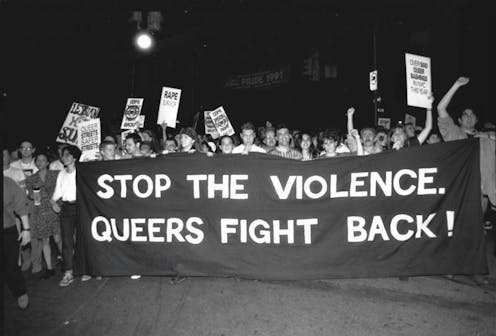
Recently, a number of people have questioned or critiqued the use of the word “queer” to describe LGBTIQA+ folk. One writer to the Guardian claimed that the “q-word” was as derogatory and offensive as the “n-word”, and should not be used.
While there is a clear history of the word being used in aggressive and insulting ways, the meaning(s) and uses of queer have never been singular, simple or stable.
The origin of the word ‘queer’
Queer is a word of uncertain origin that had entered the English language by the early 16th century, when it was primarily used to mean strange, odd, peculiar or eccentric. By the late 19th century it was being used colloquially to refer to same-sex attracted men. While this usage was frequently derogatory, queer was simultaneously used in neutral and affirming ways.
Read more: Out of the coffin and the closet: gay vampires are no longer sub-text, they're just text
The examples provided in the Oxford English Dictionary show this semantic range, including instances of homosexual men using queer as a positive self-description at the same time as it was being used in the most insulting terms.
Compare the neutral:“Fourteen young men were invited […] with the premise that they would have the opportunity of meeting some of the prominent ‘queers’” (1914); the insulting: “fairies, pansies, and queers conducted […] lewd practices” (1936); and self-affirmed uses: “young men who call themselves ‘queers’” (1952).
In the 1960s and 1970s, as sexual and gender minorities fought for civil rights and promoted new ways of being in society, we also sought new names for ourselves. Gay liberationists began to reclaim queer from its earlier hurtful usages, chanting “out of the closets, into the streets” and singing “we’re here because we’re queer”.
Their newsletters from the time reveal sustained questioning of the words, labels and politics of naming that lesbian and gay people could and should use about themselves. Some gay libbers even wanted to cancel the word homosexual because they felt it limited their potential and “prescribes a whole system of behaviour […] which has nothing to do with my day-to-day living”.
In Australia, camp was briefly the most common label that lesbian women and gay men used to describe themselves, before gay became more prominent, used at that time by both homosexual men and women.
The evolving use of the word queer
In the early 1990s, gay had come to be used more typically to refer to gay men. Respectful and inclusive standards of language evolved to “lesbian and gay”, and then “LGBT”, as bisexuals and transgender people sought greater recognition.
Queer began to be used in a different way again: not as a synonym for gay, but as a critical and political identity that challenged normative ideas about sexuality and gender.
Queer theory drew on social constructionism – the theory that people develop knowledge of the world in a social context – to critique the idea any sexuality or gender identity was normal or natural. This showed how particular norms of sexuality and gender were historically contingent.
Thinkers such as Michel Foucault, Michael Warner, Judith Butler, Eve Kosofsky Sedgewick and Lauren Berlant were enormously influential in the development of this new idea of queer. Some people began to identify as queer in the critical sense, not as a synonym for a stable gender or sexual identity, but to indicate a non-conforming gender or sexual identity.
Activists in groups such as Queer Nation also used queer in this critical sense as part of their more assertive, anti-assimilationist political actions.
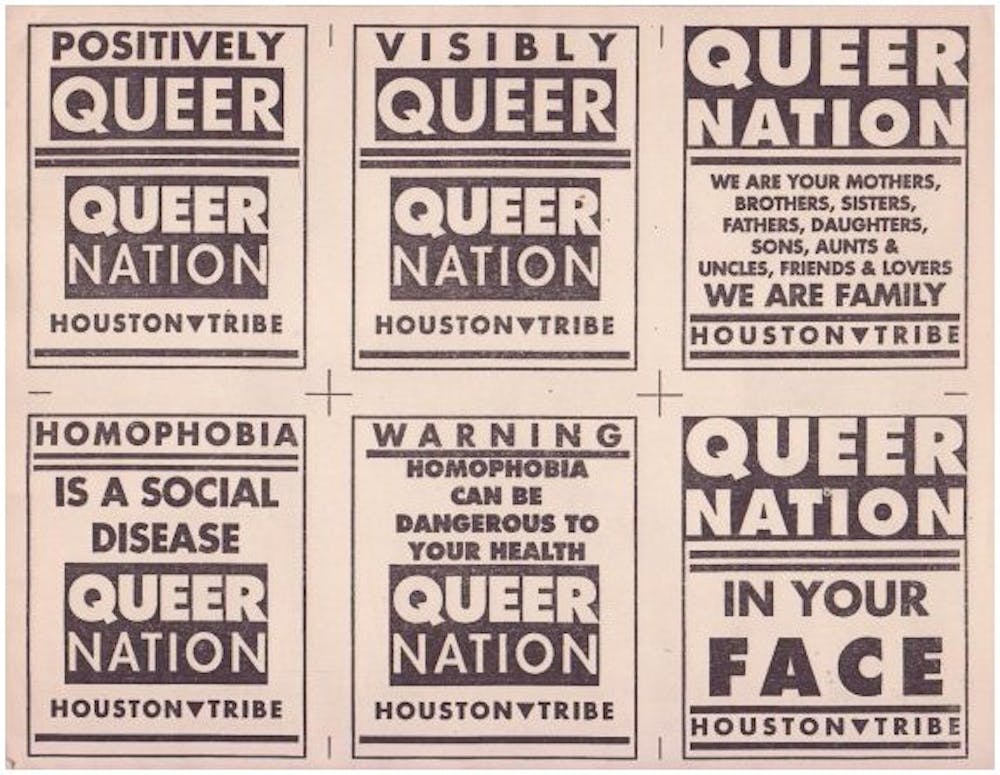 Posters from Queer Nation’s Houston chapter.
Wikimedia Commons
Posters from Queer Nation’s Houston chapter.
Wikimedia Commons
Queer as an umbrella term
From the early 2000s, it became more common to use queer as an umbrella term that was inclusive of the spectrum of sexual and gender identities represented in the LGBTIQA+ acronym.
Today, queer is included among the terms lesbian, gay, bisexual, transgender, gender diverse, intersex, asexual, brotherboy and sistergirl, recognised in style guides as the most respectful and inclusive way to refer to people with diverse sexualities and genders.
Of course, the different usages and meaning of words such as queer have often overlapped and have been hotly contested. Historical usages and associations persist and can sit uncomfortably next to contemporary reclamations.
Queer as a slur?
Contemporary concerns with queer’s historical use as a slur seem odd to me. The heritage report A History of LGBTIQ+ Victoria in 100 Places and Objects (which I co-authored), surveys the complexity of language use in historical and contemporary society.
It is notable that almost all of the words that LGBTIQA+ people use to describe ourselves today have been reclaimed from homophobic or transphobic origins.
In fact, it could be said that liberating words from non-affirming religious, clinical or colloquial contexts and giving them our own meanings is one of the defining characteristics of LGBTIQA+ history.
While queer does have a history of being used as an insult, that has never been its sole meaning. Same-sex attracted and gender diverse folks have taken the word and have been ascribing it with better meanings for at least the past 50 years.
Queer’s predominant use today is as an affirming term that is inclusive of all people in the rainbow acronym.
At a time when trans and gender diverse folk are facing particularly harsh attacks, I’m all for efforts to promote inclusion and solidarity. Respectful language use doesn’t require us to cancel queer, but rather to be mindful of its history and how that history is experienced by our readers and listeners.
Authors: Timothy W. Jones, Associate Professor in History, La Trobe University
Read more https://theconversation.com/reviled-reclaimed-and-respected-the-history-of-the-word-queer-197533


 Daily Bulletin


