

Christmas may be safe, but three-year port dispute shows the IR system is full of holes
- Written by: Shae McCrystal, Professor of Labour Law, University of Sydney
Australia’s industrial relations umpire has delayed industrial action that would have crippled Australia’s ports in the lead-up to Christmas.
But the dispute in which it has intervened – one that has dragged on since 2019 – shows the need for reform of Australia’s collective bargaining system.
The Fair Work Commission last week intervened in the protracted dispute between tugboat operator Svitzer Australia and three maritime unions after the company declared its intention to “lock out” staff in a bid to force a resolution – either by the unions caving or by the commission using its powers to arbitrate outstanding matters.
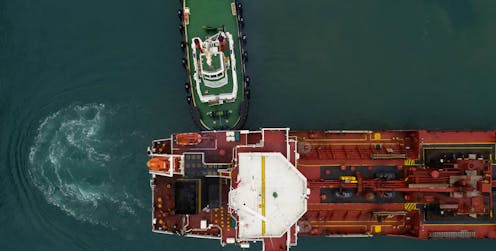
Svitzer, a subsidiary of Danish shipping giant Maersk, employs about 600 staff at 17 Australian ports. Its tugboats guide the arrival and departure of container ships carrying about 75% of Australia’s trade. The lockout would have prevented ships entering or leaving port.
Last Friday the full bench of the Fair Work Commission ordered a six-month suspension on any industrial action by Svitzer or the three unions – the Construction, Forestry, Maritime, Mining and Energy Union (CFMMEU), the Australian Maritime Officers Union (AMOU), and the Australian Institute of Marine and Power Engineers (AIMPE).
It did so using its powers to stop industrial action that threatens to cause significant damage to the economy or part of it.
However, the commission refused Svitzer’s application to terminate the notified lockout, an outcome that could have led to the commission arbitrating the outstanding matters in dispute. Arbitration appeared to be Svitzer’s aim but was opposed by the unions.
Background to the dispute
Svitzer and the unions began negotiating a new enterprise agreement in late 2019. The company wanted changes to the agreement made in 2016 to give it greater flexibility in hiring staff. The unions opposed these changes on the basis they would lead to greater casualisation.
The process laid down by the Fair Work Act is to negotiate, with “protected industrial action” available to the parties to support their claims.
But the Act’s provisions make it particularly hard for port workers to take impactful industrial action, given the commission can suspend or terminate any action threatening to cause significant economic damage.
In February, the commission blocked 48-hour strikes slated for ten ports in Western Australia, Queensland and New South Wales.
As a result, the unions have taken more low-level industrial action, such as work bans and limited stoppages, which are unlikely to attract the attention of the commission.
Svitzer’s decision to lock out workers recalls that of Qantas’s strategy in 2011, when the airline shut down its fleet to push the commission to arbitrate its dispute with unions over a new enterprise agreement. Qantas was widely considered the winner in the subsequent arbitration.
Svitzer’s motivation is to get rid of the 2016 enterprise agreement. Indeed in January it applied to have the commission terminate the agreement, which remains in force until replaced.
Termination would mean Svitzer’s employees would be covered only by award provisions and individual contracts – an effective win for the company. (This application remains before the commission.)
Will the government’s IR reforms help?
With a settlement not really any closer, the Svitzer dispute demonstrates the failure of the Fair Work Act to provide a safety valve to resolve intractable disputes.
Employment and workplace relations minister Tony Burke has argued the Albanese government’s industrial relations reforms – yet to pass the Senate – will assist in a dispute like Svitzer.
They will help, but on their own will not be enough.
The amendments will remove the ability to seek termination of an existing agreement while bargaining for a new agreement. This provision was not intended to be used as leverage during a dispute, as Svitzer has done.
The amendments also propose a new “intractable dispute mechanism”. This is different from current provisions because it does not require anyone to threaten or take potentially damaging industrial action before a party can seek arbitration by the commission.
More fixes needed
However, the bill does nothing to improve the Fair Work Act’s weak requirements for parties to bargain in “good faith”. This will continue to enable surface bargaining, leading to protracted disputes.
The provisions policing industrial action will still be among the most complex and costly in the developed world.
To ensure the Fair Work Commission is seen a fair and reasonable arbitrator, its members (appointed by the federal government) must also better reflect society, to restore faith in the institution for all parties concerned. Otherwise, unions may continue to resist arbitration, fearing the outcome will favour employers.
Moreover, despite the proposed expansion of multi-employer bargaining, the Albanese government has committed to maintaining the primacy of enterprise-level bargaining.
Read more: A mandate for multi-employer bargaining? Without it, wages for the low paid won't rise
So suppressing workers’ pay and conditions will continue to be strategy to obtain a competitive advantage over other businesses. (Svitzer has argued its 2016 agreement means it cannot compete for port contracts.)
While the focus of our system remains the single enterprise, and workers’ pay and conditions can be used to undercut competitors, disputes like the one at Svitzer will continue to feature in the industrial landscape.
Authors: Shae McCrystal, Professor of Labour Law, University of Sydney


 Daily Bulletin


