

Australia relies on controversial offsets to meet climate change targets. We might not get away with it in Egypt
- Written by: Bill Hare, Adjunct Professor, Murdoch University
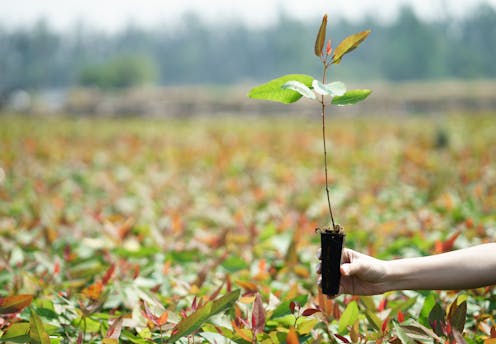
It’s small wonder a major fossil fuel producer like Australia has relied so heavily on carbon offsets. Plant new forests - or say you will avoid clearing old ones - and you can keep approving new gas and coal developments. This year, whistleblower Professor Andrew McIntosh claimed up to 80% of these offsets weren’t real. They didn’t actually offset emissions.
In Australia, renewables are the only real source of emission reduction. The rest of the economy is set to slowly increase emissions. But what matters is actually reducing how many tonnes of heat-trapping greenhouse gases go up into the sky and add to the 2.5 trillion tonnes of CO2 humans have already emitted - of which more than a trillion tonnes remain in the atmosphere. Last year, carbon dioxide and methane levels hit new highs.
As the world’s policymakers head to Egypt for next week’s crucial climate talks, offsets will be in the spotlight next to climate finance, loss and damage to vulnerable communities and 2030 emissions targets. Egyptian president Abdel Fattah El-Sisi has pitched the COP27 conference as the moment “where words were translated to actions”.
For Australia, this is an opportunity to move away from relying on dubious offsets and focus on the real action of actually cutting emissions.
Remind me what offsets are?
Offsets measure how much carbon is soaked up by, say, a reforestation project. As the saplings grow, they store carbon. Offsets are a way to theoretically package up this stored carbon - or emissions claimed to have been avoided by not deforesting an area of land - and sell it to companies who would like to keep pumping out emissions equal to the amount stored in new forests.
You can quickly see the problem. Who’s checking to see if these forests were planted – or if they were going to be planted anyway? Are emission reductions or storage real – and additional to what would otherwise have happened?
While international offsets are notoriously variable in quality, our Australian Carbon Credit Units scheme is hardly blameless. In Australia, many offsets rely on “avoided emissions” such as leaving a forest intact rather than cutting it down, and counting the carbon in these forests as an offset. This, as Professor McIntosh showed, has been easily gamed. Most of our offsets are not real and not additional.

In July, the federal government launched a review of Australia’s offset scheme, chaired by Professor Ian Chubb. Last week, Chubb told The Australian “offsets can’t be a device which big emitters use not to […] do something about reducing emissions”.
Chubb’s comments echo global scientific and political concerns over offsetting. UN Secretary General Antonio Guterres has warned our over-reliance on offsets net zero emission claims is a form of greenwashing.
Offsetting large-scale emissions, after all, essentially licenses the companies who buy offsets to just keep on pumping out - and even massively increase - emissions of carbon dioxide and methane. And as a new report points out, sequestering carbon into trees is not equivalent to reducing fossil fuel emissions.
There is a very long tail to every tonne of fossil CO₂ added to the atmosphere: around 400 kilograms will still be there after a century. After 1,000 years, there’s still around 25%. After 10,000 years, there’s still around 20%. This carbon will go on heating the planet for millenia.
Yet in Australia, offset permanence counts as anywhere between 25 and 100 years, depending on the project.
That means offsets have to be very good to be worthwhile. If they’re not real, additional and permanent – or if they’re used to continue fossil fuel emissions – then they will make climate change worse rather than better.
Read more: Now we know the flaws of carbon offsets, it's time to get real about climate change
What does this mean for Australia?
In the last decade, Australia has become the world’s top exporter of liquefied natural gas (LNG). This has been enormously lucrative for gas producers and a boon to government revenues.
We’re already seeing companies shipping so-called “carbon-neutral” LNG from Australia. Emissions from burning or using this gas has, they claim, been offset.
Is carbon-neutral gas possible? Well, no. Australia is one of only a handful of countries with its own government-sponsored offsetting system, ClimateActive. This is intended to certify companies as carbon neutral when they have reduced their emissions “as much as possible” while “cancelling out” remaining emissions through offsets.
Sceptical? You’re not alone. Environmental policy experts say this legacy system from the previous Coalition government effectively amounts to state-sponsored greenwashing.
That’s not the only questionable environmental legacy. Labor is also reviewing the safeguard mechanism – effectively an emissions trading scheme. It was pitched as a way to reduce the 25% of our emissions which come from industrial facilities. Fossil fuels account for more than half the facilities.
But instead of falling, emissions across the facilities actually rose by 7% over the five years to 2021 - equivalent to more than nine million tonnes of carbon dioxide.
In our submission to the mechanism review, we suggest the government should pivot to a full emissions trading scheme for the industrial sector – without offsets.
Unfortunately, Labor has already suggested draft legislation to revise the mechanism which would allow more offsetting, rather than require substantial emission reductions from Australia’s industries.
 Chevron’s enormous Gorgon gas project in Western Australia is the largest facility under the safeguard mechanism.
Ray Strange/AAP
Chevron’s enormous Gorgon gas project in Western Australia is the largest facility under the safeguard mechanism.
Ray Strange/AAP
What’s likely to happen to offsets at COP27?
When the world’s leaders and negotiators got the Paris Agreement across the line in 2015, there was much celebration. Now comes the harder part: actually making the transition.
Under rules adopted in Glasgow, offsetting may be permitted – as long as carbon offsets are high integrity (they’re real and additional), and operate transparently with robust accounting (we can check they’re real and are not double-counted).
This will be on the table in Egypt, where negotiators will seek to hash out detailed rules for tracking and checking each nation’s progress – or lack thereof – towards emissions reduction goals.
Expect to see intense negotiation around avoiding emissions – that is, not cutting down forests. To date, avoided emissions have not been counted as part of a country’s efforts. But that may change.
Integrity and transparency have long been challenges in accounting for avoided or offset carbon in the land sector.
The world will be watching to see if Australia – now under new management – is still willing to push for the right to buy cheap and sometimes questionable offsets. And will it support rules and requirements to guarantee permanence?
Australian industries are lobbying to use these kinds of international offsets to meet emission obligations. The question is, will Labor seize the chance to move away from them, and instead reduce emissions?
Read more: We can't stabilise the climate without carbon offsets – so how do we make them work?
What’s the best way forward for Australia?
Let’s say Labor’s tweaks to the safeguard mechanism become law. In this scenario, offsets continue, despite their chequered history.
We would miss many opportunities to invest in technologies which actually reduce the CO₂ pouring out of machines and smokestacks. And we would miss a vital opportunity to shift away from our reliance on fossil gas, which – when burned overseas – produces massive emissions and risks slowing the clean energy shift in developing economies.
That’s the bad timeline.
In the good timeline, Labor seizes the historic moment. Amid intensifying and accelerating climate change, the public want change. The Russian invasion of Ukraine has shown the security risks of foreign fossil fuels. And after nine years of go-slow tactics, Australia has a government elected on a promise to actually slash emissions.
Let’s hope they turn away from the false promise of offsets, and pass the test.
Authors: Bill Hare, Adjunct Professor, Murdoch University


 Daily Bulletin


